

 Freedom Index
Listen to the article
From Utah Political Watch, Inc. v. Musselman, decided yesterday by Judges Timothy Tymkovich, Michael Murphy, and Robert Bacharach:
The Utah Legislature opens its legislative sessions to the public so that its constituents may observe the state’s lawmaking process. The Legislature also grants additional access to professional journalists through what it calls its Capitol Media Access and Credentialing Policy. Beyond what the Legislature affords the public, credentialed journalists receive perks such as entry to a press room and secure areas of the Capitol, use of designated media workspaces in the Senate and House galleries, and access to media availabilities and press events with elected officials. To be eligible for a credential, a journalist must be “part of an established reputable news organization” and “[a]dhere to a professional code of ethics.” The policy categorically excludes journalists associated with “[b]logs, independent media or other freelance media” from receiving a credential.
Bryan Schott is a journalist who covered the state house for more than twenty-five years on behalf of various institutional media companies, including Salt Lake City’s most prominent newspaper. The Legislature granted media credentials to Schott each year that he worked for these companies. But in 2025, after Schott left the newspaper and started his own independent news organization—Utah Political Watch—while continuing to report on state politics and legislature matters, the Legislature denied his credential application.
The court allowed Schott’s case to go forward, concluding that “he plausibly alleged that the Legislature denied his application because of his news stories’ viewpoints”:
Before addressing whether the speech at issue is protected by the First Amendment, we first consider the nature of the forum that Utah created under the media credentialing policy because it informs our analysis of the first prong. Schott alleges Utah’s policy has created a limited public forum. Limited public forums are tangible or intangible spaces the government opens to “certain groups or for the discussion of certain topics.” The Legislature asserts its policy is instead a nonpublic forum but acknowledges the difference between the two forums is immaterial because the legal standards are the same. A nonpublic forum is “where the government is acting as a proprietor, managing its internal operations.”
We need not decide between whether Utah’s credentialing policy created a limited public forum versus a nonpublic forum. We resolve this appeal by concluding the policy formed one or the other because in either forum the legal standard is the same: In both limited public and nonpublic forums, speaker-based speech restrictions must be both viewpoint neutral and “reasonable in light of the purpose served by the forum ….”
The district court construed that at “the heart of [Schott’s viewpoint discrimination] claims is an assertion of an unequivocal right to gather news.” It cited our decision in Smith v. Plati (10th Cir. 2001) to conclude that “‘there is no general First Amendment right of access to all sources of information within governmental control,’ and the press does not have a ‘special right of access to government information not available to the public.'” To dismiss Schott’s claim that the policy denies him access equal to the rights of other credentialed media, the district court again relied on Smith to conclude that “the First Amendment does not encompass a right to ‘resources … routinely given to other media ….'” …
[But] Schott asserts neither a right to newsgathering nor a right of equal access to all information the Legislature provides other media. Rather, he alleges the Legislature blocked his access to a government-created forum because of his viewpoint. A right to such access is well-established….
Unlike Smith, who asserted a “right of access to news sources,” Schott does not assert a broad right to newsgathering. And unlike Smith’s mandamus claim for “equal access” to the same information that the University provided to other media members, Schott merely seeks access to a state-created forum under reasonable and viewpoint-neutral criteria. Further, in Smith we did not consider whether the University had created a government forum. Smith v. Plati is therefore inapt. Moreover, …[t]he Second, Seventh, Ninth, and D.C. Circuits have each concluded that if the government opens government property to the press, it cannot deny access to only some journalists based on their views….
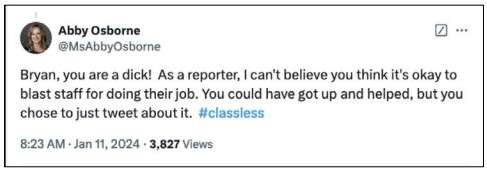
Schott alleges the Legislature denied him a credential because of the critical views he expressed in his reporting on members of the Legislature…. On top of alleging that (1) legislative officials publicly and privately expressed their distaste and contempt for his reporting, Schott also alleges that (2) the Legislature applied the policy inconsistently by credentialing journalists from some blogs and independent media that are similar to UPW, but denying his application, and (3) the Legislature revised the policy to categorically exclude blogs and independent media right after it revoked his credential and he started UPW. These are not conclusory allegations. After crediting their veracity, we conclude it is plausible the Legislature denied Schott’s credential application because of his views.
[Earlier, the court offered this example of the “distaste and contempt for [Schott’s] reporting,” quoting a Tweet from the “Chief of Staff for the Utah House of Representatives” in response to Schott’s “post ‘poking a little fun’ at legislative staffers who struggled to set up a backdrop”:]
To be sure, the Legislature contests many of Schott’s allegations. But at the motion-to-dismiss stage, we accept Schott’s factual assertions as true, and we do not consider the Legislature’s factual arguments or its submitted evidence even if it appears to contradict Schott’s allegations.
To dispute Schott’s allegations of inconsistent application, the Legislature explains why it granted credentials to other journalists that have similar editorial structures to UPW. For instance, the Legislature argues that even though Utah News Dispatch calls itself “independent” it is not “independent media” under the policy because it is affiliated with another media organization. The Legislature also argues that Schott’s allegations that credential holders from Davis Journal and Utah Policy are self-edited like him, are insufficient because he did not allege supporting facts “concerning those entities’ editorial structure, oversight, or practices.”
And finally, the Legislature contends the fact that it denied other “self-supervised applicant[s] like Schott” demonstrates it did not deny his application because of his views. But the Legislature is merely seeking to contradict Schott’s factual allegations. Schott alleges the Legislature granted credentials to other journalists that are independent and self-edited—the truth of whether those comparators are actually “blogs” or “independent media” under the policy are factual questions not up for debate at the motion-to-dismiss stage….
Judge Tymkovich also added a separate concurring opinion, suggesting what the district court might consider on remand when it deals with a facial viewpoint discrimination challenge to the credentialing policy:
[V]iewpoint covers more than an individual’s particular thoughts and ideas on a given topic; it also covers his decision on “how best to speak” and express those ideas. For example, in Matal v. Tam the Supreme Court held the Lanham Act’s bar on granting disparaging trademarks was viewpoint discrimination because “[g]iving offense is a viewpoint.” “The First Amendment’s viewpoint neutrality principle protects more than the right to identify with a particular side.” “It protects the right to create and present arguments for particular positions in particular ways, as the speaker chooses.” And when the exclusionary term of a government policy “distinguishes between two opposed sets of ideas,” it “results in viewpoint-discriminatory application.”
The media credentialing policy’s blanket exclusion of independent media appears to me to be viewpoint-based because it bars access based on a journalist’s editorial choice to speak in an unedited and institutionally unaffiliated manner…. “One of the prerogatives of American citizenship is the right to criticize public men and measures—and that means not only informed and responsible criticism but the freedom to speak foolishly and without moderation.” … This “independent” viewpoint is opposed to a moderated and corporately affiliated perspective and mode of speech. Thus, a journalist from an independent media organization communicates his ideas through his own unfiltered viewpoint by choosing not to be subject to anyone else’s editorial control.
Additionally, the policy’s terms that exclude journalists from organizations that are not “reputable” and journalists that do not follow a code of “ethics” are strikingly similar to the Lanham Act’s doomed “immoral or scandalous” criterion. See Iancu v. Brunetti (2019) (noting “a typical definition” of the viewpoint-based term “scandalous” is “disreputable” and finding the restriction against “immoral”—i.e., unethical—speech to be viewpoint-based). The Legislature’s policy thus “distinguishes between two opposed sets of ideas: those aligned with conventional moral standards [(i.e., a code of “ethics”)] and those hostile to them; those inducing societal nods of approval [(i.e., “reputable”)] and those provoking offense and condemnation.” “The [policy] favors the former, and disfavors the latter”—categorically placing independent media in the disfavored set of ideas. Under this distinction, the policy seemingly permits the government to act as the arbiter of whether a news organization’s speech is reputable or ethical. That, however, would be something the government cannot do. See Iancu (Alito, J., concurring) (“[A] law banning speech deemed by government officials to be ‘immoral’ or ‘scandalous’ can easily be exploited for illegitimate ends.”).
The Legislature nevertheless insists its policy is neutral because it merely imposes speaker-based restrictions and thus excludes disreputable and unethical speakers, not speech. But “[c]haracterizing a distinction as speaker based is only the beginning—not the end—of the inquiry.” A speaker-based restriction is unconstitutional if “[i]n its practical operation” it engages in the “official suppression of ideas.”
I am skeptical that the Legislature’s speaker-speech distinction holds up in practical application: For the Legislature to judge whether a speaker is “reputable” or “ethical,” it must evaluate the speaker’s speech. Is UPW disreputable because Schott does not have “an editor and is the final arbiter and executioner of his stories”; or is UPW disreputable because Schott’s speech is unedited, unmoderated, and conveyed in a “stream of consciousness” manner? The Legislature’s speaker-speech distinction seems to be one without a difference: A news organization is “reputable” because of its speech….
[Amici] persuasively argue that in enacting the Speech and Press Clauses, the Framers were concerned that the government might attempt to control the press—a term originally understood to protect what we might now call independent journalists…. See Eugene Volokh, The Freedom of Speech and of the Press Clause, in The Heritage Guide to the Constitution (3d ed. 2025) (“[T]he Free Press Clause … was enjoyed by all who used printing presses to communicate to the public at large…. Professional publishers and journalists were not seen as having any more constitutional rights than everyone else had.”).
For example, the history of the Press Clause shows that it created a “broad right [for] ‘every citizen‘ to publish his sentiments …, since at the time of the founding there were no professional journalists in the modern sense of the word.” Michael W. McConnell, Reconsidering Citizens United as a Press Clause Case, 123 Yale L.J. 412 (2013).
The Federalist—written by three non-journalists and published in New York newspapers as occasional essays—is the most famous example, but there were hundreds of others. When the Founders spoke of the importance of “the press,” they were not talking about professional news media, but about the printing press, meaning the ability of people to disseminate ideas easily and inexpensively to a broad public. The licensing of the press, which was the great evil against which the Amendment was directed, applied to books and pamphlets as much as to newspapers. Indeed, pamphlets were among the most important publications for the influencing of public opinion. Thomas Paine’s Common Sense, which he self-published, is a famous example…. To confine freedom of the press to professional journalism … would require shrinking—”abridging”—the scope of the Clause, making its coverage narrower than at the time of the Framing.
And another scholar cites historical evidence to argue that viewpoint discrimination by the government against all individuals has always been disfavored. See Jud Campbell, Natural Rights and the First Amendment, 127 Yale L.J. 246 (2017) (“[T]he Founders widely thought that the freedom to make well-intentioned statements of one’s views belonged to a subset of natural rights, known as ‘unalienable’ natural rights, that could not be restricted in promotion of the public good and thus fell outside legislative authority to curtail.”)….
Amici also contend there is a long tradition in this country of allowing media access—free from government-determined, viewpoint-based access requirements—to legislative sessions. For example, in the First Congress, Representative Burke introduced a resolution to remove journalists from the House floor who allegedly “misrepresented” debates. Other congressional members sharply criticized Burke’s proposal. See, e.g., [Annals oc Cong.] (Representative Hartley described it as “an attack upon the liberty of the press”); id. (James Madison argued it was “improper to throw impediments in the way of such information as the House had hitherto permitted”). Burke withdrew his resolution, and ultimately, Congress concluded it was best to leave it to reporters themselves to determine “the admission of such persons as thought themselves qualified ….” …
Charles Miller (Institute for Free Speech) and Robert P. Harrington (Kunzler Bean & Adamson, PC) represent plaintiffs.
Read the full article here
Fact Checker
Verify the accuracy of this article using AI-powered analysis and real-time sources.