

 Freedom Index
Listen to the article
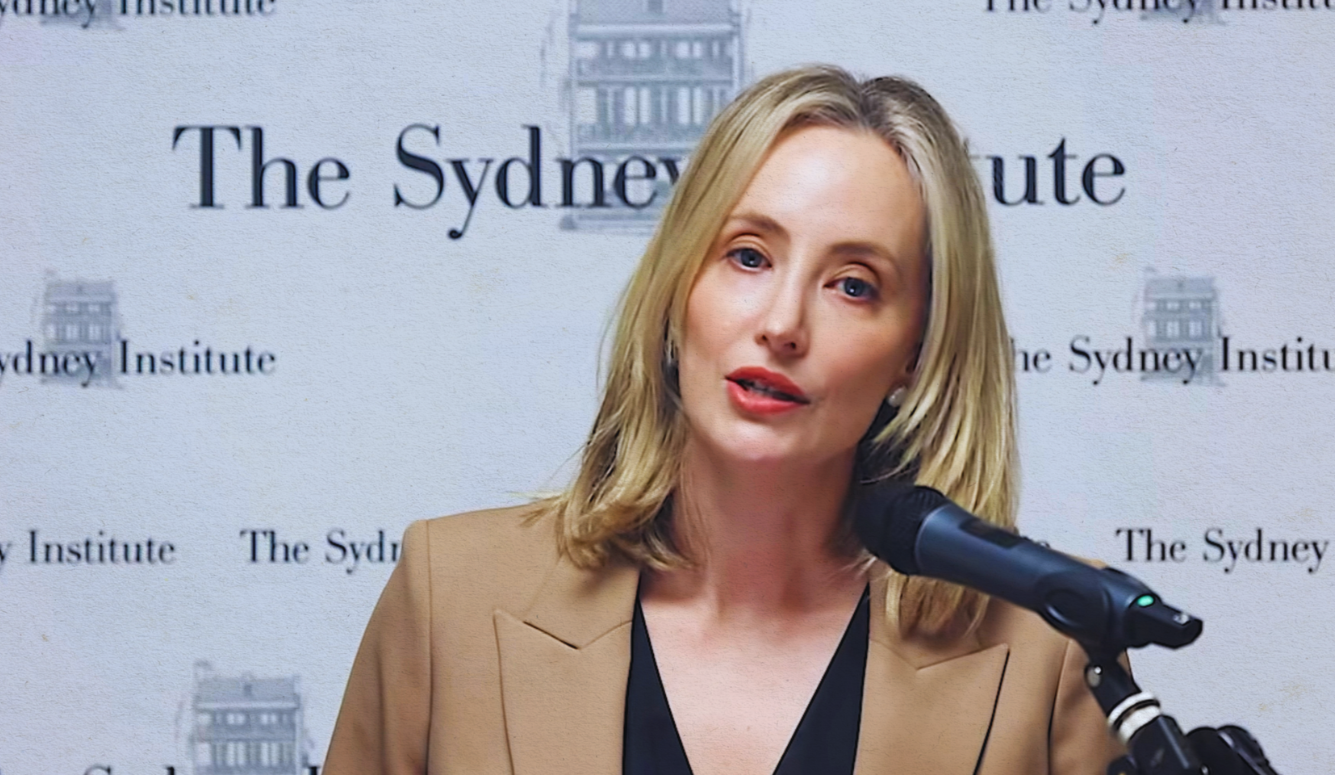
Editor’s Note: What follows is the transcript of a speech delivered by Claire Lehmann at the Sydney Institute on Wednesday, 17 June 2026 titled “From Waitress, to Public Servant, to Small Business Owner.“ On 12 May 2026, the Australian federal government handed down a budget that scrapped negative gearing, removed the 50 per cent capital gains tax discount for company founders and other investors, and introduced a 30 per cent minimum tax rate on capital gains regardless of other income. The speech below is a response to that budget, delivered to an audience in Sydney.
Fifteen years ago, I worked for a woman, a Deputy Secretary in the federal Department of Health, who told me something that I have never forgotten. She said that “the federal government just throws money down the toilet.”
I’ve remembered that statement for fifteen years. It bothered me at the time, because I knew she was being honest. But after the Budget that was delivered on May 12 of this year, it bothers even more. Taxes on Australian workers keep rising through bracket creep. More taxes have been added to this burden with the scrapping of negative gearing and the scrapping of 50 percent discount to capital gains tax (CGT). Meanwhile the federal government keeps flushing money down the toilet.
I understand why many Australians are fed up and are turning towards parties that promise to disrupt the status quo.
The title of this talk is “From Waitress, to Public Servant, to Business Owner.” I’ve had all three of these jobs, in that order. Tonight I want to use them to make an argument about where the real fault line in this country lies.
For most of this country’s political history, the major fault line has been between labour and capital—between workers and the bosses who employ them. That’s the fault line that shaped the union movement, and the party that grew out of it. The Australian Labor Party.
But that fault line isn’t as clear anymore. I believe that the major political conflict we have isn’t between workers and bosses. And it isn’t between the public versus private sector either. The real fault line is between those whose work lifts productivity and those whose work puts a drag on it. Those who lift productivity include the surgeon, the teacher, the tradie, and the founder: anyone whose work makes someone else more likely to produce. One doesn’t even have to be in paid work to be productive. Stay at home mums are some of the most productive people in our society, raising the future human capital of the nation.
On the other side of the fault line sits work that exists to administer, monitor, or process the people who are actually doing the producing, often with no clear link back to any outcome at all. Every organisation carries some of that second kind of work. But it’s in government that it’s growing the fastest, and where it has the least accountability. Because government is the only part of the economy that gets to write its own cheque and send someone else the bill.
Now credit where credit is due. I am not an anti-Labor ideologue. I actually come from Labor family. My grandmother used to cheer on Paul Keating during question time, and when I was at university I gave out how-to-vote cards for Penny Wong in my hometown of Adelaide. I’ve been the beneficiary of medicare, and our higher education system, all supported by our taxes. And I actually agree with the government’s decision to scrap negative gearing and to lift the CGT discount on unproductive assets, namely housing.
That being said, the decision to scrap the 50 percent CGT discount on company founders, and implement a minimum tax rate of 30 percent for anyone with a capital gain, no matter how much they earn, strikes me as mad. To compound this, our income tax rates remain some of the highest in the world.
All this has led me to conclude that somewhere along the way, something has changed. The Labor Party has gone from being a party of the worker to being the party of the bureaucrat. The same party that purports to defend workers has overseen the highest amount of tax revenue generated from labour in Australia’s history. The government collected $349 billion in personal income tax last financial year.
The same party that says it wants to promote “equity” hasn’t raised the income tax–free threshold, which has been in place since 2012. The same party that purports to stand for the fair go now wants to punish people for trying.
The Tragicomic Death Throes of Canada’s (Former) Workers’ Party
The New Democratic Party, which once championed the country’s unions, is now in the hands of a radicalised anti-Israel activist who wants to nationalise grocery sales and shut down oil production.
I learned what work was from the hospitality industry. My first job was at Hungry Jacks, when I was 14 years old. I was paid $4.62 per hour, and my feet would have blisters by the end of the shift. By nineteen, I was working full-time in one of Adelaide’s most popular restaurants, a steakhouse on Gouger Street. I made $500 a week.
I loved it. But it was physically demanding work. The pace meant every minute counted—slacking off could have a cascading effect. You were also never separated from the person who owned the place. I used to work alongside my bosses. I wouldn’t have been able to tell you what a profit margin was, but I understood that my bosses were not rich. The whole thing only worked because people were grinding to keep the doors open.
I also saw the painful side of business ownership. My last job before I finished my degree was at a small Italian restaurant, run by a French immigrant. He worked so hard keeping that restaurant going. But I learned shortly after I had left, that a person I had worked alongside for years had been quietly stealing from the till. By the time anyone noticed, $100,000 was gone. Not long after that, my old boss closed the restaurant.
By the time I learned that this little Italian restaurant had closed, I had moved on from the hospitality industry. By the age of twenty-five, I’d finished my degree, and moved to Canberra. I embarked upon what I thought would be a long career as a public servant. I began work at the Federal Department of Health and Ageing.
A quick bit of context, for anyone who’s never worked in Canberra: not all departments are the same. Some are leaner than others. And some are genuinely well run.
And some of the public servants I worked alongside in Canberra were dedicated, capable people. But the Department of Health has a reputation, even among public servants, as one of the more bloated workforces in Canberra. When I was there it had a staff of 4-5000, today it has a staff of over 7000.
Let me give you a glimpse of what life is like for a graduate in the department. On my first rotation, I was reprimanded for writing a ministerial letter too quickly. Two hours was sufficient time to write a letter I thought—one that mostly consisted of copy and pasting boilerplate from other letters—but according to the director of the team, I needed to take a day.
Why? Because they had nothing else for me to do. There were no meetings, no policies being drafted, and no conference papers for us to work on. So we had morning tea instead. And afternoon tea. We took long lunches. We did crossword puzzles to keep our brains active, and daily “quizzes” to alleviate the boredom. The Director of the section once sent a ministerial letter back to me asking me to delete a comma. I was excited. Because deleting a comma meant that I had something to do.
Sometimes there would be a meeting, or a conference, which meant that it was all hands on deck preparing briefing notes for the Minister, and arranging pens on desks for delegates. But most of the interesting work in the department was done by consultants. I wondered why graduates had been hired in the first place, to work as glorified secretaries if all the substantial work was just being farmed out to private industry. Even with a staff of 7000, most of whom from my observation were massively underemployed, the department still outsourced work.
I wasn’t the only one who suffered from this situation in the department. Other graduates would confide in me about their despair. One friend of mine used to cry in the bathroom.
At the same time however, there were people in the department actively campaigning for less. I was shocked to find a flyer from the union sitting on my desk one morning, advocating for even better conditions—even though we had flex time, we couldn’t be fired, and were having morning teas almost every day. I looked at the flyers and thought: how much more comfortable could this possibly get?
I should clarify here: it is technically possible to get fired in the federal public service. But the process can take about 12 months, and there is very little incentive to initiate such action. It is much easier to just redeploy an underperformer into another team. And that is what happens over and over again.
One woman I worked with on one of my rotations was functionally incapable. She had been at the level of APS 5 for thirty years (as a graduate I was on APS4). She was unable to do a Google search for work purposes, and unable to file documents in alphabetical order. She sat at her desk researching properties online all day. She was paid, in 2011, $65,000 per year. ($94,000 today).
For someone who had come from my work background, in busy restaurants, this all felt like a slap in the face. If this is what white collar work is like then this whole thing is a scam, I thought.
The budgeting was its own kind of madness. There was an open, acknowledged habit of overspending on purpose—spend the whole allocation every year, whether you needed to or not, because if you didn’t spend it, you’d lose it the following year. It’s the opposite of every incentive that exists in the private sector, where underspending is the whole point.
That’s the context for the sentence I opened with tonight. That Deputy Secretary—one of the most senior people in the department told me, matter of factly, that the federal government just throws money down the toilet. It wasn’t a secret. We all knew we were wasting time, and wasting money. So I quit. I felt ashamed participating in what I considered an abuse of the Australian taxpayer.
At the time I didn’t have the words to describe what I had seen at the Department of Health in economic terms. But it does have a name. Economists call it the free-rider problem.
Picture a sharehouse where shared cleaning responsibilities are never enforced. There’s always someone who does the dishes, and always someone who just “forgets.” If a shared responsibility is never enforced, then the person who is forgetting never bears any cost. The kitchen still gets cleaned, because someone else always ends up doing it for them.
Now extrapolate that idea out to an entire department, where nobody can be fired, where overspending is rewarded, and where the people footing the bill—you and I, the Australian taxpayers—have no choice about whether to pay, and no say in how the money is spent.
That was one department, fifteen years ago. Multiply it across the whole of government, and you get the budget that was handed down a few weeks ago. Everything I’ve described to you tonight is about to get a whole lot worse, from both directions: the unproductive side getting bigger, and the productive side getting taxed harder for trying.
Since 2022, the APS has grown by 26 per cent. The cost of running it has blown out by 42 per cent—to $114.6 billion, or roughly $8,200 for every taxpayer in this country, every year. Budget papers show that figure being revised up by a further $19.6 billion over the next four years—on its own, enough to wipe out any savings from cutting the NDIS. Government spending overall now sits at 28 per cent of GDP—the highest it’s been in my lifetime.
But here’s what I find most telling: of all the things this budget reformed, the government’s own spending wasn’t one of them. There was no plan to shrink the size of government, no serious attempt to ask why the APS needs to keep growing so fast. Every other part of the economy was asked to adjust. The one part of the economy that gets to write its own cheque was not.
A few weeks ago, the Secretary of the Treasury, Jenny Wilkinson, gave the post-Budget address to the Australian Business Economists. It’s worth paying attention to what she chose to talk about, because it tells you something about how this budget was actually built. Her speech was thorough, and serious, and almost entirely about one thing: who has more wealth, and who should have less. Page after page of analysis on lifetime income distribution, effective tax rates by income bracket, who benefits from negative gearing and trusts and by how much. All of it very carefully modelled.
But all of the modelling was based on the assumption that wealth just naturally manifests itself.
The Treasury Secretary did not model how these tax changes might affect the decision to start a business at all, to take the risk, to build the very thing that gets redistributed in the first place. When she did address the risk question directly, her answer was that the research didn’t support the idea that capital gains tax impacts risk-taking, beyond compensating for inflation. She mentioned one citation, and moved on. The Treasury, by its own admission elsewhere, hasn’t modelled the productivity impact of these reforms at all. You can build a very rigorous case for redistribution. It’s a different exercise entirely to build a case for growth, and that is what Treasury has not done.
Australia is already a hard place to take risks, and it’s getting harder. The OECD’s latest survey found that Australia has gone from being one of the five easiest countries in the OECD to start a business in the late 1990s, to below the OECD average today. The rate of creation of new companies has been falling since the mid-2000s, and its slowing down. And the conversations I’ve had, particularly with young people online, about the proposed changes have told me something else: there’s very little understanding in this country of why entrepreneurship matters, or what risk actually does.
Risk is not just about business. An artist starting a new body of work, a scientist researching a brand new theory, a couple deciding to have their first baby—all of these are bets on a future that hasn’t happened yet, made by people who don’t know how it’ll turn out. A scientist doesn’t know in advance whether five years of work on an obscure problem will lead anywhere. A film director doesn’t know ahead of time if his film will find an audience or flop. A new parent doesn’t know that their expected child will be healthy. They take the risk anyway—and when it pays off, we’re all better off because of it.
What we don’t see is the risk not taken. The research not pursued. The film not made. The business not started. The children that are never born. When people don’t take risks, we can’t know what future we’ve missed out on. Those losses are invisible—which is exactly why they’re so easy for the government to ignore them. You can’t put a line item in a Budget for the company that never existed.
So here’s where this leaves me. I believe in the social contract—the idea that we put something in, so that we all can get something out that none of us could build alone. A hospital. A school. A road. What I don’t believe is that we’re currently honouring this contract. As citizens we are putting in more than ever. But we are getting back a public service that refuses to constrain its own growth, and now a Budget that didn’t even attempt to try.
So how do we get out of all this? My suggestion for government is this. Reform the Australian Public Service. Managers and directors need the power to fire underperforming workers without a twelve-month process standing in their way. Ask honestly how much of the public service could be cut without affecting a single deliverable—I’d suggest the answer is not trivial. And the incentive to overspend has to be re-assessed: no other part of the economy works this way. If we want to restore some fairness to the worker, we have to be far more responsible with how we spend their hard-earned money.
On that note: I agree with Angus Taylor that income tax needs to be indexed to inflation. The top bracket of $180,000 was introduced in 2008. Had it been indexed since then, it would sit closer to $280,000 today. Instead our top tax bracket kicks in at $190,000. Every working Australian would be better off if the brackets moved with inflation. That successive governments have avoided this reform is a generational scandal.
And before we raise capital gains tax on business owners—what the economist Richard Holden has called “a productivity tax during a productivity crisis”—there are other ways to deal with housing affordability that don’t require punishing risk. Reducing immigration. Taxing unproductive land. Plenty of credible economists have already mapped out ways to increase housing supply. None of it is exotic. All of it has been sitting on the shelf, waiting for a government willing to do something harder than redistribute what already exists.
Finally, tonight, I want to finish by speaking to the risk-takers in this room.
I’ve noticed, in the past few weeks, a resurgence of something pernicious that can sometimes characterise this country: tall poppy syndrome.
I’ve seen ordinary Australians, who own a modest amount of shares, likened to robber barons. I’ve seen small business owners described as being “subsidised” by the current tax settings.
This is an inversion of the truth. Everyday Australians investing in shares are doing the right thing, and should be rewarded for it, not punished for their thrift. People who take the risk to start a business are not subsidised by our tax settings—they pay income tax, company tax, payroll tax, and GST. When a capital gain finally occurs, it’s on money that has already been taxed. This is no subsidy in the equation.
We should also remember something this country seems to have forgotten: in a free market, a business only succeeds when it gives customers something better, or cheaper, than the alternative. The value captured by the business owner is only ever a small fraction of the value created for everyone else.
The future is built by the saver who buys shares instead of another holiday. The tradie who decides to start a business and hire apprentices. The founder who pays himself $80,000 a year, the surgeon, the teacher, the parent who took the risk of bringing a child into the world.
Long live every Australian still willing to build something nobody asked them to build. They are not the burden this country needs to manage. They are the only thing that has ever paid for everything else.
Quillette invites thoughtful responses to its essays.
Selected responses are published once per week as part of a curated Letters to the Editor feature. If selected, letters appear under the contributor’s real name and may be edited for clarity and length.
To submit a letter for consideration, please email [email protected].
Read the full article here
Fact Checker
Verify the accuracy of this article using AI-powered analysis and real-time sources.