Close Menu
FSNN | Free Speech News NetworkFSNN | Free Speech News Network
  • Home
  • News
    • Politics
    • Legal & Courts
    • Tech & Big Tech
    • Campus & Education
    • Media & Culture
    • Global Free Speech
  • Opinions
    • Debates
  • Video/Live
  • Community
  • Freedom Index
  • About
    • Mission
    • Contact
    • Support
Trending

A Slow Thursday At The Court

13 minutes ago

Foundation loses another key leader as Hsiao-Wei Wang resigns

33 minutes ago

What happens when ChatGPT becomes the front door to crypto

35 minutes ago
Facebook X (Twitter) Instagram
Facebook X (Twitter) Discord Telegram
FSNN | Free Speech News NetworkFSNN | Free Speech News Network
Market Data Newsletter
Thursday, June 18
  • Home
  • News
    • Politics
    • Legal & Courts
    • Tech & Big Tech
    • Campus & Education
    • Media & Culture
    • Global Free Speech
  • Opinions
    • Debates
  • Video/Live
  • Community
  • Freedom Index
  • About
    • Mission
    • Contact
    • Support
FSNN | Free Speech News NetworkFSNN | Free Speech News Network
Home»Cryptocurrency & Free Speech Finance»Morning Minute: Crypto Sinks After Hawkish FOMC
Cryptocurrency & Free Speech Finance

Morning Minute: Crypto Sinks After Hawkish FOMC

News RoomBy News Room3 hours agoNo Comments6 Mins Read930 Views
Share Facebook Twitter Pinterest Copy Link LinkedIn Tumblr Email VKontakte Telegram
Morning Minute: Crypto Sinks After Hawkish FOMC
Share
Facebook Twitter Pinterest Email Copy Link

Listen to the article

0:00
0:00

Key Takeaways

Playback Speed

Select a Voice

Morning Minute is a daily newsletter written by Tyler Warner. The analysis and opinions expressed are his own and do not necessarily reflect those of Decrypt. And check out our new daily news show covering all of the top stories in 5 minutes, downloadable on Apple Pod or Spotify.

GM!

Today’s top news:

  • Crypto majors fall another 1% after a hawkish FOMC; BTC at $64k
  • Saylor’s STRC falls to $89 and new low; MSTR -5%
  • Illinois becomes first state to pass crypto tax, applying 0.2% to broker txns and holdings
  • CME is suing the CFTC over their approval of perps in the US
  • Moody’s launched onchain credit ratings on Solana

🏦 Warsh’s First Fed Meeting Comes In Hawkish

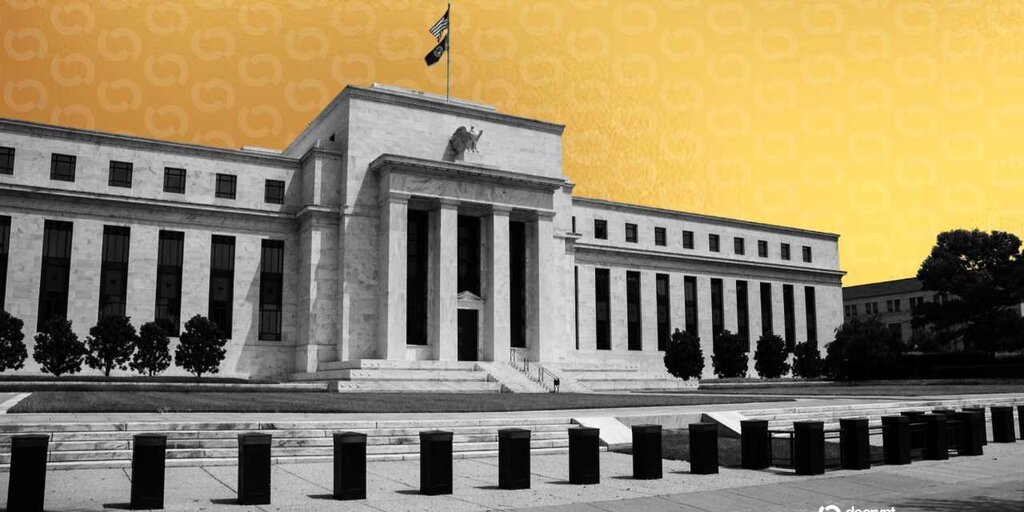
The Fed held its benchmark rate at 3.50% to 3.75% on Wednesday, a fourth straight hold, at Kevin Warsh’s first meeting as chair. That was expected; Warsh’s hawkish tone was not.

Ahead of the meeting, the Fed shared its updated dot plot, lifting the median year-end 2026 rate projection to 3.8% from 3.4% in March, which means the committee now pencils in at least one hike this year rather than a cut. A full half of the members favor a hike as soon as 2026, citing a firm labor market and inflation at a three-year high. Warsh himself declined to submit a dot.

That was hawkish on its own, but it was Warsh’s commentary that confirmed it. Warsh repeatedly stressed the Fed’s commitment to price stability in his press conference, a signal he may not deliver the cuts many expected from a Trump nominee, and he removed the easing bias from the statement. He made it very clear that getting inflation back to the Fed’s 2% goal is the priority and that he wants to make it happen. The market read that as “hikes are coming.”

The reaction was sharp. The 2-year Treasury yield jumped more than 16 basis points to 4.22%, and the Dow fell 507 points after hitting a record earlier in the day. Rate expectations repriced hard: odds of a hike by the September meeting rose to roughly 70% (20% chance of a double hike), up from about 30% a day earlier. the December meeting now prices an 88% chance of at least one hike, and expectations for any 2026 rate cut have collapsed to zero.

For crypto, this impacts the potential summer recovery and “winter is over” bounce. That thesis leaned on the war ending and liquidity loosening, and a hawkish Fed pushes the other way, with rising yields, a firmer dollar, and no cuts ahead are tightening conditions for risk assets. Bitcoin dropped to $64,000 in the aftermath, MSTR fell 5% and STRC made a new low at $89. But given stocks have recovered this morning and are green pre-market, it appears this may be more of a crypto problem than a broader market problem. Perhaps the Saylor overhang is the actual driver here.

Either way, it appears we may be in for a summer of chop and potential grind lower.

🚩 Illinois Becomes 1st State to Pass A Crypto Tax

Illinois Governor J.B. Pritzker signed a $55.9 billion state budget that includes the Digital Asset Privilege Tax Act, a 0.2% tax on crypto activity that takes effect January 1, 2027. It makes Illinois the first US state to tax digital asset transactions directly rather than just taxing gains.

On paper, the tax falls on digital asset brokers, the exchanges, custodians, and platforms that exchange, transfer, or store crypto for customers. They have to register with the state, remit 0.2% of the value involved, and face felony charges for violations, and out-of-state brokers are covered once their Illinois sales pass $100,000. It’s projected to raise about $60 million.

The reason the industry is alarmed is that the cost will not stop at the businesses. The tax is built like a sales tax, triggered by activity on behalf of a customer in the state, so brokers are expected to pass it straight through to users. An Illinois resident who buys, sells, moves, or has crypto held through an exchange will effectively pay the 0.2% in fees, on every taxable transaction, not once a year on gains. Yes, the tax will apply simply for holding Bitcoin on an exchange like Coinbase—and then for every buy/sell and every transfer. No bueno.

Industry groups including the Crypto Council for Innovation and a16z have called it the first state tax that hits people simply for transacting in crypto, arguing it singles out digital assets in a way no tax does for stocks or bonds.

And then there is the precedent. If Illinois gets away with this new tax without many companies jumping ship, expect other states to copy it. And of course, the other option is to gradually increase from 0.2% over time.

As for the Act itself, the timing makes it hard to fight. The provision was added late to the budget, Pritzker has already signed it, and the legislature is out of session, so there’s little near-term path to changing it before 2027. Lawsuits may be the only recourse. But based on the initial reactions, those are certainly coming (and soon)…

This is one of the most anti-crypto laws in the U.S.

It taxes the exchange, transfer, or storage of digital assets—you buy BTC, you pay a tax; you hold your BTC on Coinbase, you pay a tax; and so on.

There is effectively no comparable state financial transaction tax on stocks,… https://t.co/vreRHHAAl4

— miles jennings (@milesjennings) June 17, 2026

🌎 Macro Crypto and Markets

Corporate Treasuries & ETFs

Meme Coin Tracker

  • Meme leaders were red; DOGE -2%, SHIB -3%, PEPE -2%, PENGU -5%, TRUMP -1%, BONK -2%, SPX -9%, FARTCOIN -5%
  • AVICI (+47%), CARDS (+23%), and Jotchua (+65%) led movers on Solana
  • Base movers included SYND (+150%) and LBM (+50%)

📈 Myriad Market of the Day

💰 Token, Airdrop & Protocol Tracker

🚚 What is happening in NFTs?

  • NFT leaders were mostly flat; Punks even at 33.5 ETH, BAYC -2% at 9 ETH, Pudgy even at 4.48 ETH; Hypurr’s -5% at 239 HYPE
  • World Flag (+150%) and Hilma af Klint (+800%) led top movers

Daily Debrief Newsletter

Start every day with the top news stories right now, plus original features, a podcast, videos and more.



Read the full article here

Fact Checker

Verify the accuracy of this article using AI-powered analysis and real-time sources.

Get Your Fact Check Report

Enter your email to receive detailed fact-checking analysis

5 free reports remaining

Continue with Full Access

You've used your 5 free reports. Sign up for unlimited access!

Already have an account? Sign in here

Share. Facebook Twitter Pinterest LinkedIn Tumblr Email Telegram Copy Link
News Room
  • Website
  • Facebook
  • X (Twitter)
  • Instagram
  • LinkedIn

The FSNN News Room is the voice of our in-house journalists, editors, and researchers. We deliver timely, unbiased reporting at the crossroads of finance, cryptocurrency, and global politics, providing clear, fact-driven analysis free from agendas.

Related Articles

Media & Culture

A Slow Thursday At The Court

13 minutes ago
Cryptocurrency & Free Speech Finance

Foundation loses another key leader as Hsiao-Wei Wang resigns

33 minutes ago
Cryptocurrency & Free Speech Finance

What happens when ChatGPT becomes the front door to crypto

35 minutes ago
Cryptocurrency & Free Speech Finance

Jerome Powell Supports Fed’s New Stablecoin Policies—But Chair Kevin Warsh Abstains

40 minutes ago
Media & Culture

The Most Interesting Supreme Court Opinion Line-Up You Will See This Year

1 hour ago
Cryptocurrency & Free Speech Finance

Algorand unveils roadmap for post-quantum security by end-2027

2 hours ago
Add A Comment
Leave A Reply Cancel Reply

Editors Picks

Foundation loses another key leader as Hsiao-Wei Wang resigns

33 minutes ago

What happens when ChatGPT becomes the front door to crypto

35 minutes ago

Jerome Powell Supports Fed’s New Stablecoin Policies—But Chair Kevin Warsh Abstains

40 minutes ago

The Most Interesting Supreme Court Opinion Line-Up You Will See This Year

1 hour ago
Latest Posts

World Refugee Day 2026: Supporting journalists in exile amid transnational repression

1 hour ago

On Tuesday 16 June, Baroness Tina Stowell introduced her anti-SLAPP Bill in the House of Lords. Photo: Parliament TV The UK Anti-SLAPP Coalition, which is co-chaired by Index on Censorship, had a significant campaign success this week when coordinated Bills were introduced in both the House of Lords and the House of Commons. On Tuesday 16 June, Baroness Tina Stowell introduced her anti-SLAPP Bill in the House of Lords. The next day, Sir John Whittingdale MP introduced a parallel bill in the Commons. Remind me: what is a SLAPP? SLAPP stands for strategic lawsuit against public participation. The term describes legal threats and actions that are used to intimidate and harass journalists, whistleblowers, campaigners, academics, and survivors of abuse (among others) by burdening them with time-consuming and costly litigation. Anyone who speaks out on an issue of public interest is at risk. Even if a defendant has every chance of succeeding at trial, the lengthy process of preparing a legal defence is so prohibitively expensive that they are forced to quietly submit to the claimant’s demands. This means they are silenced. SLAPPs threaten our right to freedom of expression and our democracy by preventing ordinary people from being able to hold power to account. They also remove information from the public domain, which means that SLAPPs have an impact on all of us. We have published case studies of a small number of the SLAPPs that have crossed our desks in the UK Anti-SLAPP Coalition. From cosmetic surgery patients to environmentalists, abuse survivors and campaigners, you can read them here. So, what would the new bills actually do? The proposal is simple: Anyone who believes that they are facing a SLAPP would be able to ask a judge to examine the case at an early stage. If the court concludes that the claim is being used to suppress public-interest speech, it could be dismissed before huge legal costs begin to accumulate. This “early dismissal” mechanism would shift the balance away from wealthy claimants who can use litigation as a pressure tactic, and towards defendants who currently face years of stress, uncertainty and expense. What these bills definitely won’t do is to protect public-interest speech across the UK. This is a devolved issue, and legislation passed in Westminster will only cover England and Wales. Separate anti-SLAPP bills will need to be passed in Scotland and Northern Ireland to ensure that everyone in the UK is protected from SLAPPs. Why now? Successive governments have acknowledged the problem of SLAPPs, but have failed to bring forward comprehensive legislation. Anti-SLAPP measures were, yet again, left out of this year’s King’s Speech despite repeated and widespread calls for their inclusion. Even after the speech, Deputy Prime Minister David Lammy confirmed that the government would bring forward legislation “as soon as time allows”. The introduction of parallel Private Members’ Bills is therefore as much a political signal as a legislative exercise: Parliament is being asked to show that the issue has not gone away. Will these Bills become law? The honest answer is that we don’t know. The second reading for Whittingdale’s bill is scheduled for late November, and no date has yet been set for Stowell’s bill. However, the impact is immediate as it keeps anti-SLAPP reform firmly on Parliament’s agenda, providing a ready-made legislative blueprint to show that legislation to stamp out SLAPPs can be done effectively and easily within the existing legal framework. In other words, the real question is not whether Stowell’s or Whittingdale’s bills become law exactly as drafted. It is whether the government will finally listen to mounting pressure to back these bills, and put their weight behind ensuring comprehensive anti-SLAPP legislation that will protect anyone who speaks out in the public interest. But I heard that anti-SLAPP legislation has already been enacted. Why then is the UK Anti-SLAPP Coalition pushing for more legislation? Because the UK’s existing anti-SLAPP protections are very limited. The Economic Crime and Corporate Transparency Act (ECCTA) introduced anti-SLAPP provisions in 2023, but they apply only to cases linked to economic crime. Many abusive cases fall outside that definition. It also depends on a subjective test, forcing the court to undertake a time-intensive process by which the intentions of the SLAPP filer have been identified. That’s why we need a broader law that can protect anyone facing a SLAPP, regardless of the subject matter. What can I do to support the UK Anti-SLAPP Coalition as they continue to call on the government to enact comprehensive anti-SLAPP legislation? You can support the work of the Coalition by writing to your MP, by posting your support for action on SLAPPs using the hashtag #StopSLAPPs, and by signing up to the newsletter of the Anti-SLAPP Coalition here. READ MORE

1 hour ago

Algorand unveils roadmap for post-quantum security by end-2027

2 hours ago

Subscribe to News

Get the latest news and updates directly to your inbox.

At FSNN – Free Speech News Network, we deliver unfiltered reporting and in-depth analysis on the stories that matter most. From breaking headlines to global perspectives, our mission is to keep you informed, empowered, and connected.

FSNN.net is owned and operated by GlobalBoost Media
, an independent media organization dedicated to advancing transparency, free expression, and factual journalism across the digital landscape.

Facebook X (Twitter) Discord Telegram
Latest News

A Slow Thursday At The Court

13 minutes ago

Foundation loses another key leader as Hsiao-Wei Wang resigns

33 minutes ago

What happens when ChatGPT becomes the front door to crypto

35 minutes ago

Subscribe to Updates

Get the latest news and updates directly to your inbox.

© 2026 GlobalBoost Media. All Rights Reserved.
  • Privacy Policy
  • Terms of Service
  • Our Authors
  • Contact

Type above and press Enter to search. Press Esc to cancel.

🍪

Cookies

We and our selected partners wish to use cookies to collect information about you for functional purposes and statistical marketing. You may not give us your consent for certain purposes by selecting an option and you can withdraw your consent at any time via the cookie icon.

Cookie Preferences

Manage Cookies

Cookies are small text that can be used by websites to make the user experience more efficient. The law states that we may store cookies on your device if they are strictly necessary for the operation of this site. For all other types of cookies, we need your permission. This site uses various types of cookies. Some cookies are placed by third party services that appear on our pages.

Your permission applies to the following domains:

  • https://fsnn.net
Necessary
Necessary cookies help make a website usable by enabling basic functions like page navigation and access to secure areas of the website. The website cannot function properly without these cookies.
Statistic
Statistic cookies help website owners to understand how visitors interact with websites by collecting and reporting information anonymously.
Preferences
Preference cookies enable a website to remember information that changes the way the website behaves or looks, like your preferred language or the region that you are in.
Marketing
Marketing cookies are used to track visitors across websites. The intention is to display ads that are relevant and engaging for the individual user and thereby more valuable for publishers and third party advertisers.