Close Menu
FSNN | Free Speech News NetworkFSNN | Free Speech News Network
  • Home
  • News
    • Politics
    • Legal & Courts
    • Tech & Big Tech
    • Campus & Education
    • Media & Culture
    • Global Free Speech
  • Opinions
    • Debates
  • Video/Live
  • Community
  • Freedom Index
  • About
    • Mission
    • Contact
    • Support
Trending

BTC and gold fall together as a rate-hike bet hits every hedge

7 minutes ago

EU Seeks Transaction Ban on 11 Crypto Platforms in Russia Sanctions Push

9 minutes ago

Today in Supreme Court History: June 9, 1970

45 minutes ago
Facebook X (Twitter) Instagram
Facebook X (Twitter) Discord Telegram
FSNN | Free Speech News NetworkFSNN | Free Speech News Network
Market Data Newsletter
Wednesday, June 10
  • Home
  • News
    • Politics
    • Legal & Courts
    • Tech & Big Tech
    • Campus & Education
    • Media & Culture
    • Global Free Speech
  • Opinions
    • Debates
  • Video/Live
  • Community
  • Freedom Index
  • About
    • Mission
    • Contact
    • Support
FSNN | Free Speech News NetworkFSNN | Free Speech News Network
Home»AI & Censorship»I Thought I Knew Silicon Valley. I Was Wrong
AI & Censorship

I Thought I Knew Silicon Valley. I Was Wrong

News RoomBy News Room9 months agoNo Comments3 Mins Read411 Views
Share Facebook Twitter Pinterest Copy Link LinkedIn Tumblr Email VKontakte Telegram
I Thought I Knew Silicon Valley. I Was Wrong
Share
Facebook Twitter Pinterest Email Copy Link

Listen to the article

0:00
0:00

Key Takeaways

Playback Speed

Select a Voice

Of course, Silicon Valley was never all flowers and psychedelics. “For all that it might flatter itself with counterculture roots, making money and accumulating power has always been in the mainstream,” says Kapor. And of course, the Valley’s politics always accommodated a strong libertarian strain.

But even venture capitalists seemed to vibe with the feeling of revolution—as if the Weathermen switched from making bombs to doing IPO road shows. When the internet arrived like a thunderclap, the ideological soundtrack became ear-splitting. In his celebrated 1996 “Declaration of the Independence of Cyberspace,” my friend John Perry Barlow argued that the internet transcended earthbound laws and borders. “Your legal concepts of property, expression, identity, movement, and context do not apply to us,” he wrote.

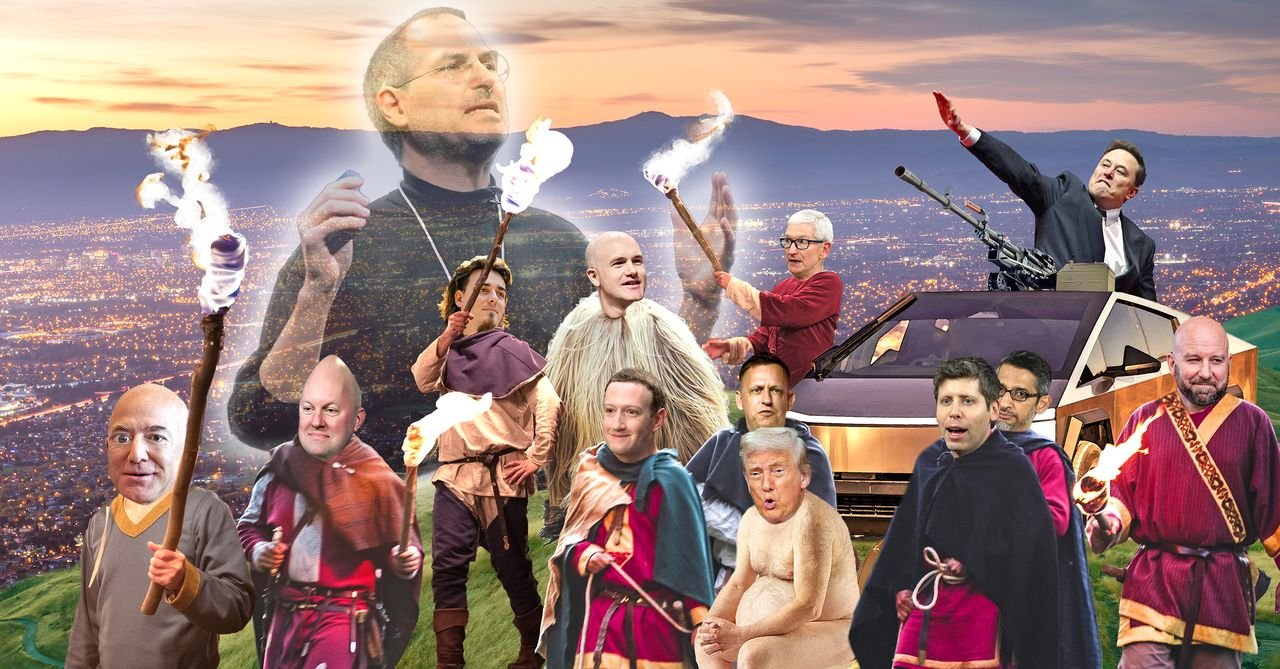
Oh my God, did we post our hopes on the internet. When I first met them, Larry Page and Sergey Brin were wide-eyed idealists. Jeff Bezos came on like a buddy, eager to point out that Amazon employees, himself included, set up their computers on repurposed wooden doors instead of pricey desks. After my first conversation with Zuckerberg, he went home to a tiny apartment with no furniture.

And then the giants of the internet scaled up their companies to impose their own concepts of expression, identity, and context. Those once humble leaders reaped unimaginable rewards. Now they can’t flaunt their riches enough—multiple homes, yachts, planes.

On a typically pleasant July day, I met up with Russell Hancock, who runs a think tank called Joint Venture Silicon Valley, in the living room of his Palo Alto home. He nabbed it during the 2000 tech crash; now you can’t buy a shack in Paly without near-generational wealth. Page and Zuckerberg, unsatisfied with a single homestead, have scooped up nearby properties, transforming once idyllic streets into supervillain compounds.

“The people that are doing fabulously well, they’re really having a terrific time,” Hancock says. For everyone else in Silicon Valley, the wealth gap is getting more punishing, more absurd. When Apple had its IPO in 1980, Steve Jobs’ net worth topped an almost-unheard-of $100 million. Now Zuckerberg is reportedly offering AI researchers that much moolah for a single year’s labor. Hancock brings up the Gini coefficient, a measure of inequality that’s popular among the World Bank crowd. Since the ’90s, “we went from 30 on the Gini to 83,” he says. “Those are the conditions for the French Revolution.”

Another big change was unfolding. For the longest time, notes Chris Lehane, a former Bill Clinton staffer who has worked for companies like Airbnb and OpenAI, software “was almost like a fourth dimension.” Tech leaders could afford to stay out west and avoid politics. But then software products started to break down entire sectors of business. “These products were physically manifesting themselves in taxis, short-term rentals, and food delivery,” Lehane says, “bumping up against existing political systems, beliefs, laws.” Sometimes people died from that incursion. Old, beloved businesses closed. Local politicians got mad. To game the system, Silicon Valley jumped to the swamp. As one technologist in the current administration tells me, “The Valley now realizes it can’t ignore politics, because politics won’t ignore you.”

Read the full article here

Fact Checker

Verify the accuracy of this article using AI-powered analysis and real-time sources.

Get Your Fact Check Report

Enter your email to receive detailed fact-checking analysis

5 free reports remaining

Continue with Full Access

You've used your 5 free reports. Sign up for unlimited access!

Already have an account? Sign in here

Share. Facebook Twitter Pinterest LinkedIn Tumblr Email Telegram Copy Link
News Room
  • Website
  • Facebook
  • X (Twitter)
  • Instagram
  • LinkedIn

The FSNN News Room is the voice of our in-house journalists, editors, and researchers. We deliver timely, unbiased reporting at the crossroads of finance, cryptocurrency, and global politics, providing clear, fact-driven analysis free from agendas.

Related Articles

Media & Culture

Trump Attempts To EO America Into Mimicking Denmark’s Vaccination Schedules

7 hours ago
AI & Censorship

How and Why to Fight Back Against Social Media Bans

11 hours ago
AI & Censorship

Tell Congress: Just Say No to NO FAKES

12 hours ago
Media & Culture

Techdirt Podcast Episode 452: How To Stop Good Companies From Going Bad

14 hours ago
Media & Culture

Daily Deal: The Ultimate Python & Artificial Intelligence Bundle

15 hours ago
Media & Culture

CEOs Who Think AI Replaces Their Employees Are Just Bad CEOs

16 hours ago
Add A Comment

Comments are closed.

Editors Picks

EU Seeks Transaction Ban on 11 Crypto Platforms in Russia Sanctions Push

9 minutes ago

Today in Supreme Court History: June 9, 1970

45 minutes ago

Japan’s three largest banks eye joint stablecoin issue by March 2027

1 hour ago

Hyperliquid, Paradigm Urge FinCEN Revise GENIUS Rule

1 hour ago
Latest Posts

Japan’s Largest Banks Plan Joint Stablecoin Launch by March 2027

1 hour ago

Reading: The Quietest Way To Disobey

2 hours ago

XRP market shows signs of capitulation as holders sell at loss

2 hours ago

Subscribe to News

Get the latest news and updates directly to your inbox.

At FSNN – Free Speech News Network, we deliver unfiltered reporting and in-depth analysis on the stories that matter most. From breaking headlines to global perspectives, our mission is to keep you informed, empowered, and connected.

FSNN.net is owned and operated by GlobalBoost Media
, an independent media organization dedicated to advancing transparency, free expression, and factual journalism across the digital landscape.

Facebook X (Twitter) Discord Telegram
Latest News

BTC and gold fall together as a rate-hike bet hits every hedge

7 minutes ago

EU Seeks Transaction Ban on 11 Crypto Platforms in Russia Sanctions Push

9 minutes ago

Today in Supreme Court History: June 9, 1970

45 minutes ago

Subscribe to Updates

Get the latest news and updates directly to your inbox.

© 2026 GlobalBoost Media. All Rights Reserved.
  • Privacy Policy
  • Terms of Service
  • Our Authors
  • Contact

Type above and press Enter to search. Press Esc to cancel.

🍪

Cookies

We and our selected partners wish to use cookies to collect information about you for functional purposes and statistical marketing. You may not give us your consent for certain purposes by selecting an option and you can withdraw your consent at any time via the cookie icon.

Cookie Preferences

Manage Cookies

Cookies are small text that can be used by websites to make the user experience more efficient. The law states that we may store cookies on your device if they are strictly necessary for the operation of this site. For all other types of cookies, we need your permission. This site uses various types of cookies. Some cookies are placed by third party services that appear on our pages.

Your permission applies to the following domains:

  • https://fsnn.net
Necessary
Necessary cookies help make a website usable by enabling basic functions like page navigation and access to secure areas of the website. The website cannot function properly without these cookies.
Statistic
Statistic cookies help website owners to understand how visitors interact with websites by collecting and reporting information anonymously.
Preferences
Preference cookies enable a website to remember information that changes the way the website behaves or looks, like your preferred language or the region that you are in.
Marketing
Marketing cookies are used to track visitors across websites. The intention is to display ads that are relevant and engaging for the individual user and thereby more valuable for publishers and third party advertisers.