

 Freedom Index
Listen to the article
An excerpt from the long (and, I think, basically correct) opinion in Hoffman v. N.Y. Times Co., decided yesterday by Judge Evelyn Padin (D.N.J.):
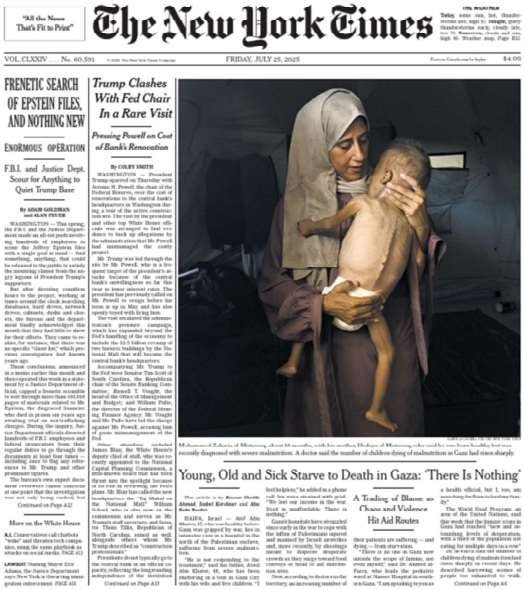
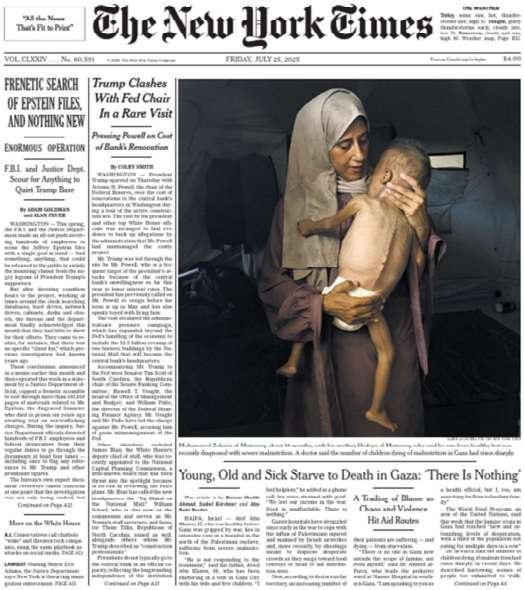
Pro se Plaintiff Harold Hoffman brings this action against Defendant the New York Times Company …. Plaintiff’s suit stems from an article published by the New York Times on July 25, 2025, titled “Young, Old, and Sick Starve to Death in Gaza: ‘There Is Nothing'” along with the article’s accompanying photo:
According to Plaintiff, the New York Times deliberately and misleadingly omitted the fact that the infant in the photo—an 18-month-old baby named Mohammed Zakaria al-Mutawaq (pictured with his mother, Hedaya al-Mutawaq)—was born with cerebral palsy, hypoxemia, and serious genetic disorders in order to advance an untrue narrative about the impact of the war between Hamas and Israel on those living in Gaza. Plaintiff also claims that the New York Times’s publication of the Article runs in contravention of its motto “All the News That’s Fit to Print.” …
Plaintiff brings five claims under the NJCFA [N.J. Consumer Fraud Act] as well as one claim for common law fraud. The NJCFA prohibits:
The act, use or employment by any person of any unconscionable commercial practice, deception, fraud, false pretense, false promise, misrepresentation, or the knowing, concealment, suppression, or omission of any material fact with intent that others rely upon such concealment, suppression or omission, in connection with the sale or advertisement of any merchandise or real estate, or with the subsequent performance of such person as aforesaid, whether or not any person has in fact been misled, deceived or damaged thereby, is declared to be an unlawful practice….
Here, Plaintiff appears to bring claims based on two affirmative misrepresentations—(1) publishing the Article and Photo knowing they were false/misleading and (2) the New York Times’s Motto—as well as two knowing omissions related to the Article—(1) failing to include Mohammad’s full health history in the Article and (2) removing his allegedly healthier older brother from the Photo….
[1.] Plaintiff’s NJCFA claims based on the Article and Photo
At the outset, the Court notes that “to state a claim within the scope of the [NJCFA], a plaintiff must allege facts that establish that the alleged fraudulent conduct induced or lured the plaintiff into purchasing merchandise or real estate.” …
[T]he Article and the Photo … were published long after Plaintiff subscribed to the New York Times. Indeed, Plaintiff concedes that the Article and Photo are not what induced him to purchase a subscription to the New York Times. As such, Plaintiff cannot show that the Article or Photo were made in connection with the sale or advertisement of merchandise or that any omission from either is what caused his loss. It necessarily follows that Plaintiff cannot state a NJCFA claim for any conduct arising from the publication of the Article or Photo.
[2.] Plaintiff’s NJCFA claim based on the New York Times’s Motto
While the New York Times makes several arguments why Plaintiff cannot state a claim under the NJCFA based on its Motto, the Court need only address one: the Motto is not an affirmative misrepresentation actionable under the NJCFA…. The NJCFA … “distinguishes between actionable misrepresentations of fact and ‘puffery.'” “Advertising that amounts to ‘mere’ puffery is not actionable because no reasonable consumer relies on puffery. The distinguishing characteristics of puffery are vague, highly subjective claims as opposed to specific, detailed factual assertions.” In Rodio, for instance, the New Jersey Supreme Court held that Allstate’s slogan, “You’re in good hands with Allstate,” was “nothing more than puffery” and was therefore not “a deception, false promise, misrepresentation, or any other unlawful practice within the ambit of the [NJCFA].”
The Court agrees with the New York Times that its Motto is not a false statement of fact. For one, the Court finds that the Motto is a highly vague and subjective statement that assures consumers nothing in particular. As the New York Times persuasively argues, “[w]hat is ‘fit’ and what is not ‘fit’ is by its very nature not a fact, but a subjective determination made by editors,” and Plaintiff himself recognizes the New York Times “is entitled to editorial freedom to choose what news to emphasize.” As such, the New York Times has the discretion to choose what news is fit to print. That Plaintiff does not like that news—or believes that the New York Times’s reporting is not news but politically motivated lies—does not change the fact that the New York Times’s Motto is a highly subjective statement that affords it significant discretion choose what it deems fit to print.
In addition, it is hard to even consider the Motto as reaching any level of puffery. It makes no specific claim of superiority (either a general claim of superiority or a claim of superiority by reference to any metric), nor does it assure consumers anything “specific and measurable.” … See, e.g., In re Toshiba Am. (D.N.J. 2009) (holding that a statement that a product was for “Today, Tomorrow and Beyond” to be non-actionable puffery); Argabright v. Rheem Mfg. Co. (D.N.J. 2016) (finding that a manufacturer’s statements claiming its products were “top-quality” and “dependable” could not support a misrepresentation claim); Peruto v. TimberTech Ltd. (D.N.J. 2015) (finding statements that a decking product was “designed to provide years of low-maintenance use and enjoyment,” “dependable and attractive for years,” and “[provided] years of outdoor living pleasure” constituted non-actionable puffery). The New York Times’s Motto is even more vague than these statements, and in the Court’s view, is one that no reasonable person would attach importance to when considering whether to purchase a New York Times subscription….
[3.] Plaintiff’s NJCFA claim based on the New York Times’s Handbook of Practices for Ethical Journalism (the “Handbook”)
In his Opposition, Plaintiff changes course and asserts for the first time that what induced him to purchase a New York Times subscription was neither the Article, the Photo, nor the Motto, but rather, the New York Times’s “written promise to deliver accurate news coverage in exchange for his subscription funds.” The written promise Plaintiff is referring to is a statement within Chapter Two of the Handbook: “accuracy is the foundation of our credibility.” “In reliance on this promise of accurate news reporting,” which Plaintiff notes “is viewable on-line for all subscribers to see and to rely upon,” Plaintiff “purchased and maintained the subscription.” …
As noted above, to be actionable under the NJCFA, an affirmative misrepresentation must be made “in connection with the sale or advertisement of any merchandise or real estate.” … [P]utting aside that Plaintiff does not plead with particularity when he first saw the Handbook or when he first subscribed to the New York Times, Plaintiff fails to show that this statement within the Handbook was made in connection with the sale or advertisement of merchandise. All Plaintiff offers is that the statement “is viewable on-line for all subscribers to see and to rely upon,” which is meaningfully different from showing that the statement was made in connection with the sale or advertisement of merchandise….
[T]he same deficiencies that doom Plaintiff’s NJCFA claims also doom his common law fraud claims….
David L. Cook (Sills Cummis & Gross) represents the Times.
Read the full article here
Fact Checker
Verify the accuracy of this article using AI-powered analysis and real-time sources.