Close Menu
FSNN | Free Speech News NetworkFSNN | Free Speech News Network
  • Home
  • News
    • Politics
    • Legal & Courts
    • Tech & Big Tech
    • Campus & Education
    • Media & Culture
    • Global Free Speech
  • Opinions
    • Debates
  • Video/Live
  • Community
  • Freedom Index
  • About
    • Mission
    • Contact
    • Support
Trending

Canada just got its first regulated digital dollar to take on the U.S. stablecoin’s crypto dominance

5 minutes ago

Bitcoin Breaks $80K Barrier: Will Altcoins Follow?

7 minutes ago

US Government Says China’s Best AI Models Lag Behind. Experts Aren’t So Sure

8 minutes ago
Facebook X (Twitter) Instagram
Facebook X (Twitter) Discord Telegram
FSNN | Free Speech News NetworkFSNN | Free Speech News Network
Market Data Newsletter
Monday, May 4
  • Home
  • News
    • Politics
    • Legal & Courts
    • Tech & Big Tech
    • Campus & Education
    • Media & Culture
    • Global Free Speech
  • Opinions
    • Debates
  • Video/Live
  • Community
  • Freedom Index
  • About
    • Mission
    • Contact
    • Support
FSNN | Free Speech News NetworkFSNN | Free Speech News Network
Home»News»Legal & Courts»Children Describe ‘Despair, Loneliness, and Boredom’ at Colorado Juvenile Detention Centers
Legal & Courts

Children Describe ‘Despair, Loneliness, and Boredom’ at Colorado Juvenile Detention Centers

News RoomBy News Room3 hours agoNo Comments4 Mins Read270 Views
Share Facebook Twitter Pinterest Copy Link LinkedIn Tumblr Email VKontakte Telegram
Children Describe ‘Despair, Loneliness, and Boredom’ at Colorado Juvenile Detention Centers
Share
Facebook Twitter Pinterest Email Copy Link

Listen to the article

0:00
0:00

Key Takeaways

Playback Speed

Select a Voice

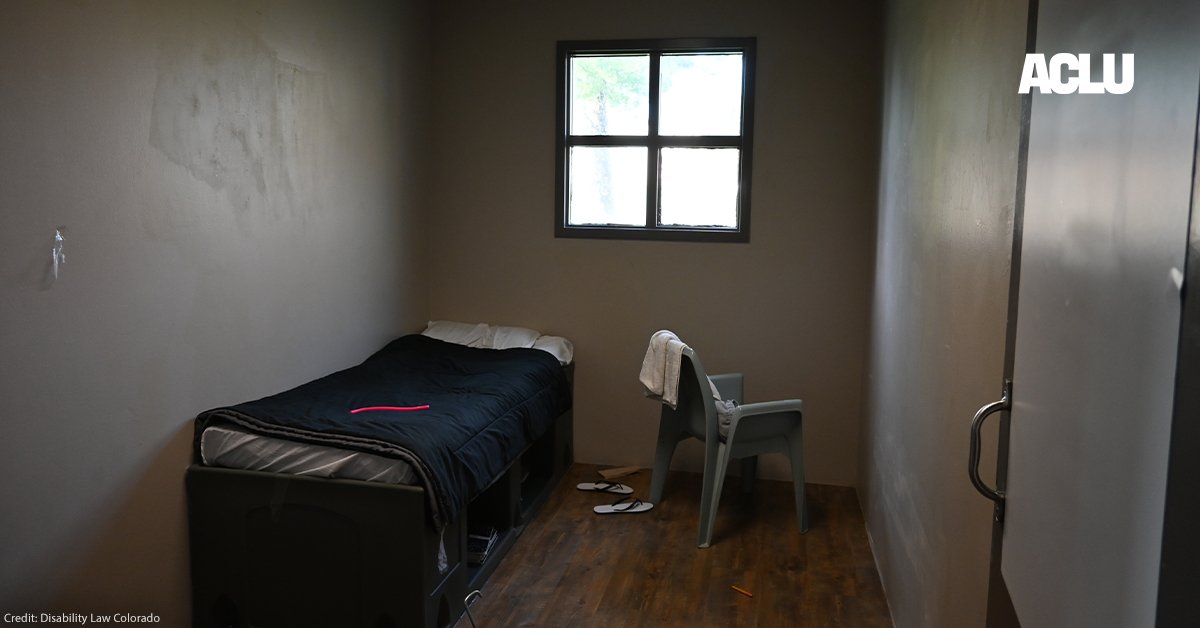
*Editor’s Note: This photo was originally published by Disability Law Colorado in its recent report: Breaking Point: Conditions in the Colorado Division of Youth Services (2021–2025)

Tony S. is 12 years old and has been locked up for over six months, even though a Colorado judge in his delinquency case said he should be released. Tony has been diagnosed with autism spectrum disorder and a medical condition that causes cognitive impairments, behavioral issues, and developmental delays. He is scared to go to court in handcuffs. He wants to listen to country music and play board games, like other kids his age.

Tony, who’s named using a pseudonym due to his status as a minor, is a named plaintiff in a class-action lawsuit filed in March by the ACLU National Prison Project, the ACLU of Colorado, advocacy organizations Children’s Rights and Disability Law Colorado, and the law firm Ropes & Gray. For hundreds of children like Tony, the judges in their delinquency cases have specifically said that they should not be locked up in detention but rather, released to a foster placement or back home, with services like therapy. Yet, these children languish for days, weeks, or months locked in detention facilities simply because of Colorado’s failure to find any other place for them. Children with disabilities and foster children are at particular risk of this unlawful detention.

The state’s failure to release children from jail to a more suitable, community-based setting violates their constitutional and statutory rights. For kids with disabilities, confining them in an institution when they could be in a community setting is a violation of the Americans with Disabilities Act. The Fourteenth Amendment also protects the right to be free from detention while a judge is deciding their case, a heightened protection afforded to children.

The conditions at a Division of Youth Services (DYS) Residential Youth Center in Colorado look shockingly like an adult jail. The doors are always locked. There’s barbed wire around the perimeter of the campus. The cell-like bedrooms have a bed, a plastic chair, and maybe a desk. There’s an overhead light that stays turned on all night so that staff can see through the window of the cell door. Kids are handcuffed when they leave the building, including when going to court. To the extent that there is any education, kids ages 12 to 17 are in the same classroom. Kids are often subject to strip searches and violent restraint tactics.

Kids here describe their days as filled with despair, loneliness, and boredom. In one video call, another 12-year-old boy said he spent his spring break doing very little — to his dismay. The break simply meant there were no classes, despite there being little else for kids to do in detention besides school. Instead, he taught himself how to shuffle a deck of cards. He asked if we could teach him the bridge part if we visited.

Any time that a child spends in detention can have long-term harmful effects. The harm is especially pronounced for kids who spend weeks and months in these restrictive settings. Research has shown that detention harms children physically, neurologically, psychologically, socially, developmentally, and academically. Time in detention derails education, disrupts relationships, limits kids’ future opportunities, and increases the likelihood a child remains involved with the system. This is not news to Colorado officials: The state has repeatedly acknowledged the harmful effects of detention on kids and has long been on notice of its failure to timely release children from detention to more community-integrated settings, as required by law.

Colorado is not an aberration. Many states are guilty of incarcerating children simply because it’s the easiest place to keep them. Instead of investing in community-based services and wraparound supports, states leave children to sit in detention, isolating them from their friends and families. Just this month, U.S. Senator Jon Ossoff and Representative Jen Kiggans issued a bipartisan Congressional report documenting this grim reality in several states. Last month, a proposed bill was introduced in the Tennessee Legislature that would allow locking foster children in detention for no other reason than the shortage of foster homes.

There are many places kids should be: in school, at a park with their friends, at sports practice, home with their siblings or parents, at a summer camp, or ballet class. Jail is no place for kids. Communities are where kids belong. Our lawsuit serves as a warning to states nationwide: The way governments treat and care for their most vulnerable children does not go unnoticed. Colorado must immediately invest in adequate processes and an array of placements and services to support children living in home settings, not in detention.

Read the full article here

Fact Checker

Verify the accuracy of this article using AI-powered analysis and real-time sources.

Get Your Fact Check Report

Enter your email to receive detailed fact-checking analysis

5 free reports remaining

Continue with Full Access

You've used your 5 free reports. Sign up for unlimited access!

Already have an account? Sign in here

Share. Facebook Twitter Pinterest LinkedIn Tumblr Email Telegram Copy Link
News Room
  • Website
  • Facebook
  • X (Twitter)
  • Instagram
  • LinkedIn

The FSNN News Room is the voice of our in-house journalists, editors, and researchers. We deliver timely, unbiased reporting at the crossroads of finance, cryptocurrency, and global politics, providing clear, fact-driven analysis free from agendas.

Related Articles

Media & Culture

Trump’s New European Car Tariffs Demonstrate Why His ‘Deals’ Are Worthless

45 minutes ago
Campus & Education

Press freedom in Pakistan falls off a cliff

2 hours ago
Media & Culture

Justice Alito Enters Administrative Stay of Mifepristone Order

2 hours ago
Media & Culture

Justice Neil Gorsuch: ‘Aspirations for Power Need To Be Checked’

3 hours ago
Media & Culture

How a Bill Banning AI Companions for Kids Could Usher in Widespread ID Checks Online

4 hours ago
Media & Culture

How Bad Facts Make Good First Amendment Law

5 hours ago
Add A Comment
Leave A Reply Cancel Reply

Editors Picks

Bitcoin Breaks $80K Barrier: Will Altcoins Follow?

7 minutes ago

US Government Says China’s Best AI Models Lag Behind. Experts Aren’t So Sure

8 minutes ago

EFF Submission to UK Consultation on Digital ID

42 minutes ago

Trump’s New European Car Tariffs Demonstrate Why His ‘Deals’ Are Worthless

45 minutes ago
Latest Posts

Hut 8 cuts bitcoin credit costs with FalconX refinancing, freeing 3,300 BTC from collateral

1 hour ago

Bitcoin Price Flips Volatile on Iran Events as $80,000 Battle Heats Up

1 hour ago

Banks Stay Tight-Lipped as Senators Reveal Proposed Clarity Act Stablecoin Deal

1 hour ago

Subscribe to News

Get the latest news and updates directly to your inbox.

At FSNN – Free Speech News Network, we deliver unfiltered reporting and in-depth analysis on the stories that matter most. From breaking headlines to global perspectives, our mission is to keep you informed, empowered, and connected.

FSNN.net is owned and operated by GlobalBoost Media
, an independent media organization dedicated to advancing transparency, free expression, and factual journalism across the digital landscape.

Facebook X (Twitter) Discord Telegram
Latest News

Canada just got its first regulated digital dollar to take on the U.S. stablecoin’s crypto dominance

5 minutes ago

Bitcoin Breaks $80K Barrier: Will Altcoins Follow?

7 minutes ago

US Government Says China’s Best AI Models Lag Behind. Experts Aren’t So Sure

8 minutes ago

Subscribe to Updates

Get the latest news and updates directly to your inbox.

© 2026 GlobalBoost Media. All Rights Reserved.
  • Privacy Policy
  • Terms of Service
  • Our Authors
  • Contact

Type above and press Enter to search. Press Esc to cancel.

🍪

Cookies

We and our selected partners wish to use cookies to collect information about you for functional purposes and statistical marketing. You may not give us your consent for certain purposes by selecting an option and you can withdraw your consent at any time via the cookie icon.

Cookie Preferences

Manage Cookies

Cookies are small text that can be used by websites to make the user experience more efficient. The law states that we may store cookies on your device if they are strictly necessary for the operation of this site. For all other types of cookies, we need your permission. This site uses various types of cookies. Some cookies are placed by third party services that appear on our pages.

Your permission applies to the following domains:

  • https://fsnn.net
Necessary
Necessary cookies help make a website usable by enabling basic functions like page navigation and access to secure areas of the website. The website cannot function properly without these cookies.
Statistic
Statistic cookies help website owners to understand how visitors interact with websites by collecting and reporting information anonymously.
Preferences
Preference cookies enable a website to remember information that changes the way the website behaves or looks, like your preferred language or the region that you are in.
Marketing
Marketing cookies are used to track visitors across websites. The intention is to display ads that are relevant and engaging for the individual user and thereby more valuable for publishers and third party advertisers.