

 Freedom Index
Listen to the article
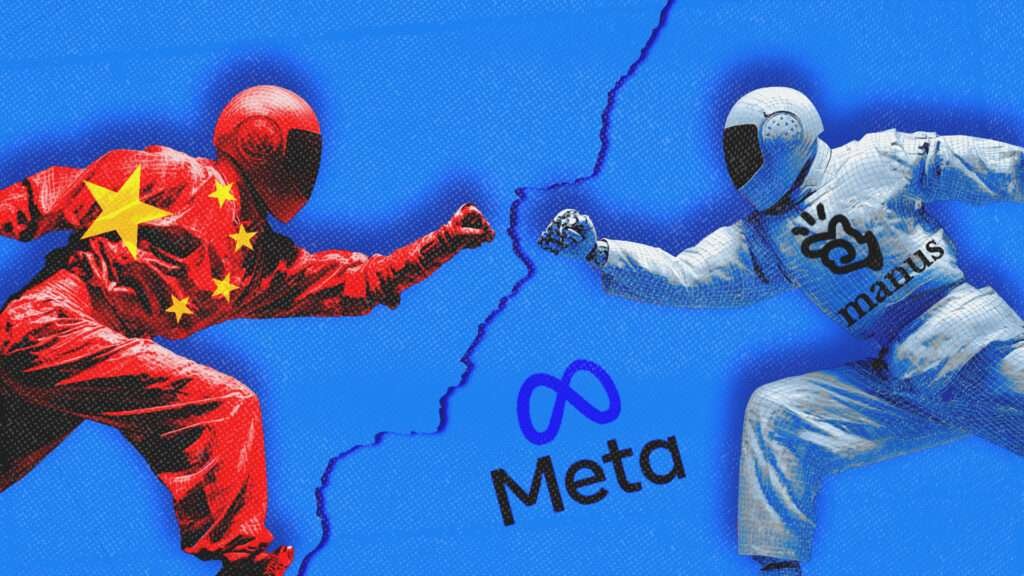
Earlier this week, the People’s Republic of China blocked Meta from acquiring Manus, an AI startup that developed an advanced AI agent capable of completing complex tasks and relocated last summer from China to the more business- and investment-friendly Singapore, apparently with the approval of Chinese regulators.
Meta announced its $2 billion acquisition of the fast-growing AI company last December. At the time, Meta celebrated the deal as bringing “one of the leading autonomous general-purpose agents” to billions of people and millions of businesses. In short, the synergies between Manus’ technology and Meta’s scale made for a promising acquisition.
The Chinese government was less enthusiastic.
In January, the Ministry of Commerce announced a regulatory investigation into the deal, noting its seemingly dubiously broad authority that “enterprises engaging in overseas investment, technology export, cross-border data transfer, cross-border mergers and acquisitions…must comply with Chinese laws and regulations.” On Monday, the National Development and Reform Commission, home of the Working Mechanism for Foreign Investment Security Review, declared that the deal must be unwound.
To be sure, this is but the most recent instance of China advancing its bid for global techno-economic hegemony by blocking acquisitions by large American technology companies. In 2023, the State Administration for Market Regulation, China’s main national antitrust regulator, forced Intel to scuttle its $5.4 billion acquisition of Tower Semiconductor, an Israeli chipmaker with an office in Shanghai, by delaying merger approval for 18 months.
While it is easy to be frustrated with the Chinese government and its use of merger and acquisition controls to limit the competitive advantage of American tech firms, many policymakers in the West have enabled China’s success by weaponizing antitrust and competition laws to kill pro-competitive deals by Big Tech firms.
The downfall of iRobot is a case in point. In August 2022, Amazon offered to purchase the American robotics company that, despite being the maker of the innovative autonomous Roomba vacuum cleaner, was rapidly losing market share to Chinese state-supported competitors—its stock value had halved from its 2021 zenith.
iRobot’s financial precarity and the lack of any coherent theory of anticompetitive harm notwithstanding, the Federal Trade Commission under then-Chair Lina Khan, who has long held a grudge against Amazon, launched an investigation in September 2022. Anticipating a lawsuit from federal regulators and facing scrutiny from the European Commission, Amazon withdrew its $1.4 billion bid in January 2024.
iRobot was forced to lay off 31 percent of its workforce immediately following Amazon’s announcement. By December 2025, the company was mired in hundreds of millions of dollars of debt and had filed for bankruptcy, from which it would be “rescued” by Shenzhen Picea Robotics in January.
In other words, iRobot is now a wholly owned subsidiary of a Chinese robotics company.
The upshot is clear. The American technology firms crucial to the West’s prosperity and security face ample antagonism from abroad. Rather than aiding and abetting our adversaries with a “big is bad” antitrust policy, American regulators should adopt creative policies that deter and respond in kind to China’s assault on American mergers and acquisitions.
For starters, the United States should be coordinating with key allies to foster pro-competitive mergers and maintain the West’s techno-economic edge through free trade agreements and pro-innovation partnerships that ensure its firms are global technology leaders.
Moreover, in exceptional circumstances like these that involve China acquiring American high-tech firms, U.S. policymakers might consider using tools like the Committee on Foreign Investment in the United States, which provides a mechanism for the government to prohibit foreign investments that could jeopardize national security.
The Meta-Manus affair should be yet another wake-up call for American (and European) policymakers to work together and unleash innovation. Let’s hope they finally get the message.
Read the full article here
Fact Checker
Verify the accuracy of this article using AI-powered analysis and real-time sources.