

 Freedom Index
Listen to the article
War hawks love the idea of “credibility.” In his confirmation hearing last year, Secretary of State Marco Rubio called his philosophy “peace through strength by restoring the credibility of American deterrence.” When President Donald Trump sent special forces to capture Venezuelan ruler Nicolás Maduro, Vice President J.D. Vance said that “Maduro is the newest person to find out that President Trump means what he says.” Secretary of Defense Pete Hegseth similarly stated last month that “Iran is learning the hard way that President Trump means what he says.”
It’s ironic praise for a president who so often doesn’t mean what he says. In between his Venezuelan and Iranian interventions, Trump threatened Denmark, stating that he would take over the Danish territory of Greenland “the easy way” or “the hard way.” On January 20, in a rant about Greenland, he stated that “there can be no going back.” It turns out there was. The next day, Trump agreed to a “framework of a future deal” over expanded U.S. military access to the island. The whole episode was promptly forgotten, just like his repeated threats to tariff the world. And in the current Middle East standoff, he has issued and extended deadlines for Iran to open the Strait of Hormuz multiple times.
There is a method to the madness. “Sometimes it pays to be a little wild,” Trump wrote in his 1987 book on business, The Art of the Deal, explaining that he creates fear and then lets the counterparty come up with a favorable alternative. That tactic may work sometimes, but it’s the opposite of building credibility; the point is the mismatch between statements and true intentions. One common defense of Trump, coined by conservative journalist Salena Zito, is that people should take him “seriously, not literally.” If that’s the case, then why talk about “credibility” in the first place?
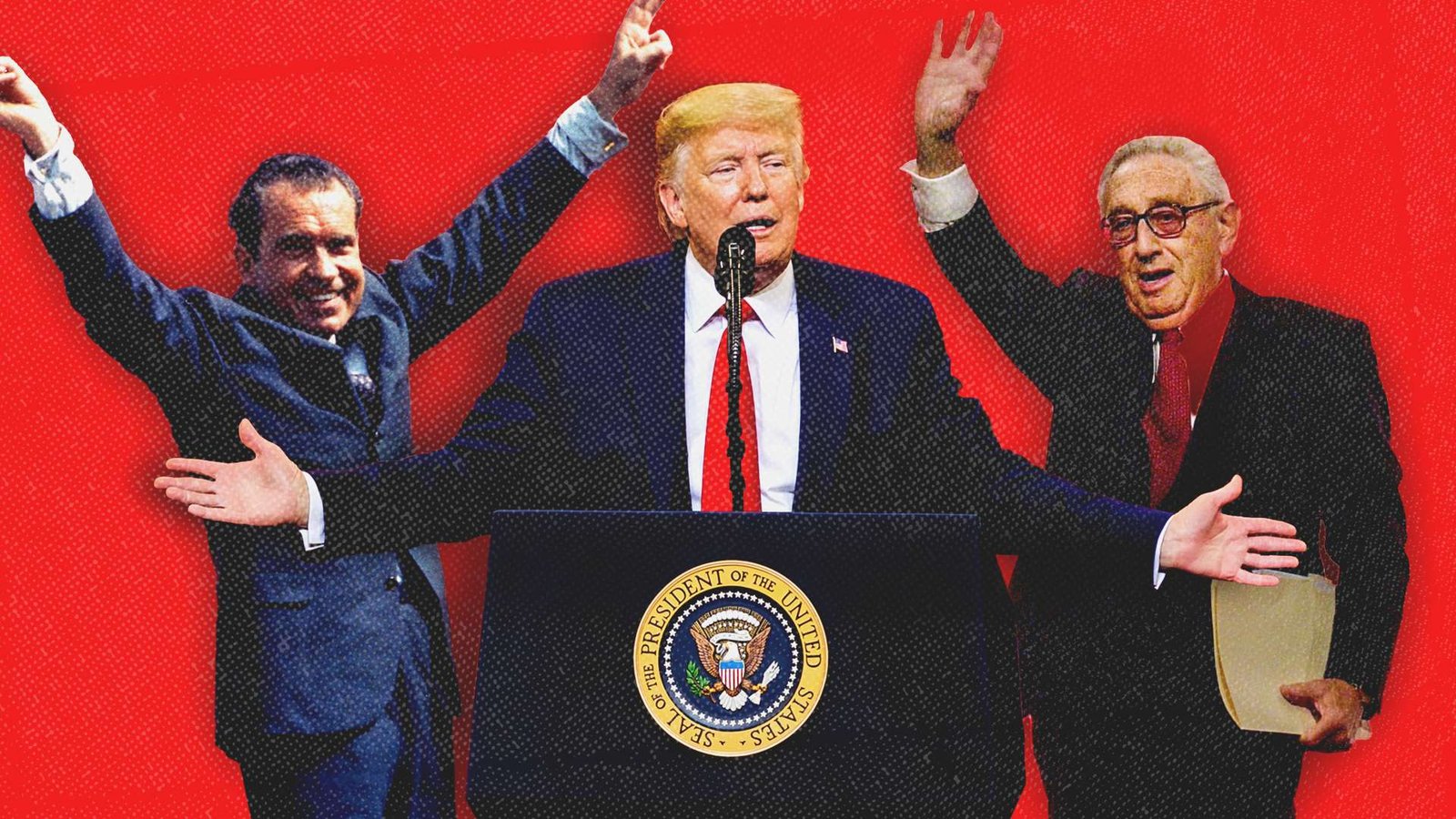
The problem isn’t unique to Trump. Decades ago, President Richard Nixon and his top foreign policy adviser, Henry Kissinger, obsessively talked about maintaining American “credibility.” Yet they also believed in “madman theory,” the notion that acting irrational, erratic, and downright nuts is a useful way to intimidate opponents. That contradiction is at the heart of a lot of hawkish logic. For many hawks, credibility doesn’t actually mean what most people think it means: a reputation for straight talk and serious promises. Instead, it’s a code word for pride, or plain old looking tough, even at the cost of being believed.
The Nixon era also goes to show what happens when the madman strategy of negotiations doesn’t work. Nixon and Kissinger understood that the Vietnam War was unwinnable, but Kissinger believed that “a sudden withdrawal might give us a credibility problem,” because other states might believe that the U.S. was weak. Instead, he resolved to “drag on the process” of losing. Nixon played the madman, swinging between diplomatic overtures and threats of nuclear annihilation, while he escalated the bombing of North Vietnam and secretly invaded Cambodia.
These escalations got tens of thousands of people killed, including thousands of Americans. (The largest shootdown of B-52 bombers ever happened during Nixon’s “Christmas bombings,” just before the Paris Peace Accords were signed in early 1973.) The madman strategy also didn’t work. In the end, communist North Vietnam was able to chase Americans from Vietnam at gunpoint. To the extent that prestige and honor are important, the humiliation of evacuees crowding the last helicopters out of Saigon was a lot more damaging than the Nixon administration accepting a stalemate would have been.
On its own, credibility can be an important asset for a country to preserve. The classic work of Cold War military strategy, Arms and Influence by Thomas C. Schelling, states that deterrence “requires more than a military capability. It requires projecting intentions.” Sometimes, the book states coldly, “the threat has to be made lively when the prohibited action is undertaken.” But the other half of making a threat believable comes from holding back. The target of a threat has to know “that he can avoid the pain or loss if he does comply,” Schelling writes, or else he has no reason to believe that fighting back is worse than backing down.
Many hawks love the first part of Schelling’s argument while ignoring the second. They tend to attack any case of the United States holding back. Sometimes they argue that an enemy backing down is an opportunity to take advantage of their weakness. Or that the enemy is just too evil to leave alone. Either way, a loud domestic lobby for escalation no matter what makes the U.S. government less credible, because it can’t be trusted to hold back.
After all, Libyan ruler Moammar Gadhafi gave up his nuclear program—and then was killed by U.S.-backed rebels in 2011. And every attack on Iran during the Trump administration came with some bad-faith negotiating trap. Trump agreed to negotiate with Iran in June 2025, allowed Israel to attack Iran a few days before the scheduled talks, said he would take “two weeks” to decide whether to join in, and then did so two days later. This time around, Trump similarly attacked Iran and killed its leaders a few days before he was scheduled to negotiate with them.
These tricks have real, immediate costs to U.S. credibility. Russian ruler Vladimir Putin became obsessed with Gadhafi’s assassination, both because Gadhafi was seemingly punished for agreeing to U.S. terms, and because Russia had green-lit the U.S. intervention based on apparently deceptive promises from the Obama administration. That war radicalized Putin, who sent Russian forces into Ukraine and Syria over the next few years.
Iran’s new leadership, too, has said that it is entering the ceasefire from a position of “no trust” in negotiations with the United States. And the slow pace of peace talks has itself led to a vicious cycle of credibility problems. In an apparent attempt to keep markets optimistic, Trump has put out a steady stream of announcements that Iran is about to fold, none of which have ended up panning out. Traders are now paying less attention to Trump’s statements, while both U.S. and Iranian diplomats have privately acknowledged that these declarations are making negotiations harder to conduct.
Or to put it slightly differently, Trump has come out of the Iran War with the world less sure that he “means what he says.” Even if other countries are more sure that he is willing to use violence, they cannot take his words as a reliable measure of what he wants.
Make no mistake, the United States is better off for the fact that Trump was not a credible speaker when he threatened to invade Greenland or to kill the “whole civilization” of Iran. But the past few months go to show how credibility chasing and madman theory fail on their own terms. Hawks have repeatedly put the United States in a position of having to pay a high price to escalate or look stupid. In more than a few cases, they have landed the country in the worst of both worlds, both stuck in a fight and looking less believable than before.
Read the full article here
Fact Checker
Verify the accuracy of this article using AI-powered analysis and real-time sources.