Close Menu
FSNN | Free Speech News NetworkFSNN | Free Speech News Network
  • Home
  • News
    • Politics
    • Legal & Courts
    • Tech & Big Tech
    • Campus & Education
    • Media & Culture
    • Global Free Speech
  • Opinions
    • Debates
  • Video/Live
  • Community
  • Freedom Index
  • About
    • Mission
    • Contact
    • Support
Trending

BTC slides as Fed chair nominee Warsh says Trump didn’t demand rate cut

4 minutes ago

Nium Integrates USDC Payments with Coinbase Across 190 Countries

5 minutes ago

This Frankenstein AI Merges Claude Opus, GLM and Qwen—And Outperforms Top Models

6 minutes ago
Facebook X (Twitter) Instagram
Facebook X (Twitter) Discord Telegram
FSNN | Free Speech News NetworkFSNN | Free Speech News Network
Market Data Newsletter
Tuesday, April 21
  • Home
  • News
    • Politics
    • Legal & Courts
    • Tech & Big Tech
    • Campus & Education
    • Media & Culture
    • Global Free Speech
  • Opinions
    • Debates
  • Video/Live
  • Community
  • Freedom Index
  • About
    • Mission
    • Contact
    • Support
FSNN | Free Speech News NetworkFSNN | Free Speech News Network
Home»News»Media & Culture»Pittsburgh Thinks the NFL Draft Is Worth $19 Million of Taxpayer Money. Here’s What Past Draft Data Say.
Media & Culture

Pittsburgh Thinks the NFL Draft Is Worth $19 Million of Taxpayer Money. Here’s What Past Draft Data Say.

News RoomBy News Room3 hours agoNo Comments9 Mins Read104 Views
Share Facebook Twitter Pinterest Copy Link LinkedIn Tumblr Email VKontakte Telegram
Pittsburgh Thinks the NFL Draft Is Worth  Million of Taxpayer Money. Here’s What Past Draft Data Say.
Share
Facebook Twitter Pinterest Email Copy Link

Listen to the article

0:00
0:00

Key Takeaways

Playback Speed

Select a Voice

Hello and welcome to another edition of Free Agent! Don’t worry if you end up in a tough spot this week, everything will be alright.

If hosting the NFL draft or getting drafted seems like a great deal to you, I’m sorry to say those two things are not as glorious as they seem. Keep reading to find out why. We’ll close with some thoughts on the shockingly high prices being charged for transit and parking at the World Cup.

Don’t miss sports coverage from Jason Russell and Reason.

  • An ESPN version of Jeopardy! is apparently in the works, with Joe Buck likely to host.
  • Zachariah Branch, who will probably get drafted this weekend, was arrested for obstructing a sidewalk and obstructing a law enforcement officer.
  • For sports bars, streaming sports is more complicated and expensive than you think.
  • President Donald Trump apparently wants former President Teddy Roosevelt inducted into the Pro Football Hall of Fame (a bit odd, considering Roosevelt was a critic of professionalizing sports and had more of a direct impact on the college game).
  • Sen. Tammy Baldwin (D–Wisc.) has a plan to regulate sports broadcasts.
  • Kansas City (the Missouri one) is prepared to spend “up to $600 million” on a new Royals stadium.
  • Dallas might demolish its city hall to build a new entertainment district, including a Mavericks arena.
  • An online mob got mad at Nike for a Boston Marathon ad that said “Runners welcome. Walkers tolerated.” Nike gave in and removed the ad.
  • Now the Justice Department is investigating MLB’s streaming deals, after recently opening an investigation into the NFL’s deals.
  • “The Shocking Secrets of Madison Square Garden’s Surveillance Machine“
  • Elsewhere in Reason: “The Promise and Limits of Trump’s Psychedelic Therapy Order“
  • The Commanders added a spear in their alternate logo and people got mad:

    The Association on American Indian Affairs called the Commanders’ logo update “disappointing and inappropriate,” adding, “We are not your mascot,” per @USAToday.

    The team called its new alternate logo, which features a spear and interwoven “W,” “a powerful joining of past and… pic.twitter.com/Q4J5sQIwiQ

    — Yahoo Sports (@YahooSports) April 17, 2026

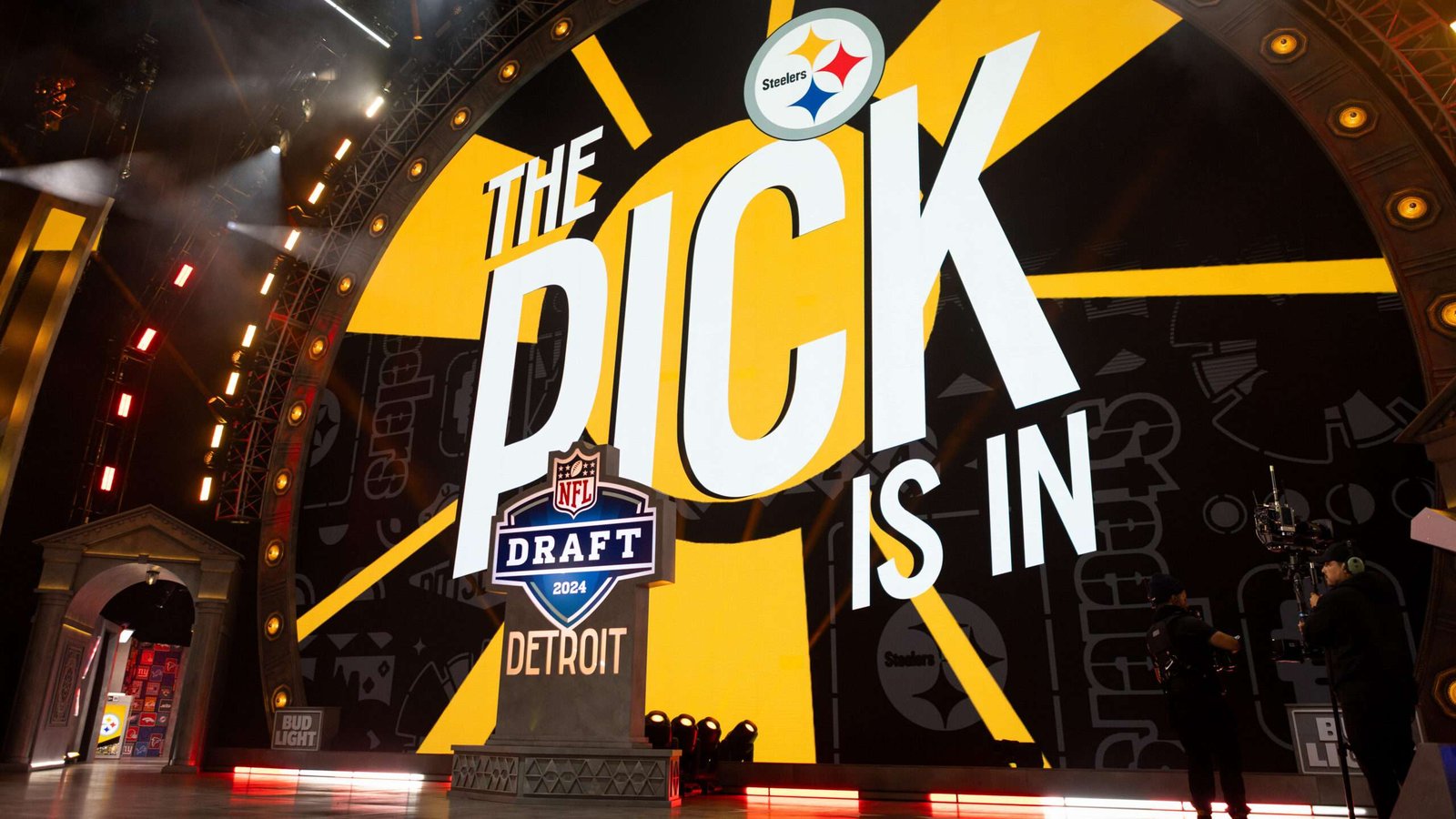
If you believe the NFL and local authorities, hordes of football fans are about to descend on Pittsburgh from all over the country to spend gobs of money watching the NFL draft in person, forever altering the region’s economy for the better. As many as 700,000 fans might attend, they say, with the expected economic impact well within the range of “$120 million to upwards of $213 million.” (Don’t worry, the draft will also result in 500 new trees planted in Allegheny County, plus “400 hanging flower baskets and 420 yellow-and-black planters” installed downtown.) 

If you really think all that is going to happen, then spending a measly $19 million in taxpayer dollars to bring the draft to town seems well worth it. Pennsylvania is spending about $13 million of that, with the rest coming from county and city sources. It is mostly flowing to Pittsburgh’s tourism nonprofit, VisitPittsburgh, which has vaguely said it is spending $16 million on “essential services” (according to great reporting by Mia Hollie of Pittsburgh’s Public Source). The main intent of that spending is on tourist marketing, though.

The problem is that most draft attendees are not traveling from the farthest corners of the country—it’s mostly locals and day-trippers. The total attendance numbers and economic projections are overly rosy too. Once you realize that, the whole facade of the draft as an economic engine worth public subsidies starts to fall.

“The overwhelming majority of visitors are local residents or day-trippers and much of their spending is likely redirected from other local entertainment or dining options rather than being economic gains for the host cities,” economist E. Frank Stephenson from Berry College wrote in a paper last year. “The net gain in room rentals in the 2019-2024 host cities varies greatly from a decrease of nearly 20,000 room nights in Las Vegas to an increase of about 9,000 room nights in Nashville, but in all cases is a small fraction of the claimed number of people attending draft-related events.”

That $19 million in taxpayer spending on the event is just the floor, too. “Pennsylvania State Police said they, too, are coordinating security planning, traffic tactics, risk assessments and interagency exercises, while declining to provide an estimated cost for that work, citing security reasons,” writes Adam Annaccone with the University of Texas at Arlington. “That means the public cost of hosting the draft may be visible only in part.” The cost isn’t just financial, but time: Authorities have spent months training and preparing for the event instead of working on other priorities.

It’s not just law enforcement spending time on the draft, the city is also using in-kind staff time from at least nine city departments, “including, but not limited to: Office of the Mayor; Office of Management and Budget; Innovation and Performance; Finance; Permits, Licenses, and Inspections; Public Safety; Public Works; Parks and Recreation; Mobility and Infrastructure,” according to a 2024 city resolution.

Perhaps worst of all, the city’s public schools are switching to remote learning from Wednesday through Friday because of the draft—even though the draft doesn’t start until late Thursday night.

So overall, Pittsburgh hosting the draft is costing tens of millions of taxpayer dollars (largely spent on marketing), likely won’t meet its overly optimistic attendance and economic impact projections, involves spending a secret amount of money on security, takes up hours and hours of law enforcement and city government staff time, and also keeps kids out of schools for three days.

But hey, at least Pittsburgh is going to get some new trees and flowers out of it.

I’m not trying to persuade you to skip watching the draft in person or on TV. If you’re into that, great! Since the Lions are a bit unpredictable with their draft strategy, I usually just wait until I get a phone notification that tells me who we got, and then I’ll read some grade reports afterward.

Either way, draft picks are going to be all smiles when they put on the hat for their new team this weekend. What they might not be thinking about is how much more money they could be earning if it weren’t for the league’s collective bargaining agreement with the players union.

Since 2011, drafted players have basically no negotiating power with their teams. Instead of arguing for their fair market value, they get a preset salary for four years (with a fifth-year option for first-rounders). Because the average career of a drafted player is roughly five or six seasons (though the data here is contested and murky), most NFL players don’t get paid their real market value for most of their career, especially considering the dampening effects of the salary cap. Even with inflation and league growth, the first overall draft pick in 2026 still won’t have a rookie contract as valuable as the first overall draft picks in 2009 and 2010 (partially because those picks, Matt Stafford and Sam Bradford, negotiated for longer deals).

It’s an odd quirk of the law that this arrangement—preset salaries and employers assigned by draft—is only legal because it’s been agreed on between the players union and NFL owners. “The system works out well for the league’s owners, who get to keep a below-market ceiling on a large portion of their player contracts,” as I wrote last year. “It works well for veteran players, who get to soak up a bigger portion of the salary-capped pie. It doesn’t work out for young draft picks—and it’s a surprise more of them don’t speak out about it.”

As the World Cup gets closer, there was lots of discussion last week about some eye-popping public transit news: New Jersey is charging fans $150 for a round-trip regional train ticket to MetLife Stadium (far more than the usual $12.90).

Fortunately, C.C. Sabathia is here to help: He says you can park at his house for $75.

Similarly to New Jersey, Boston is charging $95 for a round-trip bus ticket or $80 for the train. Parking isn’t an easy alternative either: To park near MetLife it’ll cost you $225, and in Boston it’s at least $175. Both stadiums are largely sealed off from other access points because they’re surrounded by parking lots in the suburbs—it’s not like you can just park in a nearby garage with a competitive price and walk a little bit further. Even Uber and Lyft aren’t allowed within a mile of MetLife.

FIFA having its corrupt way with every single city and country its ever touched until suddenly being shocked and stunned into submission by a final, even more corrupt thing: New Jersey

— Conor Rogers (@conorjrogers) April 17, 2026

The economics at play here are interesting. Most fans have already paid hundreds of dollars, possibly thousands, for their match tickets—even more than the average price of an NFL game at these stadiums. They might grumble about adding an unexpectedly high transit cost to their expenses, but having already paid so much for tickets, they’ll almost certainly suck it up and pay.

What’s also interesting is the tightly controlled access to Gillette and MetLife stadiums. A bus service can’t just undercut the expensive options with a budget-friendly $20 fare—it would need approval from FIFA’s local organizers, the stadium operators, and the local governments if it wants access to stadiums past otherwise closed roads.

Basically, there’s high demand for transit to stadiums, and governments (with some help from FIFA) are artificially limiting competitive options that would bring prices down.

Ideally fans would have multiple private sector options competing on price and quality to choose from. But because FIFA promised huge economic benefits that are unlikely to pan out, some governments are starting to look for ways to make up the money they’re going to lose spending on security and other costs.

Fortunately, some cities have figured out ways to get private sector help: Fans leaving World Cup matches in Philadelphia can ride the subway for free, thanks to a sponsorship by Airbnb.

I’ve also never seen an indented center field wall like this.

You ever seen an inside-the-park grand slam?

WELL YOU HAVE NOW! pic.twitter.com/OnA6rGczTN

— Oklahoma City Comets (@OKC_comets) April 15, 2026

That’s all for this week. Enjoy watching the real game of the week, the Sun Belt Women’s Golf Championship.


Read the full article here

Fact Checker

Verify the accuracy of this article using AI-powered analysis and real-time sources.

Get Your Fact Check Report

Enter your email to receive detailed fact-checking analysis

5 free reports remaining

Continue with Full Access

You've used your 5 free reports. Sign up for unlimited access!

Already have an account? Sign in here

#CivicEngagement #NarrativeControl #PoliticalMedia #PoliticalNews #PressFreedom
Share. Facebook Twitter Pinterest LinkedIn Tumblr Email Telegram Copy Link
News Room
  • Website
  • Facebook
  • X (Twitter)
  • Instagram
  • LinkedIn

The FSNN News Room is the voice of our in-house journalists, editors, and researchers. We deliver timely, unbiased reporting at the crossroads of finance, cryptocurrency, and global politics, providing clear, fact-driven analysis free from agendas.

Related Articles

Cryptocurrency & Free Speech Finance

This Frankenstein AI Merges Claude Opus, GLM and Qwen—And Outperforms Top Models

6 minutes ago
Media & Culture

The Kids Are (Mostly) Alright: New Pew Study Deflates The Social Media Panic

53 minutes ago
Media & Culture

The COVID reckoning doesn’t go far enough

55 minutes ago
Cryptocurrency & Free Speech Finance

Amazon Will Invest Up to $25 Billion More in Anthropic as AI Demand Surges

1 hour ago
Media & Culture

ICE Is on a $45 Billion Building Spree. Can Small Towns Support These New Migrant Warehouses?

2 hours ago
Cryptocurrency & Free Speech Finance

DoorDash to Pay Delivery Workers in Stablecoins via Stripe’s Tempo Blockchain

2 hours ago
Add A Comment
Leave A Reply Cancel Reply

Editors Picks

Nium Integrates USDC Payments with Coinbase Across 190 Countries

5 minutes ago

This Frankenstein AI Merges Claude Opus, GLM and Qwen—And Outperforms Top Models

6 minutes ago

The Kids Are (Mostly) Alright: New Pew Study Deflates The Social Media Panic

53 minutes ago

The COVID reckoning doesn’t go far enough

55 minutes ago
Latest Posts

A Fairytale for Everyone is a children’s book about marginalised people. Illustration: Labrisz / Lilla Bölecz This article first appeared in the Spring 2026 issue of Index on Censorship, The monster unleashed: How Hungary’s illliberal vision is seducing the Western world published on 2 April 2026. The article was published before Viktor Orbán’s defeat in the Hungarian elections on 12 April.  Anyone browsing the children’s section of a Hungarian bookshop will notice something unusual: books sealed in plastic wrappers. The popular young adult book Heartstopper by Alice Oseman will be one of them – if it’s on the shelf at all. Heartstopper is not alone. All children’s books with LGBTQ+ themes face this fate. Hungary’s second largest bookstore chain, Líra, was made an example of in 2023 after selling Heartstopper without a wrapper. It received a large fine, and a legal battle ensued. While the landscape has long been hostile for LGBTQ+ people in Hungary, the use of wrappers stems from a government regulation implementing a law introduced in 2021, ostensibly to protect children. In practice, the regulation conflates paedophilia with depictions of LGBTQ+ lives and was soon dubbed the anti-LGBTQ+ law. Another provision of the regulation says bookshops within 200 metres of churches and schools are banned from selling any books which portray LGBTQ+ identities. In small towns, navigating this is almost impossible. Grammatical pedantry wins Hungary has two major publishing house and bookshop chains and they have both fallen foul of the law. One is Líra, the other is Libri. Líra received a fine of $37,200 and two additional fines, while the much larger Libri received a fine of only $3,100. Earlier in 2023 Libri was taken over by the Matthias Corvinus Collegium, a foundation with close links to Prime Minister Viktor Orbán. Following the takeover, Libri stepped into line over the plastic wrapping directive. “There was a big question mark [over] whether Líra should challenge these decisions. But I think they made a very brave decision, and they said that they wanted to challenge [them],” Lendvai said. They won all three cases at the first instance through pure and simple grammatical pedantry. “We were about to write the petition and then an editor at the book publishing company said, ‘Well, it seems to be that a comma is missing,’” Lendvai explained. He said that the wording suggested books aimed at children with LGBTQ+ themes must be placed into sealed packaging if they were distributed separately, while the government had interpreted it to mean books must be in closed packaging and also separated. Líra neither packaged nor separated its books. As a business, arguing about a point of grammar felt much safer as the first line of argument than challenging the wider issues at stake. Líra continued to sell their books without wrappers. The law, it felt, was on its side. It also launched its Unsealed Books campaign, using audiobooks read by contemporary authors, actors and public intellectuals to give free access to titles. Two of the court decisions became final, but its ruling on the $37,200 fine was quashed by the Supreme Court. In that hearing, Lendvai tried to read out a passage from a contemporary book about a young LGBTQ+ man being welcomed by a Christian community to demonstrate why it should not be banned from sale near churches. “The chairwoman of the panel of the tribunal banned me from reading that passage and she said that this is not about books and it’s not about free speech,” he said. The law was amended, the misplaced comma was fixed. More changes meant that only books with decisive LGBTQ+ themes had to be wrapped, meaning fewer books may be affected by the law. Publishers would also have to alert bookshops when their titles fell under the provision. Líra has since filed a claim with the European Court of Human Rights, which is pending. Challenged by Europe The general law on LGBTQ+ content (which also bans such content from primetime TV and schools) has been challenged by the European Commission. Tamara Ćapeta, the advocate general at the Court of Justice of the European Union (CJEU), has said that it violates EU law. [On 21 April 2026, the Court of Justice of the European Union ordered Hungary to scrap the legislation.] Tamás Dombos of the Háttér Society – Hungary’s largest LGBTQ+ civil society organisation – said the law could be understood only in the country’s broader context of how it deals with LGBTQ+ identities. This includes a media campaign smearing LGBTQ+ people and organisations, a recent ban on LGBTQ+ gatherings, the banning of legal gender recognition for transgender people, and the restriction of adoption rights for unmarried couples. “The political message of the government is very clear: LGBTQI people are second-class citizens who do not deserve the same level of protection, and the discussion of LGBTQ+ topics in the public sphere is harmful for children,” he said. Organisations bound by legislation, he said, implemented the bans in a broad way. They don’t include same-sex couples in adverts and don’t publish books with these themes. Some take these actions because they fear being targeted by anti-LGBTQ+ campaigns and some bookshops now avoid stocking books with LGBTQ+ themes altogether. In October 2025, Hungary had its first known Banned Books Week event, where among other things students could explore an exhibition about the history of book censorship in Hungary. Gergely Gosztonyi, the head of the Digital Authoritarianism Research Lab at Eötvös Loránd University, took a lead role in the event. We asked Gosztonyi whether any of the books featured in the exhibition were titles currently being challenged in Hungary. “We came to the conclusion that we didn’t want the pilot to be very political,” he said. “We had so many books in Hungarian history that have been banned, that it was easy to pick different ones.” He is well aware of the self-censorship, and the irony. At the same time, this was a pilot project, and he didn’t want it to be the last. A fairytale ending? In 2020, A Fairytale for Everyone, edited by Boldizsár M Nagy, was the unlucky star of a very unusual press conference. Dóra Dúró, a politician from the Our Homeland Movement party, called journalists together, walked out onto the podium and shredded the book. Dorottya Rédai is executive director of Labrisz Lesbian Association, an NGO based in Budapest which raises awareness of discrimination against sexual minority women. She was also the project co-ordinator for A Fairytale for Everyone which featured our cover illustrator Lilla Bölecz. Labrisz had the idea about creating a fairytale book from a feminist perspective on the back of their education programme. Some of the stories in the book would be reworked classics and others original, with half written by established writers and the rest by emerging voices. They put out a call for the unknown writers, which Rédai said was noticed by the far right and the government. A national television show, which Rédai described as propaganda, invited her to talk about the book. “People from the community were congratulating me for days for coming out alive from the lion’s den,” Rédai told Index. Dúró’s book shredding was not the only political attack on the book. Orbán told a radio show that the LGBTQ+ community should “leave our children alone” and the book’s publisher was ordered to print disclaimers that the stories contained “behaviour inconsistent with traditional gender roles”. Booksellers were attacked for stocking it, Rédai said, adding that fascist groups put stickers on shop windows in an echo of the Nazi practice of intimidating Jewish shops. Community members rallied round, taking flowers and chocolates to the impacted shops to show their support. With all the attention, the book ended up being a bestseller. Foreign publishers picked it up and international media followed the story. “The book became a symbol of democracy and resistance against the Orbán regime,” Rédai said. “We figured out from this story that cultural resistance is very, very important.” Books are just the start It’s not just books that are under threat. Other artistic endeavours are being censored, too. In 2023, one particular story hit the international headlines. At the World Press Photo exhibition at the National Museum in Budapest, a complaint was filed over a set of photographs spotlighting a care home for elderly LGBTQ+ people in the Philippines. A notice was placed at the entrance to the museum, saying under-18s were not allowed. Museum director Laszlo Simon, a former member of the Fidesz government, was later ousted, with the government claiming he had failed to follow his legal obligations. Soon afterwards, at the National Museum of Ethnography, a small selection of photos documenting a gay couple in 1960s Brazil were hidden from view. A black cordon was strung around the section, with a woman blocking the entrance and asking everyone if they were over 18. “Two people challenged this ban,” Dombos said. “One was an underage person, and she was not let in. And then another person – that was me – said that cordoning off such content is a form of harassment against LGBTQI people.” They both recently lost their cases, although Dombos aims to take his to Strasbourg. Gideon Horváth’s sculpture which pays tribute to unfulfilled non-heteronormative love. Photo: Gideon Horváth Gideon Horváth, a Hungarian-French visual artist who often creates sculptures from beeswax, explores queer theories, subcultures and histories as part of his work. He told Index about the times he has faced censorship. In 2023 he was part of an open-air exhibition, using the term “queer ecology”. “The organiser of the exhibition first accepted it, and then she wrote to me and told me that she was informed that it would be wise regarding the political climate to not use the word ‘queer,’” he said. It was the first time he had experienced anything like this, and he said he had to put his foot down. The organiser then agreed to keep the wording, although Horváth said he saw an email from above saying it should not be allowed. A sculpture for Sidewalk the first Budapest Biennale of Contemporary Public Art labelled as “a memorial for unfulfilled, non-heteronormative loves” was allowed, he said, because the programme was organised by Budapest Gallery, which is under the municipal control of the capital’s liberal mayor. But in another municipal gallery in the capital, where he was invited to exhibit his piece from the park, he was asked to delete a number of words from the accompanying plaque with the excuse that the gallery welcomed children. He believes they were afraid of the consequences if they got it wrong. He refused to delete the words, suggesting they should be blacked out so that the self-censorship was visible. When he was shortlisted for the Esterházy Art Award in 2023, he was told by the Ludwig Museum (which falls directly under the Ministry of Culture) that the sculpture would need to be hidden and roped off. He won the battle over his work being visible but did not win the war of words. “I fought as hard as I could, but my only [other] option would have been to step out of the competition altogether,” he said. He did not want to become known as the censored gay artist from Hungary and told the museum he would not be making any changes, saying “If you change the text that’s on you”. “The curator changed it, and I was really ashamed of it all,” he said. He was announced as one of three winners of the award, a decision which he still cannot make sense of. “What I’ve seen is that institutions don’t necessarily wait for an authority to step in and tell them they can’t do something. They immediately self-censor before even having any threats,” he said. And so they go further than the law requires. The result is an erasure of LGBTQ+ voices and stories, which is likely the entire point. READ MORE

1 hour ago

Revolut targets a $200 billion IPO just months after its $75 billion share sale

1 hour ago

Prospective Fed Chair Pressed on Potential Conflicts of Interest

1 hour ago

Subscribe to News

Get the latest news and updates directly to your inbox.

At FSNN – Free Speech News Network, we deliver unfiltered reporting and in-depth analysis on the stories that matter most. From breaking headlines to global perspectives, our mission is to keep you informed, empowered, and connected.

FSNN.net is owned and operated by GlobalBoost Media
, an independent media organization dedicated to advancing transparency, free expression, and factual journalism across the digital landscape.

Facebook X (Twitter) Discord Telegram
Latest News

BTC slides as Fed chair nominee Warsh says Trump didn’t demand rate cut

4 minutes ago

Nium Integrates USDC Payments with Coinbase Across 190 Countries

5 minutes ago

This Frankenstein AI Merges Claude Opus, GLM and Qwen—And Outperforms Top Models

6 minutes ago

Subscribe to Updates

Get the latest news and updates directly to your inbox.

© 2026 GlobalBoost Media. All Rights Reserved.
  • Privacy Policy
  • Terms of Service
  • Our Authors
  • Contact

Type above and press Enter to search. Press Esc to cancel.

🍪

Cookies

We and our selected partners wish to use cookies to collect information about you for functional purposes and statistical marketing. You may not give us your consent for certain purposes by selecting an option and you can withdraw your consent at any time via the cookie icon.

Cookie Preferences

Manage Cookies

Cookies are small text that can be used by websites to make the user experience more efficient. The law states that we may store cookies on your device if they are strictly necessary for the operation of this site. For all other types of cookies, we need your permission. This site uses various types of cookies. Some cookies are placed by third party services that appear on our pages.

Your permission applies to the following domains:

  • https://fsnn.net
Necessary
Necessary cookies help make a website usable by enabling basic functions like page navigation and access to secure areas of the website. The website cannot function properly without these cookies.
Statistic
Statistic cookies help website owners to understand how visitors interact with websites by collecting and reporting information anonymously.
Preferences
Preference cookies enable a website to remember information that changes the way the website behaves or looks, like your preferred language or the region that you are in.
Marketing
Marketing cookies are used to track visitors across websites. The intention is to display ads that are relevant and engaging for the individual user and thereby more valuable for publishers and third party advertisers.