

 Freedom Index
Listen to the article
One of the most persistent and misleading fallacies in politics is that successive presidents represent a clear and decisive change in the direction of the country, especially when they are from different parties. Republican Richard Nixon barely squeaking into office in a tight three-way race meant that Democrat Lyndon B. Johnson and “the New Deal Coalition that had dominated presidential politics for 36 years” were as beaten down as hippies at the 1968 Democratic National Convention in Chicago, right? And when Ronald Reagan glided to a surprising landslide in 1980 over Jimmy Carter, it meant that the forces of free-spending, socially liberal Big Government had been kicked to the curb by the Second Coming of Calvin Coolidge.
Such clichéd interpretations flatter the newly ascendant group in power (we won because we’re new and vibrant!) while comforting the losers (we only tanked because the times changed). But the reality is always less stark. Far from breaking with or ending LBJ’s free-spending and expansive vision of government mucking around in more and more of everyday life, Nixon instead completed the regulatory agenda of the Great Society by creating new and mostly terrible agencies such as the Drug Enforcement Administration (DEA), Occupational Safety and Health Administration (OSHA), the Environmental Protection Agency (EPA), the Bureau of Alcohol, Tobacco, and Firearms (BATF), and many others that extended the reach of the federal government into everyday life. His “Vietnamization” push in Southeast Asia was a continuation of existing policy, not a break from it. (Interestingly, all three major presidential candidates in 1968 campaigned on some variation of a “swift and honorable peace” to that problematic and undeclared war.)
However highly regarded as an ex-president, Jimmy Carter’s four years in the Oval Office are typically dismissed as an abject failure by a Democrat who was “liberal, a high spender, or dovish.” Carter was none of those things, really, and he of course was, in the words of Nobel laureate economist Vernon Smith, “the great deregulator” who oversaw the liberation of airline ticket pricing and interstate trucking. He was a penny-pincher who obsessed, however ultimately ineffectively, about rising budget deficits and national debt and was, in the opinion of Sen. Rand Paul (R–Ky.), “better on the budget than Ronald Reagan.” With even a little bit of distance and hindsight, there’s a surprisingly strong case for “the important policy linkages between Jimmy Carter, the deregulating architect of the anti-Soviet proxy war in Afghanistan, and Ronald Reagan, the bumbler behind the ‘Reagan recession’ and the disastrous mission in Lebanon.”
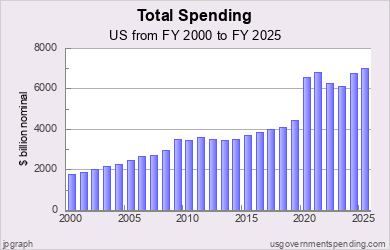
The differences between presidents matter, of course. It is hard to imagine the rebirth of optimism that occurred under the sunny Reagan taking place under the dour Carter. But on a profound level there is always more continuity than disruption in presidential switchovers. That’s certainly true so far in this awful century. When Barack Obama succeeded George W. Bush, he not only kept his predecessor’s various expansive bailout programs but also most of his secret surveillance programs, too (at least until Edward Snowden called him out). When it comes to spending, continuity is king. Each president in the 21st century has left office spending more in nominal dollars than they started with. If Milton Friedman is correct that the ultimate measure of government is spending, the most remarkable thing about presidents is that they all want more and more of the government they control, however temporarily. They may call themselves Democrats or Republicans and act as if that signals important differences, but this is like experiencing the difference between French vanilla ice cream and vanilla ice cream.
But what about Donald Trump and Joe Biden? Surely, here is a major rupture! If nothing else, it’s widely assumed that the return of Trump to a second, nonconsecutive term augured a “vibe shift” that either saved America or destroyed it, depending on your partisan affiliation. But even here, I’d argue, there’s more continuity than not.
Consider mental acuity. Going back to 2020, when they first squared off against each other at the relatively tender ages of 77 (Biden) and 74 (Trump), they were recognized as pushing our gerontocracy into uncharted and potentially dangerous territory. Biden’s disastrous performance during the June 2024 presidential debate—when he declared “we finally beat Medicare” at one point and contended “a lot of young women are being raped by their in-laws” during a question about abortion—led to him being pushed out of the race. Even the most die-hard Trump supporter must suspect that the Republican incumbent is losing at least some of his marbles lately. His apocalyptic statements warning that “a whole civilization will die” due to his Iran war policies don’t suggest he’s in great mental shape; neither does his insistence that he stopped a nonexistent war between Cambodia and Armenia. His odd defense of posting an image to Truth Social of himself as a very Jesus-like character ministering to a sick man didn’t help anything. In explaining his goal in sharing the since-deleted and much meme-ified picture, he said, “I thought it was me as a doctor.” He’s either lying (which is not good) or really, really out of touch (even worse). It’s not comforting to recall that fully 61 percent of respondents to a Reuters/Ipsos poll back in February agreed with the statement that Trump has “become erratic with age.” After all, he’s still got almost three years left to serve.
But the more striking continuity between Trump and Biden isn’t muddled thinking or flights of fancy. It’s spending. Biden ramped up spending, especially on his way out the door. Trump is doing more of the same. Yes, he’s pushing to cut certain types of spending, but in the aggregate, it’s just more and more red ink as far as the eye can see, a tendency that was true of him during his first term, both before and after the pandemic. In fact, federal spending under Trump increased $1,441 per person before COVID fully opened the spigot. Of the $7.8 trillion in new debt he signed off on in his first term, less than half was related to COVID relief. And by every indication—including his recent budget proposal, which calls for a record-high defense budget of $1.5 trillion—Trump aims to sign off on ever-increasing amounts of spending until his term expires in 2029.
Leaving aside partisan evaluations, Joe Biden’s single term as president was not a good one, partly because he continued various Trump policies related to things like tariffs and COVID. Even partisans will acknowledge that his (or his handlers’) attempts to have him stand for reelection regardless of his capacity undermined trust and confidence not just in the Democratic party but in politics broadly (just 15 percent of us trust the federal government to do what’s right “most of the time”). Reason‘s Brian Doherty made a strong case earlier this year that Trump’s return to power has been a specifically “libertarian nightmare” and we will see over the next few years whether his awfulness will increase or be hemmed in by the likely change of power in Congress after the midterms.
This much seems certain: Republican and Democratic presidents come and go, but they always leave bigger and bigger budgets as their shared legacy. And our future burden.
Read the full article here
Fact Checker
Verify the accuracy of this article using AI-powered analysis and real-time sources.