

 Freedom Index
Listen to the article
The National Aeronautics and Space Administration (NASA) faces delays in meeting its schedule for returning to the Moon, according to a new report by the agency’s inspector general. Nevertheless, the project moves forward and remains largely within its budget—a testament to the abilities of SpaceX and Blue Origin, the two private companies participating. In fact, space exploration is largely a private effort these days, with profit-seeking firms developing not just launch capability but also technology for mining Earth’s natural satellite.
You are reading The Rattler from J.D. Tuccille and Reason. Get more of J.D.’s commentary on government overreach and threats to everyday liberty.
Unfortunately, opening new commercial opportunities—even in the depths of outer space—is like ringing the dinner bell for bureaucrats and would-be regulators.
“Despite evolving technical capabilities, the international legal framework governing exploitation of the Moon is both very limited and frozen in the Cold War era,” the RAND Corporation’s Adam Urwick and Jessie Osborne fret in a recent commentary after discussing space developments. “The pursuit of profit raises paramount scientific and environmental concerns. Astronomers caution that large-scale mining activities could disrupt ongoing research and preservation of the lunar environment, leading to calls for development of comprehensive lunar laws and regulations to manage these activities responsibly.”
Earth’s moon is a dead place where nobody currently does anything. There is nothing to disrupt, let alone an environment to worry about unless you want to elevate the occasional boot print or tire tread in lunar dust to the status of a problem. The pursuit of profit there should raise no concerns beyond those of investors seeking returns—and investors and space ventures are looking for opportunity, assuming it’s not strangled by red tape.
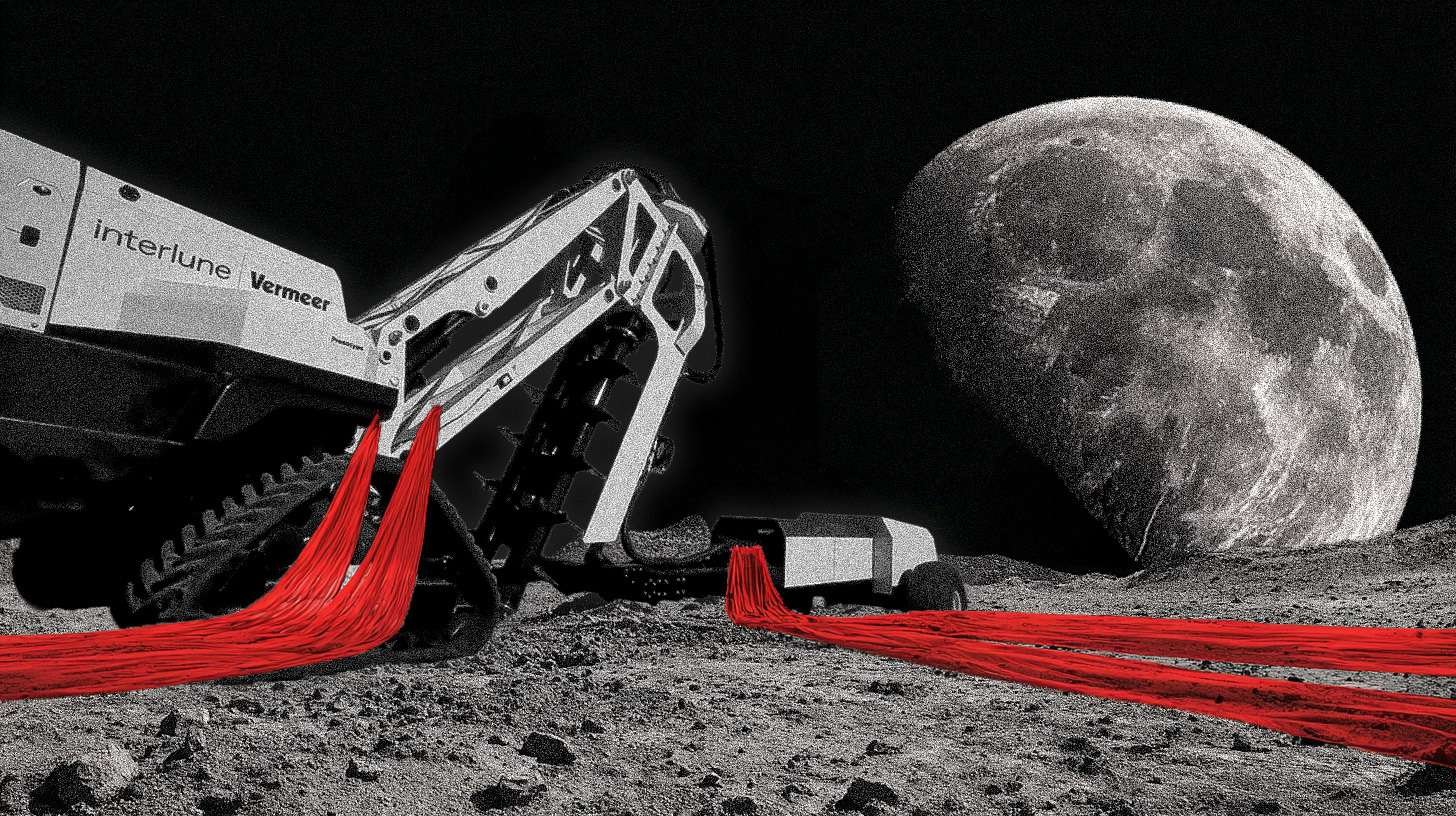
Last year, Interlune and Vermeer Corporation revealed they’ve developed a full-scape prototype of an excavator “designed to ingest 100 metric tons of Moon dirt, or regolith, per hour and return it to the surface in a continuous motion. Interlune’s immediate focus is harvesting helium-3 from the Moon.” Interlune has since signed a contract with the Air Force to deliver lunar helium-3.
The partnership between Interlune, a space technology startup, and Vermeer, an established manufacturing company, illustrates the seriousness with which industry views the prospect of tapping into space resources. Rio Tinto, an Anglo–Australian mining giant, sees its expertise in automated mining as an advantage when it comes to extracting resources in space. The company joined an industry consortium to take its abilities off-planet. It’s well-positioned to succeed in a new environment.
“While venture capital pours into space startups promising to revolutionize lunar resource extraction, the real winners may well be companies that have spent 150 years turning rock into revenue: Rio Tinto, BHP, Glencore and their peers,” Stirling Forbes, a space industry investment matchmaker, wrote last October for Space News. “Lunar mining is fundamentally a resource extraction problem that happens to occur on the moon. Space startups excel at getting there. But once you land, the hard part is mining — and that’s where most space companies have zero experience.”
“Getting there” is a challenge that private companies have been handling for years. NASA’s role is now largely confined to planning missions and then picking among private vendors to do the—literal—heavy lifting. SpaceX has done most of the work, though Blue Origin is a player. Nipping at their heels are companies like Firefly Aerospace, which this week delivered a payload to orbit for Lockheed a year after successfully sending an unmanned lander to the Moon.
A hurdle for NASA’s planned Artemis return to the Moon is that it’s intended to introduce a permanent human presence on the satellite. That requires the unprecedented feat of in-space refueling. “SpaceX will be challenged to complete required milestones ahead of the Artemis III mission, starting with Starship’s next major milestone—a large-scale, vehicle-to-vehicle cryogenic propellant transfer test,” according to the NASA Inspector General. “This test was planned for March 2025 but has been delayed 12 months to March 2026.”
Nobody really doubts that refueling in space will be accomplished. The question is whether it can be done before China sends its own manned mission there around 2030. SpaceX and Blue Origin are both making progress, according to the report, with the companies’ costs increasing by only 6 percent and 1 percent, respectively. Worries over the project’s status are mostly matters of flag waving.
As suggested by industry assessments and announcements by private firms, humans will return to the Moon one way or another, even if in the form of mining robots.
“There’s certainly reasons to go to the moon that go back to national prestige, national security, some of the reasons we’ve always gone to space,” Matt Weinzierl, a Harvard Business School economist and co-author of Space To Grow: Unlocking the Final Economic Frontier, told Marketplace‘s David Brancaccio in December. “But the new thing…is that some companies are raising money to go actually do things on the moon for profit, whether it’s mining the lunar soil or providing services to other customers on the lunar surface.”
The 2015 U.S. Commercial Space Launch Competitiveness Act established grounds for recognizing private property rights in space so that private firms would have reason to take risks and make investments. The law was intended to end-run the 1967 space treaty’s requirement that space exploration “be carried out for the benefit and in the interests of all countries.” We won’t have national territory in space, but the U.S. will recognize and enforce property claims.
But, as RAND’s Urwick and Osborne make clear, natural-born bureaucrats are ready to assert their will even before the first commercial operation has extracted an ounce of resources in space. They want “binding international agreements…which emphasise principles of stewardship, clarify access rights and support common benefits from lunar development.” To their voices you can add University of Bristol law lecturer Dr. Charles Ho Wang Mak’s worries that “unregulated mining could contaminate lunar regolith or generate debris” and other early calls for red tape in space.
The Artemis Accords, signed by multiple countries since 2020, represent an early effort to encourage “space-based exploration, scientific discovery, and commercial utilization” that at least acknowledges the interests of private enterprise. Then again, the European Space Agency’s Zero Debris Charter would export a sort of zero-gravity environmentalism to outer space.
Would-be regulators seem determined to insert themselves into the final frontier. The only saving grace is that if they want to assert their presence, they’ll have to hitch a ride from a private space company.
Read the full article here
Fact Checker
Verify the accuracy of this article using AI-powered analysis and real-time sources.