

 Freedom Index
Listen to the article
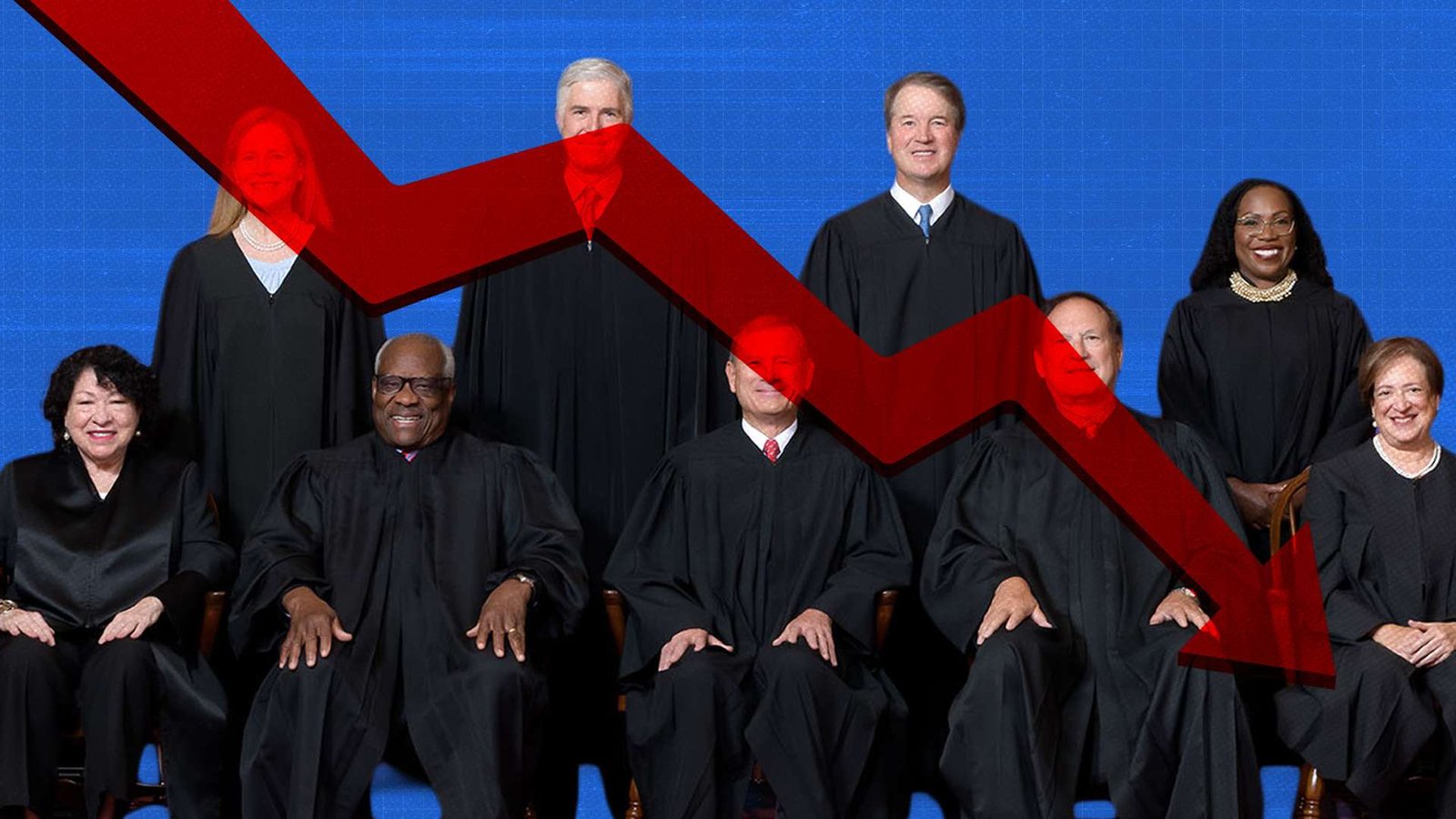
According to a new poll conducted by NBC News, the percentage of registered U.S. voters who have a “great deal” or “quite a bit” of confidence in the U.S. Supreme Court has reached a new low. What’s going on?
You’re reading Injustice System from Damon Root and Reason. Get more of Damon’s commentary on constitutional law and American history.
Here is how NBC’s senior Supreme Court reporter Lawrence Hurley summarized the results:
The latest NBC News poll shows that 22% of registered voters nationally said they have a “great deal” or “quite a bit” of confidence in the high court. Another 40% said they had “some” confidence, while 38% said they had “very little” or “no” confidence.
The previous low point for voters’ impressions of the Supreme Court came in the wake of the ruling that overturned Roe v. Wade in 2022, when 27% said they had a great deal or quite a bit of confidence.
These new poll results become even more interesting when partisanship is factored in. For example, in 2024, 53 percent of Republicans who were asked by NBC said their confidence in the Court was high. Yet in 2026, that number dropped to 35 percent. Meanwhile, in the same period, the confidence figure actually slightly increased among Democrats, who went from 4 percent voicing a “great deal” or “quite a bit” of confidence in SCOTUS in 2024 to 9 percent reporting that kind of favorable view in 2026.
This suggests that the Supreme Court’s recent decision against President Donald Trump’s illegal tariff regime may have given a tiny boost to the Court’s reputation among Democrats (who still remain overwhelmingly negative) while simultaneously hurting the Court’s standing in the eyes of Republicans, who now may perhaps share the president’s view that Justices Neil Gorsuch and Amy Coney Barrett in particular are “an embarrassment to their families” because they voted against Trump.
I wonder if this trend will continue if the Supreme Court hands Trump another defeat later this term over his unconstitutional birthright citizenship order. I seriously doubt we’ll ever get to the point where Democrats view the current SCOTUS more favorably than Republicans view it, but perhaps distrusting the current Court will become more of a genuinely bipartisan affair in the near future.
You may be wondering if such negative poll numbers actually matter for the Supreme Court. In Federalist No. 78, Alexander Hamilton explained that one of the key reasons why the Constitution established lifetime tenure for federal judges was to ensure judicial independence in the face of “the effects of those ill humors which the arts of designing men, or the influence of particular conjunctures, sometimes disseminate among the people themselves.” In other words, the idea of a politically unpopular judiciary was built into the system. Federal judges don’t stand for reelection, after all, and typically remain on the bench until they retire or die, so why can’t they handle some negative approval ratings? Call it an occupational downside to an otherwise pretty sweet gig.
On the other hand, as Hamilton also pointed out in that same Federalist paper, the judiciary “may truly be said to have neither FORCE nor WILL but merely judgment; and must ultimately depend upon the aid of the executive arm even for the efficacy of its judgments.”
Here is one way to think about that particular Hamilton quote: What happens if the Supreme Court’s judgment comes to be mostly distrusted by both political parties? Will that make it politically easier for presidents to defy court orders? Will it make it easier for the Supreme Court’s most outspoken critics in Congress to push through court-packing or some other far-reaching plan designed to upend the judiciary?
If the Supreme Court’s poll numbers truly plummet, it’s at least conceivable that we could find out.
Read the full article here
Fact Checker
Verify the accuracy of this article using AI-powered analysis and real-time sources.