Close Menu
FSNN | Free Speech News NetworkFSNN | Free Speech News Network
  • Home
  • News
    • Politics
    • Legal & Courts
    • Tech & Big Tech
    • Campus & Education
    • Media & Culture
    • Global Free Speech
  • Opinions
    • Debates
  • Video/Live
  • Community
  • Freedom Index
  • About
    • Mission
    • Contact
    • Support
Trending

Dogecoin and Ripple-linked token holders now eligible for U.S. loans

16 minutes ago

Crypto, TradFi Execs Mingle At Trump Crypto Event

20 minutes ago

Optimism Plunges Double Digits Amid Base’s Tech Stack Overhaul

21 minutes ago
Facebook X (Twitter) Instagram
Facebook X (Twitter) Discord Telegram
FSNN | Free Speech News NetworkFSNN | Free Speech News Network
Market Data Newsletter
Thursday, February 19
  • Home
  • News
    • Politics
    • Legal & Courts
    • Tech & Big Tech
    • Campus & Education
    • Media & Culture
    • Global Free Speech
  • Opinions
    • Debates
  • Video/Live
  • Community
  • Freedom Index
  • About
    • Mission
    • Contact
    • Support
FSNN | Free Speech News NetworkFSNN | Free Speech News Network
Home»News»Media & Culture»Austerity Socialism
Media & Culture

Austerity Socialism

News RoomBy News Room4 hours agoNo Comments7 Mins Read1,581 Views
Share Facebook Twitter Pinterest Copy Link LinkedIn Tumblr Email VKontakte Telegram
Austerity Socialism
Share
Facebook Twitter Pinterest Email Copy Link

Listen to the article

0:00
0:00

Key Takeaways

Playback Speed

Select a Voice

Mamdani’s budget blues: New York City Mayor Zohran Mamdani was elected on a promise of massively increasing city spending on affordable housing, fare-free transit, child care, and more.

With less than two months into the job, he’s now scrambling to figure out how exactly he’ll pay for existing city services.

The Reason Roundup Newsletter by Liz Wolfe Liz and Reason help you make sense of the day’s news every morning.

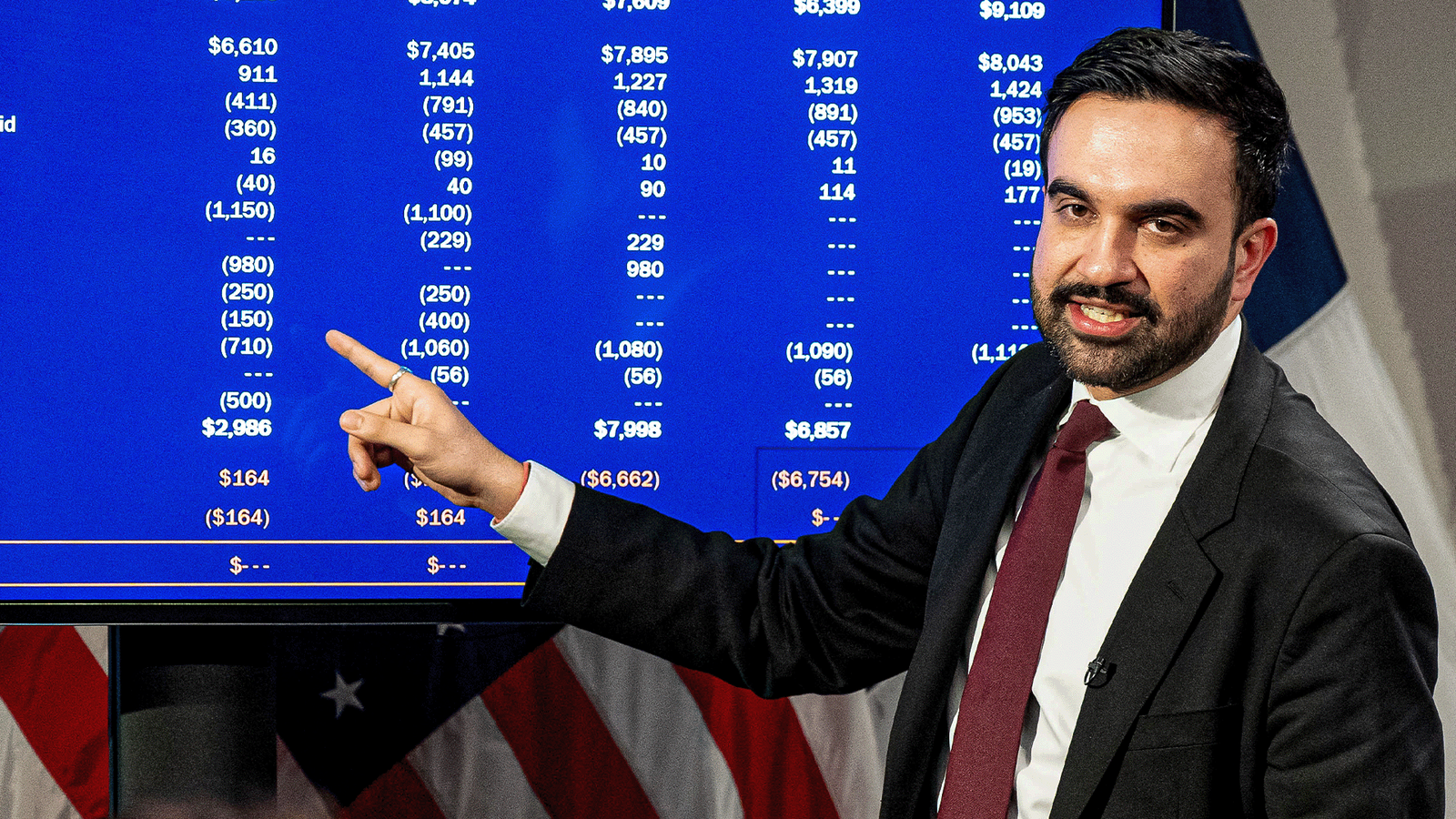
Yesterday afternoon, Mamdani unveiled a $127 billion budget plan that includes a 9.5 percent property tax increase, which, along with a $1 billion withdrawal from the city’s reserve funds, will be needed to close a $5.4 billion budget gap.

State law requires New York City to run a balanced budget. It’s a requirement that the city has only been able to comply with over the past several years by underbudgeting programs and pre-paying for city services with higher-than-expected COVID-era tax revenues and generous federal aid.

With both those sources of funds running dry, Mamdani now needs to finally close a structural budget gap that’s persisted for years.

The limits of city hall socialism: On the campaign trail, Mamdani called for raising city taxes on corporations and wealthy New Yorkers to fund his proposed expansions of city services. That’s the same well he’d prefer to draw from to balance the budget.

It’s not something he, or the city, can do on its own, however. The state Legislature and Gov. Kathy Hochul would have to sign off on any corporate or income tax increases. Hochul, who is currently running for reelection in a state with budget problems of its own, has consistently opposed a city income tax hike.

Mamdani explicitly intends to use his proposed property tax hike, which is something the city can do on its own and which would fall heavily on middle-class New Yorkers, as a means of pressuring Hochul and state officials to acquiesce to more taxes on the wealthy.

Today, I’m releasing the City’s preliminary budget. After years of fiscal mismanagement, we’re staring at a $5.4 billion budget gap — and two paths.

One: Albany can raise taxes on the ultra-wealthy and the most profitable corporations and address the fiscal imbalance between…

— Mayor Zohran Kwame Mamdani (@NYCMayor) February 17, 2026

“There are two paths that we can walk: One that offers long-term stability [i.e., higher income taxes] and a second one with significant pain [i.e., higher property taxes] that we deeply hope to avoid,” Mamdani told reporters at City Hall, per Politico.

Weakening this bluff is the fact that the local politicians, whom Mamdani needs to vote for a property tax hike, are dead-set against the idea.

“At a time when New Yorkers are already grappling with an affordability crisis, dipping into rainy day reserves and proposing significant property tax increases should not be on the table whatsoever,” said City Council Speaker Julie Menin and Councilmember Julie Lee, who chairs the finance committee, in a joint statement.

The Mayor’s Preliminary Budget begins an important conversation about NYC’s fiscal future.

The Council will release its own projections and closely review the Administration’s plan to deliver a balanced budget that protects essential services and addresses affordability. pic.twitter.com/wxB83iTW8J

— New York City Council (@NYCCouncil) February 17, 2026

Andrew Rein, president of the Citizens Budget Commission, a nonpartisan watchdog group, criticized Mamdani for offering a “false choice” between a property tax hike and an income tax hike.

“The best choice is to eliminate spending that does not improve New Yorkers’ lives and make government more efficient and effective. The Mayor should ensure that every one of the people’s $127 billion is used well, before asking them to dig into their pockets,” said Rein in a statement.

Indeed, this year’s budget proposal is $5 billion more than last year’s. Almost the entirety of the budget gap that Mamdani has to fix could be solved by holding spending at constant levels.

Clearly, massive tax increases are still where his heart is.

Balance the budget, bankrupt landlords: Should Mamdani’s property tax hike come to pass, it’ll exacerbate the negative effects of the signature “rent freeze” he’s been gunning for since his mayoral campaign started.

New York’s rent-stabilized housing stock is increasingly in financial and physical distress, thanks to a 2019 law that closed off almost all avenues for landlords to raise rents, aside from the small percentage increases approved each year by the city’s Rent Guidelines Board.

Today, some 25,000 apartment units sit vacant because their owners can’t raise rents to finance necessary repairs. At least 10 percent of rent-stabilized buildings are running an operational loss. Once debt costs are factored in, many more are likely in the red.

Mamdani’s proposal to “freeze the rent” would quicken the pace at which rent-stabilized units go bankrupt. In an occasional nod to reality, the mayor has said he’s open to property tax relief as a means of making the numbers work for rent-stabilized landlords.

Now, Mamdani’s policy is proposing to hit rent-stabilized owners with a rent freeze and a massive property tax hike. The results would likely be devastating.

“Roughly one-third of rent-regulated housing is already struggling due to rising costs, with property taxes the biggest expense,” said New York Apartment Association CEO Kenny Burgos in an emailed statement. “This proposal, coupled with Mamdani’s pledge to freeze rents for four years, virtually guarantees the physical destruction of tens of thousands of units of housing.”


Scenes from Oakland: I’m in Oakland, California, this week for a reporting trip. There are many scenes that I could include here that I will instead save for the story that brought me out here.

Instead, I’ll complain about one way that the California nanny state negatively impacted my life out here. At the grocery store, I was given a paper bag at the checkout, which is now required by state law. Plastic bags at checkout are banned.

During the walk back to the Airbnb, the day’s rain caused the bag to soften and eventually tear, spilling my items onto the street and cracking a third of the eggs I’d just purchased.

While I don’t want to say too much about the story I’m here for, I will say it is focused on a failure of California to perform basic government functions. Until the state and its cities get better at those, perhaps they should hold off on making people’s lives worse with nanny-state bag bans.


QUICK LINKS

BREAKING: “A Minneapolis-based activist network is now openly advertising “jury nullification training,” raising new concerns about the integrity of jury trials in the Twin Cities.”

Left wing activists want the fraudsters and anti-ICE attackers to get away with their… pic.twitter.com/8UkVLGVRST

— Steve Guest (@SteveGuest) February 17, 2026

  • Jesse Jackson, the civil rights activist and liberal politician, has died at age 84.
  • Opponents of California’s wealth tax proposal are ramping up their campaign, reports Politico.
  • Boneless wings are back on the menu, boys.

Update: Court says “boneless wings” is not a deceptive name for BWW to use, even though they are “essentially chicken nuggets” and not de-boned wings.

“His complaint has no meat on its bones.” https://t.co/APm02sxUic pic.twitter.com/7cJ0NJ7IZy

— Rob Freund (@RobertFreundLaw) February 17, 2026

  • Wishing you a somber Ash Wednesday

The Mardi Gras-to-Ash Wednesday pipeline pic.twitter.com/lTKmTihHxz

— Maggie Phillips (@maggiemphillips) February 17, 2026


Read the full article here

Fact Checker

Verify the accuracy of this article using AI-powered analysis and real-time sources.

Get Your Fact Check Report

Enter your email to receive detailed fact-checking analysis

5 free reports remaining

Continue with Full Access

You've used your 5 free reports. Sign up for unlimited access!

Already have an account? Sign in here

#Democracy #FreePress #InformationWar #Journalism #MediaAndPolitics
Share. Facebook Twitter Pinterest LinkedIn Tumblr Email Telegram Copy Link
News Room
  • Website
  • Facebook
  • X (Twitter)
  • Instagram
  • LinkedIn

The FSNN News Room is the voice of our in-house journalists, editors, and researchers. We deliver timely, unbiased reporting at the crossroads of finance, cryptocurrency, and global politics, providing clear, fact-driven analysis free from agendas.

Related Articles

Cryptocurrency & Free Speech Finance

Optimism Plunges Double Digits Amid Base’s Tech Stack Overhaul

21 minutes ago
Media & Culture

Today in Supreme Court History: February 18, 1988

58 minutes ago
Media & Culture

Brickbat: Justice Is Blind, and Slow

2 hours ago
Media & Culture

Security Clearance Denied for Past Child Porn Downloading; Hearing Officer Unmoved by Claims That Behavior Stemmed from Since-Resolved Gender Dysphoria

3 hours ago
Media & Culture

Hallucinating Customer Service Hell

5 hours ago
Cryptocurrency & Free Speech Finance

AI Disruption Could Cut Creator Earnings by Nearly 25% by 2028, UNESCO Warns

5 hours ago
Add A Comment
Leave A Reply Cancel Reply

Editors Picks

Crypto, TradFi Execs Mingle At Trump Crypto Event

20 minutes ago

Optimism Plunges Double Digits Amid Base’s Tech Stack Overhaul

21 minutes ago

Today in Supreme Court History: February 18, 1988

58 minutes ago

Crypto majors dive despite tech-led lift in Asian markets

1 hour ago
Latest Posts

Ledn’s $188M Bitcoin-Backed ABS Deal Enters US Bond Market

1 hour ago

Brickbat: Justice Is Blind, and Slow

2 hours ago

Creators have only three seconds to hook users before they scroll away. Photo: Ben Iwara/Unsplash Short-form video is the medium of our time. The average teenager will spend hours a day on TikTok and Instagram reels, which are the main sources of news and entertainment for the 18-24 demographic. Adam Mosseri, head of Instagram, administers the most important algorithm in the English-speaking world. He is undoubtedly as consequential as David Zaslav or Rupert Murdoch – the CEO of Warner Bros and the owner of News Corp – but his name rarely makes headlines. On Mosseri’s Instagram, videos proven to hold users’ attention will be shown to more people. “Watch-time” is the basic currency of his algorithm. This has forced creators, many of whom earn a living on the platform, to abide by a golden formula: hook, secondary hook, payoff. The algorithm has spawned an entire coaching industry in which aspiring influencers pay veteran creators for crash courses in perfecting the formula. Each course teaches more or less the same thing: promise the viewer an answer to a question, keep promising, then answer at the end. Better yet, don’t answer it – promise to answer it in the next video. Where watch-time is the quantitative component of these algorithms, “trends” are the qualitative. If a particular word, image or sound appears to be trending among a certain data demographic, unrelated content will be algorithmically choked out of that demographic’s feed. This forces creators to cluster their content around proven trends. A trend is never a story. It is always a concept or feeling that can be immediately communicated within three seconds, because it is generally understood that creators have only three seconds to hook users before they scroll away. As influential creator coach Dominik Rieger will often remark: “The viewer must immediately know ‘This is for me’.” When Sean “Diddy” Combs trends, as he often does, it is never regarding a piece of evidence or a development in one of his trials. What is, on paper, a story about sexual coercion and exploitation of power is translated by the algorithm into a static portrait: a shame-faced Puff Daddy slick with baby oil. Searching “Diddy” will take you to a trove of baby oil related brainrot, and barely a single piece of factual reporting. Diddy’s actions did not create a story to be followed but a crude vignette to be gawked at. When US president Donald Trump’s shocking birthday letter to Jeffrey Epstein was published by The Wall Street Journal, it did not become a major trend on TikTok or Instagram because the only way to parse the story was by reading the letter itself, which takes more than three seconds. As far as the algorithm is concerned, if an event’s essence cannot be compressed into a three-second span, it may as well have never happened. The proliferation of short-form video has created a media environment structurally hostile to sequential reasoning. Young people’s attention is guided by an ever-narrowing algorithmic spotlight. Stories that are too big to be rendered by the spotlight are able to bask in pitch darkness and the people we allow to control the algorithms are not interested in changing that. In fact, Mosseri has been open about his efforts to speed up trends: “I want us to be better at trends. It takes still too long for things to pop on Instagram.” The political implications of this media environment are clear. If short-form video platforms continue to transmute real-world events into less-than-superficial spectacles, the rich and powerful need not manually censor anything. If all chains of cause and effect have found their terminus in the platform algorithms, and if public consciousness is held inert by the same three-second hooks, what will be worth censoring? READ MORE

2 hours ago

Subscribe to News

Get the latest news and updates directly to your inbox.

At FSNN – Free Speech News Network, we deliver unfiltered reporting and in-depth analysis on the stories that matter most. From breaking headlines to global perspectives, our mission is to keep you informed, empowered, and connected.

FSNN.net is owned and operated by GlobalBoost Media
, an independent media organization dedicated to advancing transparency, free expression, and factual journalism across the digital landscape.

Facebook X (Twitter) Discord Telegram
Latest News

Dogecoin and Ripple-linked token holders now eligible for U.S. loans

16 minutes ago

Crypto, TradFi Execs Mingle At Trump Crypto Event

20 minutes ago

Optimism Plunges Double Digits Amid Base’s Tech Stack Overhaul

21 minutes ago

Subscribe to Updates

Get the latest news and updates directly to your inbox.

© 2026 GlobalBoost Media. All Rights Reserved.
  • Privacy Policy
  • Terms of Service
  • Our Authors
  • Contact

Type above and press Enter to search. Press Esc to cancel.

🍪

Cookies

We and our selected partners wish to use cookies to collect information about you for functional purposes and statistical marketing. You may not give us your consent for certain purposes by selecting an option and you can withdraw your consent at any time via the cookie icon.

Cookie Preferences

Manage Cookies

Cookies are small text that can be used by websites to make the user experience more efficient. The law states that we may store cookies on your device if they are strictly necessary for the operation of this site. For all other types of cookies, we need your permission. This site uses various types of cookies. Some cookies are placed by third party services that appear on our pages.

Your permission applies to the following domains:

  • https://fsnn.net
Necessary
Necessary cookies help make a website usable by enabling basic functions like page navigation and access to secure areas of the website. The website cannot function properly without these cookies.
Statistic
Statistic cookies help website owners to understand how visitors interact with websites by collecting and reporting information anonymously.
Preferences
Preference cookies enable a website to remember information that changes the way the website behaves or looks, like your preferred language or the region that you are in.
Marketing
Marketing cookies are used to track visitors across websites. The intention is to display ads that are relevant and engaging for the individual user and thereby more valuable for publishers and third party advertisers.