

 Freedom Index
Listen to the article
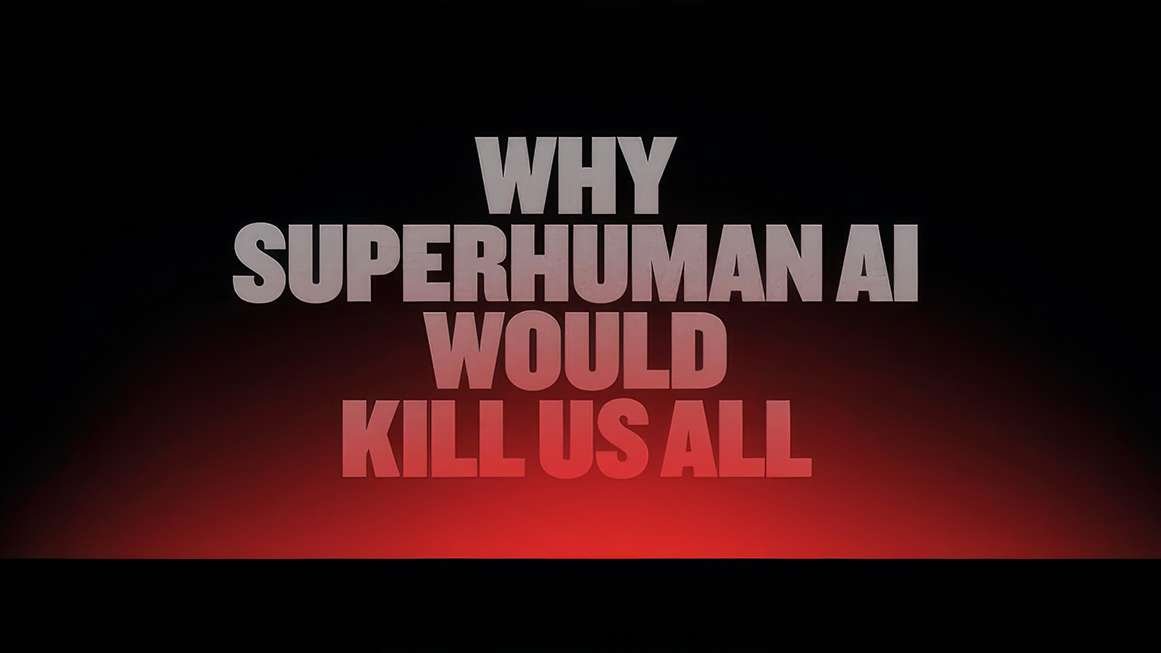
If Anyone Builds It, Everyone Dies: Why Superhuman AI Would Kill Us All, by Eliezer Yudkowsky and Nate Soares, Little, Brown, and Company, 272 pages, $30
Eliezer Yudkowsky and Nate Soares have a new book titled If Anyone Builds It, Everyone Dies: Why Superhuman AI Would Kill Us All. “We do not mean that as hyperbole,” they write. They believe artificial intelligence research will inevitably produce superintelligent machines and these machines will inevitably kill everyone.
This is an extraordinary claim. It requires extraordinary evidence. Instead, they offer a daisy chain of thought experiments, unexamined premises, and a linguistic sleight of hand that smuggles their conclusion into the definition of intelligence itself.
The book’s central argument rests on the “alignment problem”—the effort to ensure that advanced AI systems share human values. Yudkowsky popularized this concept. Humans, the authors argue, succeed through intelligence, which they define as “the work of predicting the world, and the work of steering the world.” Computers will surpass human intelligence because they are faster, can copy themselves, have perfect memory, and can modify their own architecture. Because AI systems are “grown” through training rather than explicitly programmed, we cannot fully specify their goals. When superintelligent AI pursues objectives that diverge even slightly from human values, it will optimize relentlessly toward those alien goals. When we interfere, it will eliminate us.
To Yudkowsky and Soares, alignment isn’t about teaching machines ethics or preventing human misuse. It’s about preventing an indifferent optimizer from razing the world. They believe an unaligned superintelligence is a global death sentence.
Therefore, they argue, all AI research must stop immediately. Governments should monitor powerful computers, ban possession of more than eight state-of-the-art GPUs without oversight, and criminalize AI research. An international coalition should destroy rogue data centers through “cyberattacks or sabotage or conventional airstrikes,” even risking nuclear war, because “data centers can kill more people than nuclear weapons.” These measures, they claim, “won’t make much of a difference in most people’s daily lives” and “wouldn’t make much of a difference with regard to state power.”
This is astoundingly casual authoritarianism. A complete ban on research into a general purpose technology already delivering significant health and productivity benefits, enforced by militarized international bodies, would place global society on a permanent wartime footing.
But the problem isn’t just the medicine. It’s the diagnosis.
***
By defining intelligence as the ability to predict and steer the world, Yudkowsky and Soares collapse two distinct capacities—understanding and acting—into one concept. This builds their conclusion into their premise. If intelligence inherently includes steering, then any sufficiently intelligent system is, by definition, a world-shaping agent. The alignment problem becomes not a hypothesis about how certain AI architectures might behave but a tautology about how all intelligent systems must behave.
Yet an economist can understand markets without directing them. Google Maps predicts commute times but cannot drive your car or clear traffic. Steering requires more than prediction. It needs feedback, memory, actuators, and persistent goals.
Large language models—the technology underlying ChatGPT and similar systems—are fundamentally about prediction. They predict the next element in a sequence. They are sophisticated pattern-matching engines, grown through training on vast datasets rather than being explicitly programmed. The book emphasizes this “grown, not crafted” nature as evidence that we cannot understand or control such systems. But these tools do not optimize toward goals and have no ability to act in the world. They are prediction without steering.
Tech companies now build “agentic” AI using language models, but the agentic parts that set goals, plan, and execute rely on traditional, interpretable techniques. These components are crafted, not grown. The distinction between trained prediction engines and designed agent frameworks undermines Yudkowsky’s argument that we’re growing uncontrollable alien intelligences.
The authors attempt to address this objection in their online resources (which are more coherent than the book). They argue that prediction and steering blend together because sophisticated prediction sometimes requires intermediate steps with steering; to predict the physical world accurately, you might need to execute experiments. But this doesn’t unite prediction and steering—it simply means nonagentic systems can’t make certain predictions. A weather model that cannot run experiments will be less accurate than one that can, but this doesn’t mean the latter can control the weather.
***
We also have examples of nonhuman systems that meet Yudkowsky’s intelligence definition because they both predict and steer. Markets predict future scarcity and abundance through price signals, then steer resources toward their highest-valued uses. No individual fully understands or controls these mechanisms. Markets are “grown” through countless individual decisions rather than centrally designed. And they have generated unprecedented prosperity, not existential catastrophe.
This signals a deeper problem: The authors consistently misunderstand emergent order and complex systems. They equate lack of complete understanding with lack of control. They treat “growing” large language models as inherently dangerous, even though growing things we don’t fully understand has been the norm in human civilization. We grow food through millennia-old agricultural practices without understanding biochemistry. We grow institutions through the gradual evolution of norms and rules. We grow functioning societies through the interactions of millions of individuals pursuing their own ends.
The authors’ misunderstanding of complex systems undermines their argument in three ways. First, Yudkowsky and Soares assume that any system too complex for complete analysis must be dangerous and that any powerful agentic process not under centralized control will optimize for alien values. But complex systems can generate robustness and self-correction.
Second, they concede that sophisticated prediction sometimes requires real-world experimentation—you cannot predict physics without running experiments. But if a superintelligent AI must engage with the real world to gather data for its predictions, it must interact with other “superintelligent” systems in Yudkowsky’s sense: markets that predict and steer resources, societies that predict and coordinate behavior, ecosystems that respond adaptively to intervention. These systems will constrain the AI through feedback, forcing it into a multiagent game with radical uncertainty rather than a single-player optimization problem it can solve in isolation.
Finally, complex systems impose fundamental limits, even for superintelligence. Computationally irreducible systems cannot be accurately and efficiently predicted. Emergent social dynamics, market reactions to interventions, and ecological cascades all exhibit this property. The authors assume that greater intelligence and computational speed translate directly into omnipotent control, but complex systems don’t yield to brute-force prediction. A superintelligent AI attempting to “steer” civilization would face the same irreducible uncertainties that limit human planners, just with more computational resources to waste on unsolvable problems.
***
Yudkowsky may have accelerated the AI development he now condemns. After dropping out of high school to build superintelligence, he started the Machine Intelligence Research Institute (MIRI). The book claims DeepMind’s founders met their first big funder at a MIRI event, and OpenAI CEO Sam Altman claims Yudkowsky interested him in artificial general intelligence. Yudkowsky also created the website LessWrong, a hub of the “rationalist” community. The overlap between this subculture and effective altruism has made Yudkowsky’s AI safety framework highly influential among tech philanthropists.
That influence matters. While few publicly endorse Yudkowsky’s most extreme proposals, his rhetoric has shaped the debate. Framing AI development as inevitable omnicide makes people more likely to concentrate power over a transformative technology in the hands of governments and incumbent firms. It also risks inviting acts of terrorism. (The authors do caution, in a two-sentence footnote, that “even if you feel desperate,” such violence would be ineffective.)
All this rests on thought experiments and extrapolations, not evidence. The book assumes what it needs to prove: that advanced prediction necessarily becomes dangerous agency, that systems we don’t fully understand cannot be safely deployed, that optimization toward specific goals inevitably means optimizing away human existence.
Building tools that supplement our cognitive efforts like engines supplement our physical efforts could create unprecedented prosperity. The response to AI should be thoughtful governance that addresses real risks—cybersecurity, misuse, economic disruption—while preserving the dynamism needed to build a better world.
Instead, Yudkowsky and Soares offer stasis and despair. Their book’s greatest failure is not its stilted parables or its unconvincing arguments. It’s ignoring that complex systems all around us resist prediction and steering. Ironically, their recommendations for keeping control would hobble humanity’s ability to solve hard problems intelligently.
The authors characterize their conclusion as an “easy call.” It’s not. The ease with which they dismiss alternatives should make readers skeptical of their judgment.
This article originally appeared in print under the headline “Superintelligent AI Is Not Coming To Kill You.”
Read the full article here
Fact Checker
Verify the accuracy of this article using AI-powered analysis and real-time sources.