

 Freedom Index
Listen to the article
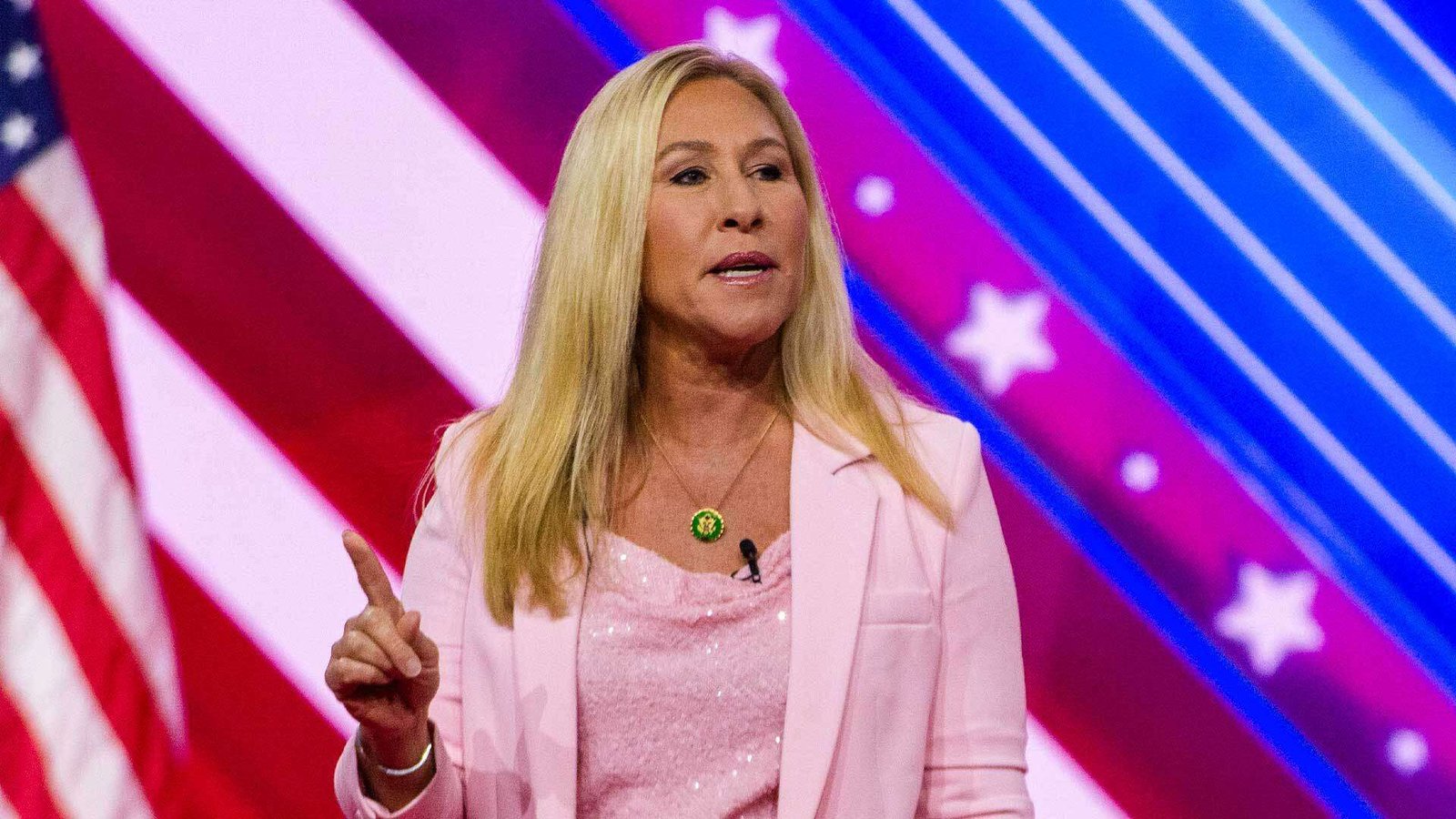
Pundits have offered elaborate explanations for the evolving views of Marjorie Taylor Greene, the Georgia Republican whose resignation from Congress takes effect today, but I don’t think you need a detailed theory to explain this woman’s journey from QAnon acolyte to MAGA exile. You just need to recognize one central fact about her: She actually believes things. Some of the things she’s believed are absurd, but that’s secondary. She has beliefs, and she’s willing—not always, but more often than the average D.C. pol—to put those beliefs ahead of other considerations.
You could already catch a hint of this during Greene’s original 2020 congressional campaign. Back then, she attracted national attention for her past interest in QAnon, a tapestry of conspiracy theories in which President Donald Trump was supposedly secretly working with special counsel Robert Mueller to defeat a cabal of elite satanic pedophiles who consume children’s blood. In those days, articles about Greene frequently linked her to another Q-friendly figure, the Colorado congressional candidate Lauren Boebert, who entered the House at the same time as Greene and eventually had a contentious falling out with her. (Greene was booted from the Freedom Caucus after she reportedly called Boebert a “little bitch.”) But even in 2020, anyone paying close attention could have seen an important difference between the two candidates. Greene had actually embraced the Q worldview (though she insisted that she had come to reject it). Boebert, asked about QAnon on the conspiracist show Steel Truth, had replied by saying she “hope[d] that this is real”—a statement delicately phrased to appeal to the Q-ish voting bloc without committing her to its worldview. Boebert was playing a cynical political game. Greene, for better or for worse, was a believer.
Not just a believer: a particular kind of believer. Most Americans don’t spend their lives soaking up the dogmas of the two big parties’ competing fan bases. To the extent that they pay attention to politics, they often adopt their views piecemeal, mixing opinions from the left and the right and, sometimes, from strange folks on the fringes. So you might be, say, an affluent woman in an Atlanta suburb, founder of a CrossFit gym, who rarely reads the op-ed pages of The New York Times or The Wall Street Journal but scrolls frequently through Facebook, absorbing rumors that the typical Times or Journal reader might regard as nuts. That was Greene, part normie and part weird—weird, in fact, because she was so normal.
The most infamous idea Greene expressed in her pre-congressional days came in 2018, when she wrote a Facebook post blaming that year’s California wildfires on space lasers controlled by the Rothschild banking family. The Rothschilds play a starring role in many antisemitic conspiracy theories, so when Greene’s post resurfaced in 2021, many people concluded the congresswoman was not merely loopy but an antisemite. Greene responded that she simply hadn’t known that the Rothschilds are Jewish. Maybe she really didn’t know, or maybe that was a lie. But if any congressperson could plausibly claim such naivete, it would be Greene. This wasn’t the Rothschild tale of someone who grew up surrounded by anti-Jewish folklore; it was the Rothschild tale of someone surrounded by folklore that had fallen out of its original context and floated like driftwood in a digital sea.
Sometimes someone with that sort of background comes to Washington, gets acclimated, and drops those early influences like a striver carefully eliminating every trace of his hometown’s accent. But Greene didn’t. She kept believing things, and that led to trouble with her party.
Even during Donald Trump’s first stint in the White House, you could see a simmering tension between two types of MAGA—the kind that was basically just pro-Trump, and a wilder, woolier bundle of Trump-era currents on the populist right. (One way to tell the difference: Check whether someone’s skepticism about the national security state disappears when the three-letter agencies pursue people not named Trump.) Greene was, along with Florida’s Matt Gaetz, the most notable Republican from the second group to have made it to Congress. Their views did not always track with the party line, particularly when it came to foreign policy. Greene once joined Democratic Rep. Rashida Tlaib, a self-described socialist from Michigan, in signing a letter asking the government to drop the prosecution of WikiLeaks founder Julian Assange, and she did it the very same week she joined a Republican push to censure Tlaib for some comments about Israel.
Despite those differences, the two MAGAs were largely united on the question of whether to support Donald Trump. But there was not, in principle, any reason why backbenchers making trouble for Republican congressional leaders wouldn’t someday start making trouble for a Republican president too, especially as Trump grew less popular. And in 2025, Greene—until then one of Trump’s most loyal soldiers—started directly criticizing the White House. Trump insisted that this was because he refused to get behind Greene’s ambition to leap from the House to the Senate, and I wouldn’t be surprised if that played a role in their split. But there was also that not-so-small matter of her beliefs. Both Greene and Trump had talked about being antiwar, for example, but she actually believed what she was saying, and so she was put off when she realized Trump was governing as a hawk. (This past weekend she denounced Trump’s Venezuela raid, calling it “what many in MAGA thought they voted to end.”) There were differences on economic policy too. And above all, there was the question of the Epstein files.
Remember: Greene used to believe that Trump was waging a secret war against elite pedophiles. Jeffrey Epstein, the moneyman who died while awaiting trial on charges of sex-trafficking minors, is widely seen—not merely by Q types but by mainstream reporters and politicians—as the man at the center of a ruling-class pedophile ring. So when Trump proved reluctant to release the full files on the Epstein case, Greene regarded it as a betrayal. “Epstein was everything,” she told The New York Times.
After that, things went south quickly. Trump called his critic “Marjorie ‘Traitor’ Greene.” Greene started bringing her criticisms of the president to such nonconservative spots as 60 Minutes, Real Time, and that hotbed of liberal feminism, The View. That last stop surprised some people, but many of Greene’s criticisms of Republican leaders have had a somewhat feminist hue. She’s a businesswoman born the year Free To Be…You and Me was released; she didn’t experience the pre-feminist era and has never shown any signs of wanting to restore it.
The conflict came to a head in November, when Greene announced her pending retirement from Congress in a statement full of anger at the highest echelons of the corporate state. “There is no ‘plan to save the world’ or insane 4D chess game being played,” she declared—a direct repudiation of the QAnon faith, which had instructed believers to trust Trump’s hidden plan.
Needless to say, the mere fact of having beliefs does not mean those beliefs are always good. Greene took several positions I liked. (I am always glad when Washington’s tiny antiwar faction gets more support.) Often she took positions I disliked. (She introduced, and the House recently passed, an anti-trans bill so extreme that it would criminalize—criminalize!—the provision of puberty blockers to transgender minors.) I doubt that many people, even among her most fervent fans, agreed with everything Greene said or did. She had the patchwork belief system of someone who thinks for herself. And if she didn’t always think those beliefs through as thoroughly as she should’ve, well, that just magnified the effect.
Greene claims she doesn’t have further political plans. And perhaps she doesn’t, at least for now. But she hasn’t stopped posting commentary—lately she’s been issuing libertarian-flavored calls for a tax strike—and she’ll surely seek ways to stay in the public eye. Maybe she’ll be running a podcast, or maybe she’ll be running for president. She doesn’t just have beliefs. She likes to give them a platform, and I doubt she’ll settle for heading back to Facebook.
Read the full article here
Fact Checker
Verify the accuracy of this article using AI-powered analysis and real-time sources.