

 Freedom Index
Listen to the article
Nazareth, December 3, 2025 — Foreign correspondents entering Gaza under Israeli military escort describe conditions that prevent independent reporting and reinforce longstanding Committee to Protect Journalist concerns: escorted visits are not meaningful access and cannot satisfy Israel’s obligations under international law to enable independent newsgathering.
Since the Israel-Gaza war began in October 2023, Israel has prevented journalists from outside Gaza entering independently, leaving Palestinians to document what human rights groups and UN experts agree is a genocide.
CPJ spoke to three journalists who were taken on escorted visits to Gaza since the October 2023 ceasefire. Their experiences show consistent patterns of restricted movement, curated interactions, pre-publication review, and staged visuals. Three other journalists that CPJ asked to comment on their experience of military-controlled trips declined, citing fear of retribution.
Noga Tarnopolsky: ‘It felt like theater’
Journalists describe their entry into Gaza as carefully staged, more performance than reporting.
France 24 correspondent Noga Tarnopolsky entered Gaza as part of a small delegation of foreign correspondents selected by the Israeli Defence Forces (IDF) Spokesperson’s Unit from a list of journalists submitted by the Foreign Press Association (FPA). She said the invitation came at the last minute, with no explicit instructions about protective gear, though colleagues warned her it was required.
To her, the visit was designed to portray danger and military professionalism, even as soldiers at the base were in T-shirts and appeared unconcerned.
At the meeting point near Nir Oz, Tarnopolsky told CPJ “journalists were shown two maps — one “on the record” and one “off the record” — neither of which provided useful information”. Tarnopolsky said the army’s “yellow line,” supposedly defining the reporting boundary, “does not actually exist” and seemed instead like a rhetorical tool to create the appearance of structure.
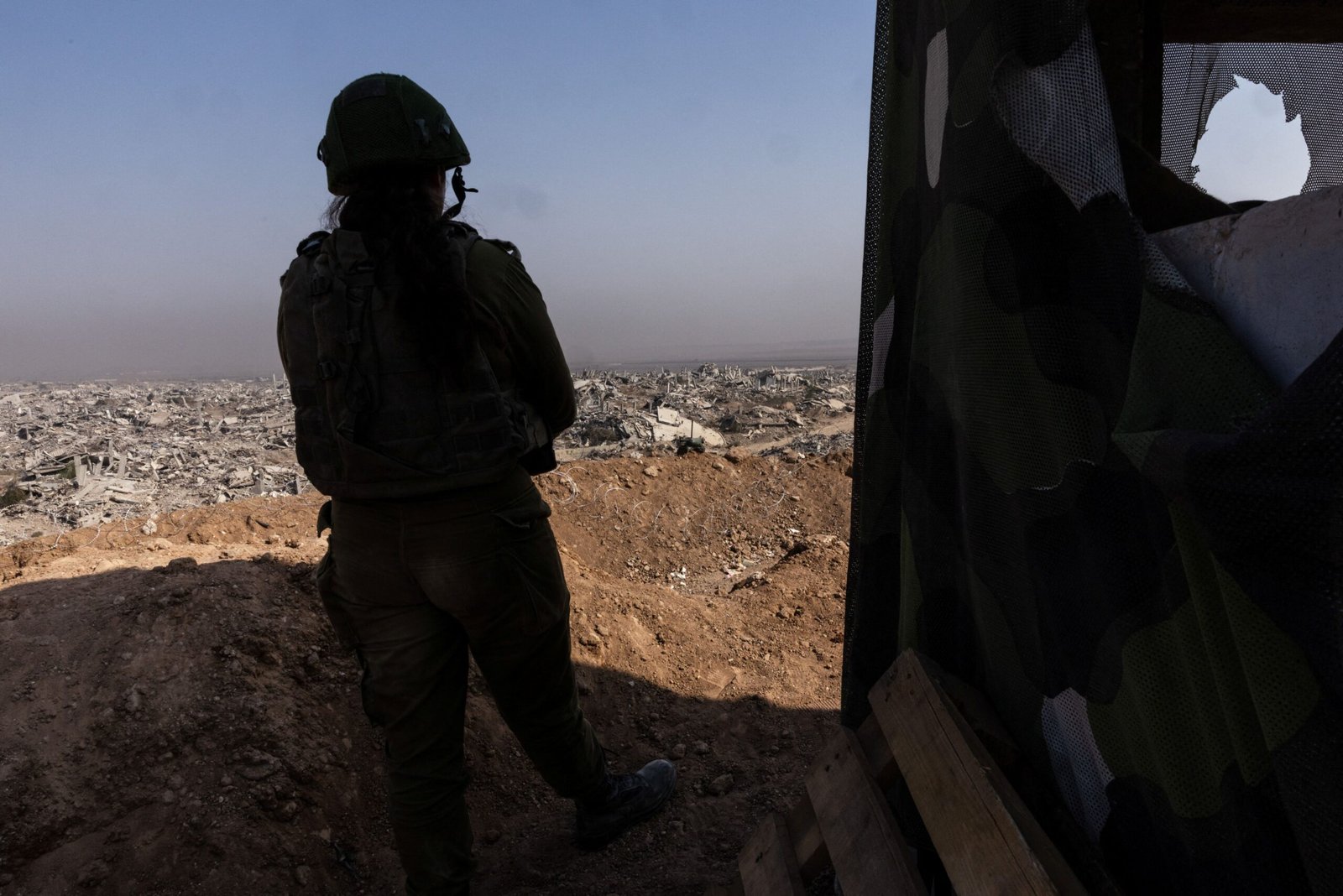
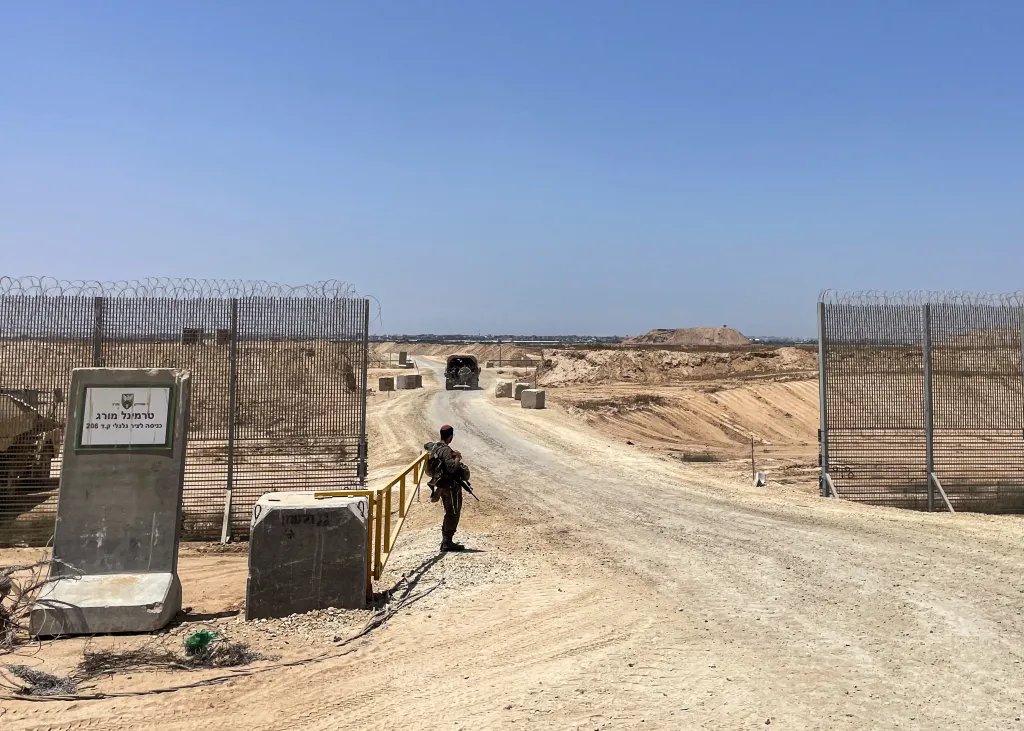
Tarnopolsky’s delegation was moved in “tarp-covered trucks to a small base inside Gaza established after the ceasefire”. From a sand dune, they viewed distant ruins of the Shuja’iyya neighborhood.
“Journalists could not move freely, approach civilians, or document independently. Each was permitted only a brief, controlled conversation with the army spokesperson,” she told CPJ.
“Everything was staged,” she said. “We didn’t see a single person, we couldn’t document anything. This was not journalistic work— it was theater.”
Tarnopolsky explained that the army did not inspect or review any of their materials, “simply because there were no materials to review.” She called her experience “a pantomime … not journalism — theater.”
Andrea Krogmann: ‘We didn’t speak to any Palestinian’
Freelance journalist Andrea Krogmann, who is based in the Middle East and contributes to several outlets including Germany’s Catholic News Agency (KNA), told CPJ that the military-escorted visits offered no meaningful reporting opportunities.
Journalists were confined entirely to army bases and were not permitted to meet any Palestinians. “We didn’t speak to any Palestinian,” she said. “We only spoke to the people the army approved — essentially the army spokesperson and two soldiers.”
Krogmann explained that all raw materials intended for publication — photographs or video — had to be shown to the army beforehand, as is standard when reporting from military facilities. Her content was approved quickly, with only a single request to blur a name on a road sign. She did not have to submit her written article to the censor. Still, she stressed that such procedures underscore the limits of escorted access: “This cannot replace an independent visit because the army decides where we go, when we go, and whom we speak to. One cannot freely speak to people.”
The tour lasted roughly 90 minutes, involved movement between bases, and never extended into civilian areas. Even soldiers struggled to identify the so-called yellow line.
Access criteria were inconsistent. Though 12 journalists were officially approved, about 20 ultimately joined after some outlets were allowed to bring photographers. Krogmann said the structure and choreography of the visit underscored why escorted tours “cannot replace independent reporting.”
Daniel Estrin: ‘Not a substitute for free reporting’
NPR correspondent Daniel Estrin echoed these concerns, calling it “a tightly controlled military tour… You see what the military wants you to see.” He told CPJ that the vantage point allowed him to observe “destruction stretching as far as the eye could see” in Shuja’iyya, but the experience “was not a substitute for free reporting.”
Estrin said the tour did not amount to PR on behalf of the army, but its restrictions justified joining the Supreme Court petition challenging the access ban. Raw footage had to be submitted for review to ensure no sensitive information was included.
Estrin and his colleagues published the constraints the military placed on reporters who participated in the visit, including Israel’s censorship laws and its ban on independent entry to Gaza.
While he observed some value in viewing destruction and infrastructure being rebuilt for the future, he stressed the limits. “We couldn’t meet Palestinians. We were only on the Israeli side of the yellow line.”
An IDF spokesperson declined to respond to CPJ’s question, via messaging app, as to how many international journalists it had escorted into Gaza since the war began or to comment on the journalists’ allegations that interviews were restricted to members of the IDF.
Two years of repeated warnings and efforts by CPJ to end the ban
CPJ has repeatedly urged Israel to lift its ban on unescorted media access, stressing that escorted visits are insufficient and that embedding can complement — but never replace — independent coverage.
In October 2025, CPJ filed an amicus brief before Israel’s Supreme Court supporting a petition by the Foreign Press Association. The brief argues that the ban violates Article 19 of the International Covenant on Civil and Political Rights, which protects the right to seek and impart information without interference.
The Israeli government has requested repeated extensions to respond to the petition, prolonging the absence of international journalists from Gaza. CPJ has urged the court to consider the significant public interest at stake and warned that continued delays risk entrenching a system of controlled access that deprives the global public of independent documentation.
The only way the international press has been able to enter has been through infrequent military escorts that last a few hours, on itineraries planned by the army. While the military presents these excursions as proof of access, journalists told CPJ these visits are confined to pre-selected areas, lack civilian contact, and prevent independent observation.
These experiences echo CPJ’s repeated warnings: restricted tours fail to satisfy internationally recognized standards for press freedom. They provide information curated by the army, not newsgathering opportunities. Journalists cannot verify claims, document civilian conditions, or conduct independent interviews, leaving coverage dependent on staged narratives.
With foreign journalists barred from Gaza, Palestinian reporters carry the burden of frontline coverage under difficult and life-threatening conditions. More than 200 Palestinian journalists and media workers have been killed in Gaza since the war began.
Read the full article here
Fact Checker
Verify the accuracy of this article using AI-powered analysis and real-time sources.