

 Freedom Index

Listen to the article
Paxos’ accidental minting of $300 trillion PYUSD on Wednesday, while undoubtedly concerning, serves as a case study as to why blockchain could shine in traditional banking.
On Wednesday, Paxos mistakenly minted $300 trillion worth of the PayPal USD (PYUSD) stablecoin, describing it as an “internal technical error.”
What’s important, however, is that the blockchain allowed its mistake to be quickly identified and corrected.
The incident took place on Oct. 15 at 7:12 pm UTC, and the entire amount was burned just 22 minutes later, as onlookers caught onto it almost immediately.
The same could not be said for the traditional banking sector.
“Mistakes happen in every financial system — the difference with blockchain is that they’re visible, traceable, and quickly correctable,” Kate Cooper, the CEO of OKX Australia, told Cointelegraph. “That transparency is a strength, not a flaw,” she added.
Cooper, who spent almost a decade as an executive at two of Australia’s biggest banks before pivoting to crypto, said the Paxos incident highlights how blockchain’s openness and transparency can transform financial oversight.
“As a former banker, I see this as proof that visibility builds trust. The same rails that expose an error can also strengthen governance and modernize how value moves through the financial system.”
A level of accountability “unheard of” in traditional banking
Ryne Saxe, the CEO of the crosschain stablecoin liquidity platform Eco, noted that blockchain offers a level of accountability rarely found in traditional finance.
“Perhaps an overlooked aspect of the inevitable onchain stablecoin economy is the benefit of transparency demanded from monetary issuers. This was an extreme case, but it’s still instructive,” Saxe told Cointelegraph.
“This level of transparency, and real time coordination, is unheard of in today’s central banking economy.”
Banks have a history of fat-finger transactions
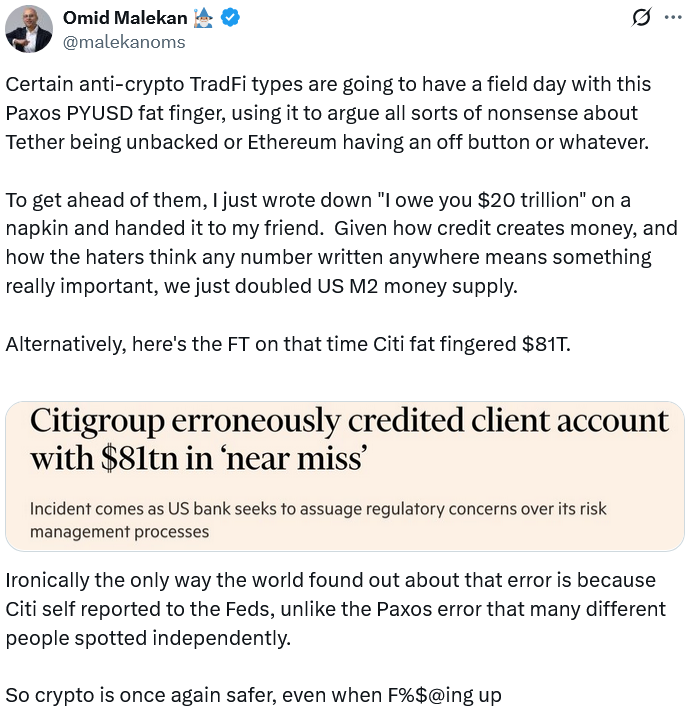
In April 2024, Citigroup accidentally credited $81 trillion to a client’s account instead of $281, taking hours to reverse the transaction. The media didn’t catch wind of it until nearly 10 months later.
In the same month, another Citigroup staffer nearly transferred $6 billion to a wealth client after pasting a customer account number into the payment amount box. It also took 10 months for the incident to be reported on.
In 2015, Deutsche Bank also mistakenly sent 28 billion euros ($32.66 billion) to one of its partners.
These incidents, of course, are only the ones that were made public.
Paxos incident still a “preventable mistake”
However, the incident shows that stablecoin companies need to tighten operational controls and risk management around token issuance, Fireblocks’ vice president of security and trust products, Shahar Madar, told Cointelegraph.
Related: Stablecoin market boom to $300B is ‘rocket fuel’ for crypto rally
“Minting $300 trillion is a preventable mistake. Stablecoin adoption is rising, and every issuer should make sure their security policies are properly set to govern the entire token lifecycle.”
“Mint, transfer and burn are highly sensitive operations, and there is no reason to settle for ‘soft’ enforcement of processes and manual checks,” Madar added.
Magazine: Review: The Devil Takes Bitcoin, a wild history of Mt. Gox and Silk Road
Read the full article here
Fact Checker
Verify the accuracy of this article using AI-powered analysis and real-time sources.