Close Menu
FSNN | Free Speech News NetworkFSNN | Free Speech News Network
  • Home
  • News
    • Politics
    • Legal & Courts
    • Tech & Big Tech
    • Campus & Education
    • Media & Culture
    • Global Free Speech
  • Opinions
    • Debates
  • Video/Live
  • Community
  • Freedom Index
  • About
    • Mission
    • Contact
    • Support
Trending

Brickbat: Rats and Roosters

35 minutes ago

Elon Musk company’s pre-IPO market has fallen 27% in three weeks

59 minutes ago

Chainalysis, South Korea Link Up on Crypto Crime

1 hour ago
Facebook X (Twitter) Instagram
Facebook X (Twitter) Discord Telegram
FSNN | Free Speech News NetworkFSNN | Free Speech News Network
Market Data Newsletter
Wednesday, June 10
  • Home
  • News
    • Politics
    • Legal & Courts
    • Tech & Big Tech
    • Campus & Education
    • Media & Culture
    • Global Free Speech
  • Opinions
    • Debates
  • Video/Live
  • Community
  • Freedom Index
  • About
    • Mission
    • Contact
    • Support
FSNN | Free Speech News NetworkFSNN | Free Speech News Network
Home»Cryptocurrency & Free Speech Finance»Understanding the “Black Friday” Market Crash
Cryptocurrency & Free Speech Finance

Understanding the “Black Friday” Market Crash

News RoomBy News Room8 months agoNo Comments4 Mins Read142 Views
Share Facebook Twitter Pinterest Copy Link LinkedIn Tumblr Email VKontakte Telegram
Understanding the “Black Friday” Market Crash
Share
Facebook Twitter Pinterest Email Copy Link

Listen to the article

0:00
0:00

Key Takeaways

Playback Speed

Select a Voice

The digital asset market faced its largest-ever liquidation cascade on October 10, now being referred to as crypto’s Black Friday. Within 24 hours, over $19 billion in leveraged positions were wiped out, marking the single biggest deleveraging event in the industry’s history.

The sell-off began late in the U.S. session after President Trump announced a proposed 100% tariff on Chinese imports, triggering global risk aversion across equities, commodities and crypto. The steepest declines occurred within a 25-minute window, as high leverage collided with thin liquidity. According to CoinDesk Reference Rates (CADLI), bitcoin fell to $106,560, ether to $3,551, and solana to $174, with smaller-cap tokens dropping more than 75% intraday.

Market dynamics & scale of deleveraging

According to CoinDesk Data, total perpetual futures open interest fell 43%, dropping from $217 billion on October 10 to $123 billion by October 11. The largest single-day contraction occurred on Hyperliquid, where open interest declined 57%, from $14 billion to $6 billion, as positions were forcefully unwound.

Source: CoinDesk Data

Data suggests that around $16 billion of the $19 billion total came from long liquidations, with nearly every trader carrying 2x leverage or higher with no stop-losses on altcoins being wiped out within minutes.

Public blockchains such as Hyperliquid provided a rare, transparent look into the sequence of forced liquidations, where the liquidation queue and execution can be verified on-chain. By contrast, centralised exchanges aggregate and batch liquidation data, meaning the true scale of forced unwinds may have even exceeded the widely reported $20 billion, since grouped reporting often understates notional values.
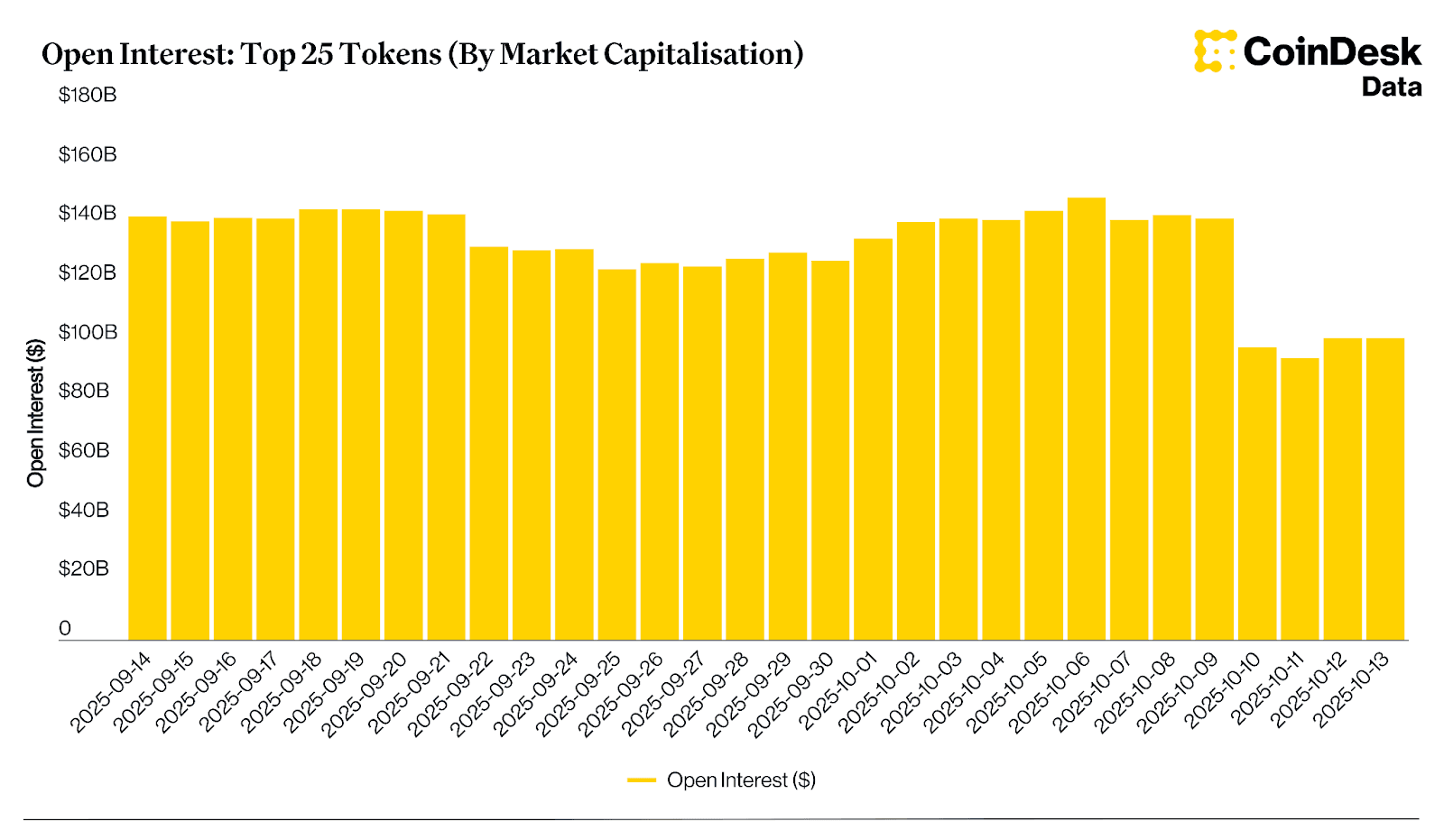
Open interest: Top 25 tokens chart

Source: CoinDesk Data

Structural stress & order book collapse

The episode underscored how tightly coupled liquidity, collateral and oracle systems have become. What began as a macro-driven unwind rapidly evolved into a market-wide stress event. As prices breached key liquidation levels, market depth collapsed by more than 80% across major exchanges within minutes.

In some instances, thin order books saw large-cap assets like ATOM temporarily print near-zero bids; a reflection not of fair market value but of market makers withdrawing liquidity as risk systems throttled activity. With collateral shared across assets and venues relying on local price feeds, feedback loops amplified volatility across the ecosystem. Even well-capitalised platforms proved vulnerable once liquidity evaporated across the board.

Fair-value pricing in volatility

When exchange-level pricing becomes erratic, CoinDesk Reference Rates such as CCIX and CADLI act as stabilising mechanisms. These multi-venue benchmarks aggregate prices from hundreds of sources, applying quality filters and outlier rejection to produce a global, consensus-based fair value.

During Black Friday’s volatility, reference rates revealed that market-wide valuations remained far less extreme than certain venue-specific prints suggested. This transparency allows market participants to distinguish between genuine repricing and localised dislocation, providing a neutral reference for post-trade performance assessment.

Reference rates don’t stop volatility, but they define it – ensuring traders, funds and exchanges have reliable data when the market breaks.

Closing thoughts

The severe dislocation in the market showed how leverage, liquidity and fragmented infrastructure can converge into a feedback loop that overwhelms even the largest trading venues. It also revealed the limits of transparency in a system where some on-chain exchanges, such as Hyperliquid, expose liquidation flows in real time, while centralised venues still operate as partial black boxes.

Crypto’s maturity will be defined by how it internalises these shocks. Better risk controls, unified collateral standards and real-time transparency will matter just as much as utilising pricing benchmarks. CoinDesk Reference Rates help confirm fair valuations when screens go red, but true resilience depends on exchange architecture, deeper order books, more robust oracle design and ultimately, exchange uptime.

The industry now faces a choice between treating this as a singular event, or as the blueprint for building a market that can absorb the next one.


Read the full article here

Fact Checker

Verify the accuracy of this article using AI-powered analysis and real-time sources.

Get Your Fact Check Report

Enter your email to receive detailed fact-checking analysis

5 free reports remaining

Continue with Full Access

You've used your 5 free reports. Sign up for unlimited access!

Already have an account? Sign in here

Share. Facebook Twitter Pinterest LinkedIn Tumblr Email Telegram Copy Link
News Room
  • Website
  • Facebook
  • X (Twitter)
  • Instagram
  • LinkedIn

The FSNN News Room is the voice of our in-house journalists, editors, and researchers. We deliver timely, unbiased reporting at the crossroads of finance, cryptocurrency, and global politics, providing clear, fact-driven analysis free from agendas.

Related Articles

Cryptocurrency & Free Speech Finance

Elon Musk company’s pre-IPO market has fallen 27% in three weeks

59 minutes ago
Cryptocurrency & Free Speech Finance

Chainalysis, South Korea Link Up on Crypto Crime

1 hour ago
Cryptocurrency & Free Speech Finance

What next for bitcoin as it faces headwinds from Fed rates to Claude’s Mythos

2 hours ago
Cryptocurrency & Free Speech Finance

Prediction Market Need Measured Approach to Insider Trading

2 hours ago
Cryptocurrency & Free Speech Finance

Ripple-linked token drops 4.5% to break another support level

3 hours ago
Cryptocurrency & Free Speech Finance

Crypto Users Wary as Anthropic’s Claude Mythos Goes Live

3 hours ago
Add A Comment

Comments are closed.

Editors Picks

Elon Musk company’s pre-IPO market has fallen 27% in three weeks

59 minutes ago

Chainalysis, South Korea Link Up on Crypto Crime

1 hour ago

Obligation to Cite-Check the Cases Cited by the Other Side and Report Errors to Court

2 hours ago

What next for bitcoin as it faces headwinds from Fed rates to Claude’s Mythos

2 hours ago
Latest Posts

Prediction Market Need Measured Approach to Insider Trading

2 hours ago

Israel Tests Iran

3 hours ago

Ripple-linked token drops 4.5% to break another support level

3 hours ago

Subscribe to News

Get the latest news and updates directly to your inbox.

At FSNN – Free Speech News Network, we deliver unfiltered reporting and in-depth analysis on the stories that matter most. From breaking headlines to global perspectives, our mission is to keep you informed, empowered, and connected.

FSNN.net is owned and operated by GlobalBoost Media
, an independent media organization dedicated to advancing transparency, free expression, and factual journalism across the digital landscape.

Facebook X (Twitter) Discord Telegram
Latest News

Brickbat: Rats and Roosters

35 minutes ago

Elon Musk company’s pre-IPO market has fallen 27% in three weeks

59 minutes ago

Chainalysis, South Korea Link Up on Crypto Crime

1 hour ago

Subscribe to Updates

Get the latest news and updates directly to your inbox.

© 2026 GlobalBoost Media. All Rights Reserved.
  • Privacy Policy
  • Terms of Service
  • Our Authors
  • Contact

Type above and press Enter to search. Press Esc to cancel.

🍪

Cookies

We and our selected partners wish to use cookies to collect information about you for functional purposes and statistical marketing. You may not give us your consent for certain purposes by selecting an option and you can withdraw your consent at any time via the cookie icon.

Cookie Preferences

Manage Cookies

Cookies are small text that can be used by websites to make the user experience more efficient. The law states that we may store cookies on your device if they are strictly necessary for the operation of this site. For all other types of cookies, we need your permission. This site uses various types of cookies. Some cookies are placed by third party services that appear on our pages.

Your permission applies to the following domains:

  • https://fsnn.net
Necessary
Necessary cookies help make a website usable by enabling basic functions like page navigation and access to secure areas of the website. The website cannot function properly without these cookies.
Statistic
Statistic cookies help website owners to understand how visitors interact with websites by collecting and reporting information anonymously.
Preferences
Preference cookies enable a website to remember information that changes the way the website behaves or looks, like your preferred language or the region that you are in.
Marketing
Marketing cookies are used to track visitors across websites. The intention is to display ads that are relevant and engaging for the individual user and thereby more valuable for publishers and third party advertisers.