

 Freedom Index
Listen to the article
Today’s New York Times reports that some federal judges are unhappy with the Supreme Court’s repeated grant of interim relief to the Trump Administration in cases challenging Administration actions.
More than three dozen federal judges have told The New York Times that the Supreme Court’s flurry of brief, opaque emergency orders in cases related to the Trump administration have left them confused about how to proceed in those matters and are hurting the judiciary’s image with the public. . . .
The striking and highly unusual critique of the nation’s highest court from lower court judges reveals the degree to which litigation over Mr. Trump’s agenda has created strains in the federal judicial system.
The story is based upon the Times‘ selective survey of federal judges. Here’s how the Times summarizes its results.
Sixty-five judges responded to a Times questionnaire sent to hundreds of federal judges across the country. Of those, 47 said the Supreme Court had been mishandling its emergency docket since Mr. Trump returned to office. . . .
In interviews, federal judges called the Supreme Court’s emergency orders “mystical,” “overly blunt,” “incredibly demoralizing and troubling” and “a slap in the face to the district courts.” One judge compared their district’s current relationship with the Supreme Court to “a war zone.” Another said the courts were in the midst of a “judicial crisis.” . . .
Forty-two judges went so far as to say that the Supreme Court’s emergency orders had caused “some” or “major” harm to the public’s perception of the judiciary. Among those who responded to the question, nearly half of the Republican-nominated judges said they believed the orders had harmed the judiciary’s standing in the public eye.
Twelve judges who responded to the questionnaire said they believed the Supreme Court had handled its emergency docket appropriately. But only two said public perception of judges had improved as a result of how the Supreme Court had handled its recent work.
The Times presents its analysis as “the most comprehensive picture to date about the extraordinary tensions within the judiciary.” But is it really all that comprehensive? According to the story, the Times “reached out to more than 400 judges, including every judge in districts that have handled at least one legal challenge to a major piece of Mr. Trump’s agenda.” In other words, the Times did not seek out a random or representative sample of federal judges, but instead solicited a sample weighted toward those judges most likely to disagree with the Supreme Court.
As I have noted in prior posts (and this essay for The Dispatch), suits challenging Trump Administration initiatives are not randomly distributed among the nation’s judicial districts. Rather they heave been concentrated in those districts plaintiffs expect to be most sympathetic to their claims. So by ensuring that every judge in such districts is included in its survey, the Times over-sampled those judges most likely to disagree with the Court’s handling of the Trump Administration’s requests for interim relief. After all, judges tend to think that their decisions were correct.
Even with the over-sampling, the Times only obtained sixty-five responses, and we have little information about the extent to which those judges are representative of those surveyed, let alone of the federal judiciary as a whole (especially if, as the story suggests at one point, that some of those surveyed are senior judges). The Times provides a breakdown of the number of responding judges appointed by Democratic and Republican presidents (and President Trump in particular).
Of the judges who responded, 28 were nominated by Republican presidents, including 10 by Mr. Trump; 37 were nominated by Democrats. While those nominated by Democrats were more critical of the Supreme Court, judges nominated by presidents of both parties expressed concerns.
This is interesting, but it only tells us so much.
Given the norms that have long prevailed with district court appointments (including the observance of blue slips), the party of the appointing president tells us far less about a district court judge than it does about appellate judges. Such norms may be breaking down, but until recently it was rare for a district court judge to get appointed without the support (or at least the acquiescence) of home state senators, and political deals were common. As a result, the political affiliation of a state’s Senate delegation has long been a better indicator of a district court judge’s likely judicial ideology than the party of the appointing president.
While the story quotes a handful of judges that were willing to provide comments to the Times reporters, the allegedly “comprehensive” picture comes from the responses to the Times‘ brief survey–survey responses that might be improper under the canons of judicial ethics. As the Times notes:
The judges responded to the questionnaire and spoke in interviews on the condition of anonymity so they could share their views candidly, as lower court judges are governed by a complex set of rules that include limitations on their public statements. . . .
The code of conduct for federal judges requires them to act in ways that promote “public confidence in the integrity and impartiality of the judiciary.” They seldom comment on public controversies and almost never share their views of Supreme Court jurisprudence, outside of the carefully chosen words of their written opinions.
Given the potential ethical concerns with speaking to the press about these questions, it may also be the case that those judges most likely to respond to the survey are also those most unhappy with or critical of the Supreme Court. If so, this would be another reason to doubt whether the sentiments the Times reports are remotely representative.
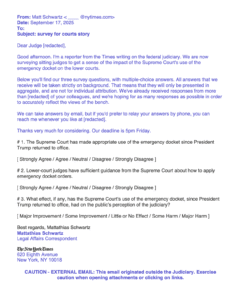
Finally, one may wonder whether the Times survey was designed to elicit particularly substantive or nuanced information. I have a copy of what the Times emailed at least some of the respondents. [Screenshot below.] Here are the questions asked:
- The Supreme Court has made appropriate use of the emergency docket since President Trump returned to office.
[Strongly Agree / Agree / Neutral / Disagree / Strongly Disagree]- Lower-court judges have sufficient guidance from the Supreme Court about how to apply emergency docket orders.
[Strongly Agree / Agree / Neutral / Disagree / Strongly Disagree]- What effect, if any, has the Supreme Court’s use of the emergency docket, since President Trump returned to office, had on the public’s perception of the judiciary?
[Major improvement / Some improvement / Little or No Effect / Some Harm / Major Harm]
The Times story ends with comments that appear to be from an interview with J. Harvie Wilkinson of the U.S. Court of Appeals for the Fourth Circuit.
A few judges were more equivocal about emergency orders, views that were echoed by Judge J. Harvie Wilkinson III of the U.S. Court of Appeals for the Fourth Circuit, a widely respected jurist and Reagan nominee who wrote a robust defense of the role that district courts play in the constitutional scheme. In an interview, Judge Wilkinson noted that the Supreme Court was largely at the mercy of circumstances beyond its control: a high volume of emergency challenges to a presidency that “would put its foot on the pedal, because it has an agenda, and it’s sensitive to the fact that electoral mandates are perishable.”
While noting that the emergency docket had its advantages in terms of quickly and uniformly managing a mushrooming caseload from the executive branch, Judge Wilkinson said there were good arguments for the Supreme Court to be careful about using it too much.
“You don’t want too many snap judgments and emergency orders creating a public impression of either secretiveness or arbitrariness,” he said.
Screenshot of NYT inquiry to a federal judge:
Read the full article here
Fact Checker
Verify the accuracy of this article using AI-powered analysis and real-time sources.