

 Freedom Index
Listen to the article
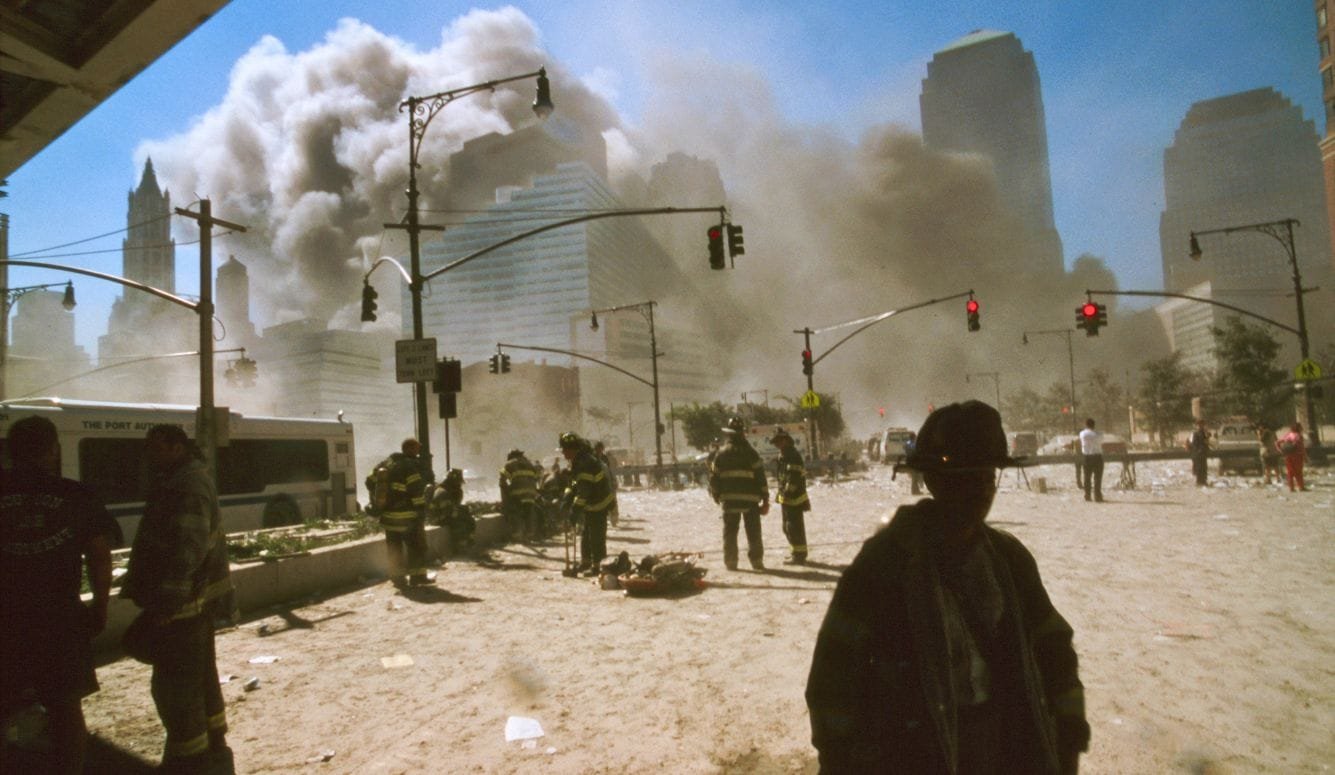
It was nearly ten years ago that a bright September day was darkened by the worst attack on the American people in our history. The images of 9/11 are seared into our national memory—hijacked planes cutting through a cloudless September sky; the Twin Towers collapsing to the ground; black smoke billowing up from the Pentagon; the wreckage of Flight 93 in Shanksville, Pennsylvania, where the actions of heroic citizens saved even more heartbreak and destruction. And yet we know that the worst images are those that were unseen to the world. The empty seat at the dinner table. Children who were forced to grow up without their mother or their father. Parents who would never know the feeling of their child’s embrace. Nearly 3,000 citizens taken from us, leaving a gaping hole in our hearts.
~President Barack Obama, 1 May 2011
The manifold ways in which they [the victims of 9/11] attached to life testified to the Quranic injunction that the taking of a single life destroys a universe. Al-Qaeda had aimed its attacks at America, but it struck all of humanity.
~Lawrence Wright, The Looming Tower
On 11 September 2001, I was in a school that no longer exists. Mrs Murphy’s fourth-grade class was located on the top floor of my hometown’s elementary school, in a building that was razed and rebuilt several years after I left. I was ten years old. The world I inhabited when I went to school that morning? I never saw it again. What does a ten-year-old know about terrorism inside the US on the scale of the 9/11 attacks? Americans and the world were transfixed by the apocalyptic images from New York City—helpless passengers perishing in a wicked collision of flames and charred wreckage, pillars of smoke, thick clouds of soot swallowing entire streets as people scampered away in terror.
Young Americans like me lived in a world premised on American supremacy and its geographic insulation from physical threats. The terrorist attacks that occurred in Jerusalem, London, Paris, Belfast, Athens, and Rome had never penetrated the American shield before. In the opening years of the 21st century, the Western world was still basking in the post-Cold War euphoria of unfettered globalisation—borderless travel, free trade, and the assumption that inter-state conflict had finally been rendered obsolete by the unstoppable march of liberalism, capitalism, and democratisation. Those illusions and the idealistic dreams of a world freed from the Hobbesian forces of history were shattered on 11 September. The living memory of a Cold War stalemate produced by the fear of mutually assured nuclear destruction gave way to newer fears of stateless jihadi terrorism, fuelled by digital propagandising. The enemy in the new century was at once more intimate and apparently omnipresent.
The 9/11 atrocities produced profound and instantaneous security changes in the form of enhanced airport screenings and an expansion of state surveillance powers. Fear became a rational motivator for previously unthinkable actions—fear, reinforced by alarmist reporting, of further attacks in other American cities by bad actors, possibly equipped with chemical weaponry or something called a “dirty bomb.” President George W. Bush stood on the smouldering ruins of the World Trade Center in New York, bullhorn in hand, surrounded by valorous first responders and fatigued searchers, and assured us that “the people who knocked these buildings down will hear all of us soon!”
Once satisfied that the homeland was safe from direct harm, Americans formerly ignorant about the geographic specifics of the outside world had their attention refocused on nefarious individuals and organisations in a distant Middle East rife with maddening religious and ethnic complexities. As the United States and its allies advanced through Afghanistan in late 2001, al-Qaeda splintered and its remnants scattered throughout the ungoverned tribal zones in the murky border regions between Afghanistan and Pakistan.
The Bush administration then diverted resources and personnel into Saddam Hussein’s sadistic Ba’athist dictatorship in Iraq in the spring of 2003, where the Jordanian militant Abu Musab al-Zarqawi would soon establish an early affiliate branch of al-Qaeda in a bloodthirsty effort to ignite a zero-sum civil war. The brief interval between the removal of the dictator and the bloodshed that followed produced a cathartic reclamation of power for the American spirit crushed by 9/11. In a moment of hubris, the US president swaggered onto an aircraft carrier to declare victory in front of a triumphant banner that announced “Mission Accomplished.”
The Report: CIA Torture Methods Under the Microscope — Review
Scott Z. Burns’s political thriller ‘The Report’ is a careful examination of the CIA’s interrogation methods.
Inside the United States, Americans watched shows like 24 and came to terms with the idea that they were now living in a morally opaque world of warrantless technological intrusions, abused civil liberties, detention without charge, enhanced interrogation techniques, extraordinary rendition, expanded covert intel warfare, fanaticism and radicalisation, imperfect assimilation, and ugly quarrels about ends and means. They debated the enlargement of state bureaucracy and power, and the nature of truth and representation as Iraq slid into an anarchic quagmire. And as the news from over there worsened, anti-American and isolationist demagogues masquerading as “anti-war” peaceniks were empowered to denounce American military intervention abroad—one of the few topics that managed to unite Barack Obama’s “nation-building at home” and Donald Trump’s “America First”—and American involvement in the wider world more generally.
To the chagrin of some of its inhabitants, the Middle East is usually synonymous with radicalism and instability. The aftermath of 11 September did nothing to dispel this impression in the West. Uprooting Saddam’s regime and the misshapen efforts to institute a democratic governing structure in post-Ba’athist Iraq upset the regional order in so many predictable and unpredictable ways that the cascading effects are still unfolding today. The US is now mired in a hot war with the Islamic Republic of Iran, a nation that benefitted from Saddam’s ouster and then spread its tentacular influence across the region, creating mayhem with its murderous clients and proxies.
Although a broad bipartisan consensus prevails in the United States that the Iraq War was a disgrace and a disaster, Americans have generally lost interest in events there since the withdrawal of US troops in December 2011. But the current state of the country ought to inform judgements of the war to liberate it. Twenty-three years ago, Saddam Hussein and his psychotic mafia dynasty ruled a traumatised and terrified nation, in which even the most marginal infractions were punishable by death. Iraq today has no shortage of imperfections, but it enjoys consistently scheduled elections that peacefully move figures and coalitions in and out of power. In 2025, Iraqi confidence in their government rose to 54 percent, compared to 26 percent just three years prior. In the same period, Iraqis who felt that their country was moving in the right direction rose from 18 percent to 53 percent.
Mentions of 9/11 have also become rare in modern political discourse—the event now feels too remote to be of immediate causal importance. But that day was a horrific meteor that reordered American politics and the direction of world history in the new century. Americans born after 11 September may not appreciate its importance since they have only ever known the world that followed. The further that terrible day recedes, the more normal the world it created becomes, until the new reality is all that anyone remembers or believes was possible.
In 2001, I was a small boy in the American Midwest, clueless about anything beyond my limited environment, suddenly and roughly awakened to the violence of the wider world and its dangers. Inarticulate and incomplete thoughts drifted through my ten-year-old mind as I lay on my family’s living room couch, numbed by the footage of the smoking Twin Towers plummeting to earth and obliterating everyone and everything underneath. How much of the American story will continue to be determined by a sunny day in September that began like any other and ended with the disappearance of the world as we knew it?
Quillette invites thoughtful responses to its essays.
Selected responses are published once per week as part of a curated Letters to the Editor feature. If selected, letters appear under the contributor’s real name and may be edited for clarity and length.
To submit a letter for consideration, please email [email protected].
Read the full article here
Fact Checker
Verify the accuracy of this article using AI-powered analysis and real-time sources.