

 Freedom Index
Listen to the article
When staff at the Logan Correctional Center learned a prison counselor may have been repeatedly sexually assaulting a female inmate, they did the sane and humane thing and immediately removed her from his reach while opening an investigation into the alleged assailant.
Just kidding. What they really did was decide to use the inmate as rape “bait.”
The idea was that when the counselor tried again, a prison investigator would jump down from a hiding space in the ceiling to stop the attack.
You are reading Sex & Tech, from Elizabeth Nolan Brown. Get more of Elizabeth’s sex, tech, bodily autonomy, law, and online culture coverage.
The plan didn’t work. The inmate was assaulted again.
And she has since sued, alleging cruel and unusual punishment.
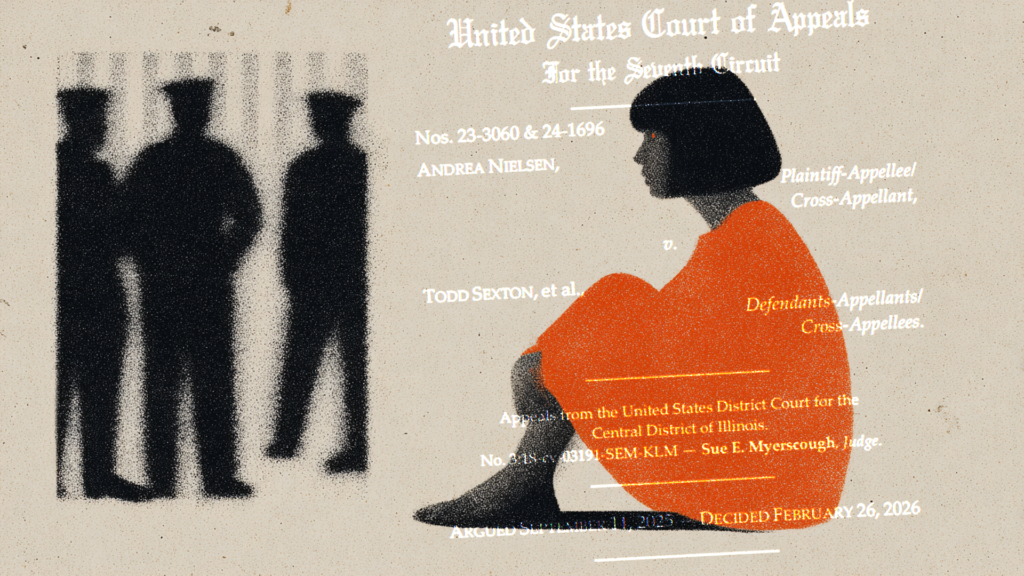
The case came before the U.S. Court of Appeals for the 7th Circuit last fall, on appeal from the U.S. District Court for the Central District of Illinois.
Prison counselor Richard MacLeod “repeatedly sexually assaulted” Andrea Nielsen while she was imprisoned at Illinois’ Logan Correctional Center, writes Judge David Hamilton in the appeals court’s February 26 opinion. But rather than “protecting Nielsen from further assaults” when her cellmate reported the abuse to prison investigator Todd Sexton and Warden Margaret Burke, the pair “formulated an outrageous plan to use her as unwitting ‘bait’ to try to catch MacLeod in the act.”
“The plan was for Sexton to stay late a few times, crawl around in the ceiling above the room MacLeod used to sexually assault Nielsen, and wait to jump down and intervene,” notes Hamilton. “The plan failed, and MacLeod assaulted her again.”
Nielsen went on to file a civil lawsuit against Burke, Sexton, and MacLeod. A jury found all three liable and ordered them to pay Nielsen $19.3 million in compensatory and punitive damages.
Two of the defendants—Burke and Sexton—subsequently appealed.
A three-judge panel from the 7th Circuit affirmed the lower court’s decision to deny them qualified immunity and to deny their motion that there was insufficient evidence for a guilty finding. “No reasonable official could have thought it proper to act as they did,” states the opinion.
But the appeals court also partially reversed the lower court’s ruling and ordered a new trial on damages—but not liability—for Sexton and Burke, citing “erroneous exclusion of evidence” at trial among other things. So, they’re still guilty, but a new trial will be necessary to determine how much money they’re on the hook for.
According to Nielsen’s trial testimony, “sexual abuse ran rampant” at the correctional center.
“The data agree with her,” writes Hamilton in the appeals court’s decision. “Reported rates of sexual abuse at Logan were the highest in the state among women’s prisons and the second highest among all Illinois prisons. Several staff members, not just MacLeod, were caught sexually abusing inmates around the time of the events of this case.”
MacLeod was Nielsen’s counselor—a position which put him in control of facilitating her calls with her 6-year-old daughter. The sexual assaults would take place when she went to his office to make these calls, according to Nielsen.
“MacLeod would summon Nielsen to his office for her phone calls with her daughter and subject her to vaginal and oral sex” while refusing to wear a condom, the appeals court opinion says.
MacLeod’s office was in what was known as the vocational building, which Burke would describe at trial as a security camera “blind spot.” Sexton described it as a “potential hot spot” for abuse.
Nielsen told the jury she felt scared to say no to MacLeod or tell anyone about his actions because he had “power over” her and she felt like she didn’t “really have a choice.” She said MacLeod threatened her with loss of phone call and letter privileges, loss of work and commissary privileges, and a segregated cell if she reported what was happening.
So she didn’t report it. But she did tell her cellmate, identified by the court only as Hicks.
Hicks reported Nielsen’s allegations to Sexton, who found the claims credible, per his trial testimony. “MacLeod had the means, motive, and the opportunity to [sexually] abuse” Nielsen repeatedly, Sexton said.
But Sexton also told the court—when the jury wasn’t present—that Hicks told him Nielsen had said “I have to get freshened up for my man” while showering and that he had taken this as evidence Nielsen may have been a “willing” participant in a sexual relationship. The trial court excluded the freshen-up comment from evidence.
Whatever Sexton thought of the comment, it shouldn’t have mattered. Even if it was said, it doesn’t necessarily imply that Nielsen was “willing.” And even if she was willing, it doesn’t mean MacLeod’s actions were OK. It’s still a crime for prison staff to have sex with inmates even if they technically consent.
In any event, Sexton passed the information from Hicks on to the warden, Burke, and said at trial that he told Burke it “could easily happen again.” Burke said at trial that she believed there could be “validity to the allegations.”
Typically this would mean “immediate protection” for the person alleging assault, said Sexton at trial. But they did not remove Nielsen from the facility or put a stop to her unsupervised meetings with MacLeod. Instead, they concocted another plan of action.
After talking to Hicks, Sexton interviewed Nielsen in a vague way two weeks later, asking her if she had any problems with staff. She declined.
That’s when he came up with Plan B: to use Nielsen as “bait” to catch MacLeod in the act. He would “crawl around in the ceiling and see if [he] could peek through the vents to catch [MacLeod] in the act” of assaulting Nielsen, he said.
And that’s what he did—without telling Nielsen about what was going on. Burke approved the plan. After hiding in the ceiling once, he switched to “stakeouts” from outside MacLeod’s office, doing these twice.
Of course, this plan “relied on MacLeod attempting to sexually assault Nielsen again, and doing so on Sexton’s schedule,” notes the appeals court. (Can’t you almost hear the judges’ exasperation?) “The plan did not work, in any case. Sexton had given up the effort by February, when MacLeod sexually assaulted Nielsen again.”
Nielsen was eventually able to convince staff to transfer her to another counselor.
But it wasn’t until months later, when another correctional officer reported MacLeod for sexual harassment, that Sexton specifically questioned Nielsen about MacLeod. This time, she told him her story. And, this time, Sexton had Nielsen transferred to another prison right away.
Not long thereafter, Sexton emailed a former colleague: “Yeah I will have to tell you about the inmate I just took to Decatur Friday dealing with a certain counselor haha it’s a good one.”
Sexton did refer Nielsen’s allegations for criminal investigation. But no criminal charges were ever brought against MacLeod.
Nielsen filed her lawsuit in federal civil court in 2018. MacLeod defaulted, meaning he did not respond to the suit. Legally, a default counts as admitting to whatever facts are alleged in a claim.
“The jury heard a series of factual stipulations as to MacLeod (since he had defaulted), including, essentially, that MacLeod had sexually assaulted Nielsen in the manner she described,” notes Hamilton in the appeals court decision.
The jury awarded her $10 million in punitive damages against MacLeod, along with $800,000 in punitive damages against Sexton, $500,000 in punitive damages against Burke, $8 million in compensatory damages, and $2 million in attorney fees.
The appeals court concluded “that the evidence supported the verdict under Nielsen’s specific theory of liability” but not her theory that the general conditions at the correctional facility were conducive to abuse and that Sexton and Burke were indifferent to them.
It also concluded “that the district court erred by excluding evidence of the ‘freshen up’ comment,” the exclusion of which may have been “prejudicial” when it comes to punitive damages. This forms part of the basis for the court’s decision regarding another trial.
It seems a shame that Nielsen will now have to go through another trial to determine punitive damages against Sexton and Burke. But it’s heartening, at least, to see the court so heartily reject their qualified immunity claim.
While “Sexton and Burke no longer contend that Nielsen might actually have consented to sex with MacLeod,” thinking so at the time could help explain their actions and may be relevant for determining the amount of damages to be awarded, the court wrote. However, “Sexton and Burke’s actions would have been unreasonable as a matter of law even if they thought that Nielsen was a willing participant in MacLeod’s sexual abuse,” writes Hamilton. “Using a prison inmate as unwitting bait to catch a staff member in the act of sexually abusing her is obviously an outrageous response. No reasonable prison official could have considered it acceptable.”
AI-generated art can’t be copyrighted? That’s what The Verge claimed on Monday. “The US Supreme Court has declined to hear a case over whether AI-generated art can obtain a copyright,” it said. That leaves in place an earlier decision in Thaler v. Perlmutter, a case decided by the U.S. Court of Appeals for the District of Columbia last year.
But that case didn’t rule out the possibility of copyright for all art generated with the aid of artificial intelligence. In Thaler, the man registering for the copyright—computer scientist Stephen Thaler—explicitly said that his AI system created the artwork independently and listed the AI as the sole author on his copyright application.
“The Copyright Office denied Dr. Thaler’s application based on its established human-authorship requirement,” stated the appeals court in its opinion. “This policy requires work to be authored in the first instance by a human being to be eligible for copyright registration.”
The court declined to say otherwise for the same reason: “The Copyright Act requires all work to be authored in the first instance by a human being,” and Thaler’s copyright registration application listed the AI assistant as the work’s sole author.
But this does not necessarily mean that anyone trying to get copyright protection for a piece created with AI tools will fail.
“The best summary of the law today is: You can copyright AI-generated content if you used it as a tool for your own expression, not as a stand-in for human expressive decision-making,” lawyer Mike Wavsz suggested on X. “Stop thinking ‘was this made by AI or not’ but instead think in terms of control versus expression. Who determined the expressive elements embodied in the final work? You, or the robot? Under current guidance from the Copyright Office, the former is protected the latter is not.”
the Thaler case is odd because Thaler insisted that his AI agent, and not him, created the art. He tried to argue the whole “human authorship” requirement was unconstitutional, and in the alternative, that his agent was his employee so “work for hire” doctrine applied.
Nope.
— mike wavsz (@horsewater) March 3, 2026
Liberalism means companies—including AI companies like Anthropic—can say no to the government, writes Jersualem Demsas at The Argument. This should not be a controversial statement—and yet, weirdly, it is, as Demsas points out:
Of all the small-l liberal principles, freedom of enterprise probably has the fewest modern defenders. We’re in a populist moment, so growing factions on both the left and right are dispositionally hostile to corporations and seek to subdue them. Corporations can be quite powerful, so the incentive to control them is strong.
While corporations aren’t people, they are made up of people. And when I talk about the freedom of enterprise, I’m talking about individual people’s rights to spend their time how they want, to create new goods for sale, to provide services they think will be valuable as well as the rights of other individuals to buy things they want that they think will make them happy. Liberals have let their distrust of corporations erode their commitment to free enterprise, leaving them without the conceptual scaffolding to resist government overreach like what the Trump administration is doing to Anthropic.
(More on what it’s doing here.)
Liberals have defended Anthropic because they agree with its restrictions on mass surveillance and autonomous weapons, notes Demsas. But she suggests they should defend the ability of corporations to say no even when they don’t agree with the reasons for that no:
The question isn’t whether you agree with these red lines, it’s whether companies get to have red lines at all.
Liberals who cannot make that principled argument are left only with the hope that officials who agree with them will get to decide on which red lines are respected.
How’s that working out so far?
For more good insight on the Anthropic situation, see this interview with Dean Ball.
1908: the Lancet, one of the most respected scientific journals, calls for 18 age limit on reading in bed amidst a moral panic surrounding children becoming “addicted” to novels, which were “designed to keep kids hooked” and destroy their attention/mental health
— Taylor Lorenz (@taylorlorenz.bsky.social) 2026-03-03T17:13:17.922Z
• Occupational licensing comes for chatbots: A New York bill would ban chatbots from giving legal or medical advice or providing any information that “if taken by a natural person” would amount to unauthorized practice of a licensed profession.
• California’s SAFE BOTS act is odd, pointless, and privacy invasive. Law processor Jess Miers shares more details in this Bluesky thread.
• Academics from 29 countries say age-verification schemes are “dangerous and socially unacceptable.”
Read the full article here
Fact Checker
Verify the accuracy of this article using AI-powered analysis and real-time sources.