

 Freedom Index
Listen to the article
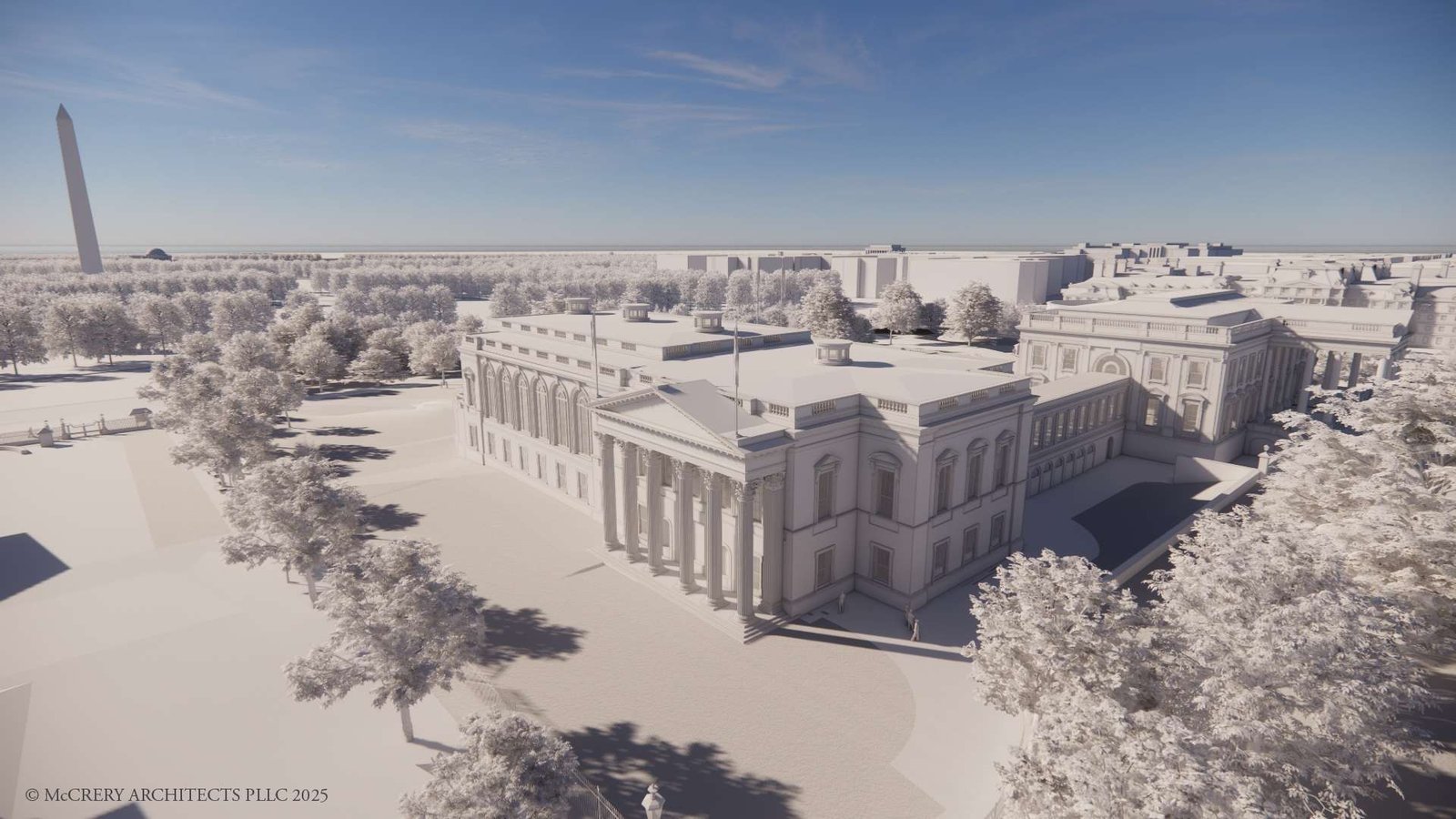
Since President Donald Trump announced his plan to replace the East Wing of the White House with an enormous ballroom last July, critics have raised several architectural objections. Among other things, they have complained about the asymmetry of the design, which would result in a lopsided White House dominated by the new structure; obstruction of the symbolic line of sight between the Capitol and the president’s residence; and the original design of the outsized portico, which featured a staircase to nowhere and 24 view-blocking columns. Last week, a federal judge added a legal wrinkle to these aesthetic concerns, saying the project cannot proceed without congressional authorization.
That decision, which the Justice Department asked a federal appeals court to block in an emergency motion filed late on Friday, reflects Trump’s tendency to do whatever he wants, regardless of what the law says. “The President of the United States is the steward of the White House for future generations of First Families,” U.S. District Judge Richard J. Leon writes in the 35-page opinion explaining his decision to issue the preliminary injunction that the National Trust for Historic Preservation sought in a lawsuit it filed last December. “He is not, however, the owner!”
Although Trump “claims that Congress has given him authority in existing statutes to construct his East Wing ballroom project and to do it with private funds,” Leon says, “I have concluded that the National Trust is likely to succeed on the merits because no statute comes close to giving the President the authority he claims to have.” Leon therefore concludes that “the ballroom construction project must stop until Congress authorizes its completion.”
The Constitution “vests Congress with complete authority over public lands,” Leon notes. It also “gives Congress legislative authority over the District of Columbia” and the appropriation of federal funds. Those provisions “establish Congress’s primacy over federal property, spending, and the District of Columbia,” Leon writes, and the defendants “have declined to argue that they have any inherent constitutional authority to build the ballroom.” That authority therefore must be based on legislation enacted by Congress.
The Trump administration relies mainly on 3 USC 105(d)(1), which authorizes the president to use appropriated money for “the care, maintenance, repair, alteration, refurnishing, improvement, air-conditioning, heating, and lighting (including electric power and fixtures) of the Executive Residence at the White House.” Does the ballroom project, which entails demolishing the East Wing and replacing it with a structure that would be 60 percent larger than the White House residence in square footage and more than three times as large in cubic volume, fit that description?
Leon thinks not. “Section 105(d)(1) plainly authorizes the President to conduct ordinary maintenance and upkeep of the White House, and nothing more!” he writes. “The list of authorized actions—which includes words like ‘care, maintenance, repair’ and ‘air-conditioning, heating, and lighting’—bring to mind things like replacing the lightbulbs, fixing broken furniture, and changing the wallpaper, not wholesale demolition of entire buildings and construction of new ones.”
The government’s lawyers argued that the terms “alteration” and “improvement” are “capacious” enough to encompass the president’s plan. “A brazen interpretation, indeed!” Leon writes. “Those two words cannot bear that weight, for a few reasons.”
First, Leon says, “the meanings of ‘alteration’ and ‘improvement’ are ‘narrowed by the
commonsense canon of noscitur a socii—which counsels that a word is given more
precise content by the neighboring words with which it is associated.'” In this case, the neighboring words include “refurnishing,” “heating,” and “maintenance,” which “strongly suggest minor ‘alteration[s]’ and ‘improvement[s],’ as opposed to “wholesale demolition and reconstruction.”
Second, Leon writes, the Trump administration’s reading of the statute is inconsistent with “the principle that Congress ‘does not…hide elephants in mouseholes’—meaning that Congress ‘does not alter the fundamental details of a regulatory scheme in vague terms or ancillary provisions.'” Those quotations come from a 2001 opinion by Supreme Court Justice Antonin Scalia, a conservative icon whom Trump has described as the very model of a “great” jurist.
The government argued that such canons of statutory construction have no place in determining whether Trump is acting within his statutory authority. “Please!” Leon responds. “The Supreme Court itself has made it clear that courts have a duty to locate the ‘single, best meaning’ of the statute, no matter the cause of action.” That’s a reference to the Court’s 2024 ruling in Loper Bright Enterprises v. Raimondo, which featured a majority of six Republican nominees, including three justices appointed by Trump.
Leon offers a third reason for rejecting Trump’s interpretation of Section 105(d)(1): It “lacks any discernible limits.” According to the government’s lawyers, “virtually any change to the White House could be framed as an ‘alteration’ or ‘improvement,'” he notes. “Indeed, some might even view tearing down the White House and building a modern skyscraper in its place as an ‘improvement.’ As Defendants have argued it, so long as the White House grounds are ‘developed’ or ‘occupied by buildings and structures,’ the President has complete authority to engage in whatever construction activity he sees fit. How grand!”
Finally, Leon notes that Section 105(d)(1) authorizes the president to spend congressionally appropriated money. It “simply does not speak to the President’s authority to spend funds not appropriated under the statute”—in this case, the $400 million in private funding earmarked for the ballroom project.
To bridge “the gaping chasm” between that price tag and the $2.5 million appropriated under Section 105(d)(1), Leon says, the defendants rely on “a convoluted funding scheme that they argue permits the President to fund the ballroom using private donations.” They note that Congress has authorized the secretary of the interior to accept donations in support of the National Park Service, which can be spent via trust funds. Under the Economy Act, they argue, the National Park Service can transfer those donations to the Office of the Executive Residence as payment for a “contract” to build the ballroom.
According to the Trump administration, Leon says, “this aptly described Rube Goldberg contraption authorizes the President to use private donations” for the purposes described in Section 105(d)(1). “While its legality is not squarely at issue here,” he writes, “this funding mechanism is, to say the least, a far cry from affirmative congressional authorization. Defendants cannot evade the limitations of § 105(d)(1) and the 2024 appropriations act through a series of unrelated statutes that say nothing about the President, the White House, or the construction of a ballroom.”
Leon adds that his understanding of Section 105(d)(1) is supported by “a nearly unbroken history of congressional authorization for construction and major renovations at the White House.” There is “zero evidence,” he says, that “Congress intended a sea-change in the way that it authorizes and funds construction at the White House” when it enacted “the relevant language” in 1978.
The National Trust also argued that the ballroom project violates 40 USC 8106, which says “a building or structure shall not be erected on any reservation, park, or public grounds of the Federal Government in the District of Columbia without express authority of Congress.” The Trump administration objected that “express authority of Congress” should not be read to require explicit permission to build a specific structure.
“Whether § 8106 requires general or specific authorization is beside the point because Congress has not provided any authorization to Defendants,” Leon writes. “Without question, Congress has not specifically authorized the ballroom construction! And, as discussed throughout this opinion, Defendants have not identified any statute giving the President or any other Defendants freewheeling authority to construct buildings at the White House or in the District of Columbia.”
The government also argued that Section 8106 “should not be read to constrain the President or limit construction at the White House absent a clear statement,” Leon notes. “Please! A clear statement rule makes sense when Congress is legislating in an area where the President exercises overlapping constitutional authority. But Defendants here have disclaimed that the President has any inherent constitutional authority over construction at the White House and have conceded that Congress’s constitutional authority over federal property is ‘exclusive.'”
These considerations, Leon says, all point in the same direction: “Unless and until Congress blesses this project through statutory authorization, construction has to stop!” But he adds that “it is not too late for Congress to authorize the continued construction of the ballroom project.”
Trump “may at any time go to Congress to obtain express authority to construct a ballroom and to do so with private funds,” Leon notes. “Indeed, Congress may even choose to appropriate funds for the ballroom, or at least decide that some other funding scheme is acceptable. Either way, Congress will thereby retain its authority over the nation’s property and its oversight over the Government’s spending. The National Trust’s interests in a constitutional and lawful process will be vindicated. And the American people will benefit from the branches of Government exercising their constitutionally prescribed roles.”
Leon delayed the effect of his injunction until 14 days after he issued it, giving the Trump administration an opportunity to appeal his decision. When Assistant Attorney General Brett Shumate asked the U.S. Court of Appeals for the D.C. Circuit for an emergency stay on Friday, he argued that “the President has complete authority to renovate the White House.” Shumate warned that leaving the injunction in place “would imperil the President and national security and indefinitely leave a large hole beside the Executive Residence.”
Maybe Trump’s ballroom will fare better in the appeals court. Or maybe he will act on Leon’s recommendation and obtain congressional approval. But his argument that no such permission is necessary, which relies on stretching a statute far beyond what its plain text can reasonably support, is of a piece with his attempts to rewrite other laws in service of his agenda.
Trump claimed the Alien Enemies Act authorized him to summarily deport anyone he identified as a member of the Venezuelan gang Tren de Aragua. He argued that 10 USC 12406 empowered him to federalize the National Guard whenever he perceived obstacles to the enforcement of federal law. He asserted that the International Emergency Economic Powers Act gave him the authority to impose tariffs at whatever rates he deemed appropriate on any imports he chose from any country he decided to target for as long as he wished.
In all of those cases, Trump encountered resistance from the judicial branch, including Trump-appointed judges and the Supreme Court. Trump’s legally dubious power grabs also include freezing research grants to universities without going through the process required by statute; attempting to deport students based on speech that supposedly threatens U.S. foreign policy interests; and threatening to revoke broadcast licenses based on an understanding of “the public interest” that precludes news coverage he views as unfair.
Trump’s grandiose plan to build an unauthorized ballroom with a 40-foot ceiling that can accommodate 1,000 or more guests may seem trivial compared to the issues raised by his other acts of self-aggrandizement. But it reflects the same disregard for the rule of law and the separation of powers—principles that Trump views as annoying obstacles that can be overcome by the sheer assertion of one man’s will.
Read the full article here
Fact Checker
Verify the accuracy of this article using AI-powered analysis and real-time sources.