Human visits to Wikipedia fell 8% year-over-year, with Wikipedia attributing it to people visiting AI summaries instead of consulting Wikipedia.
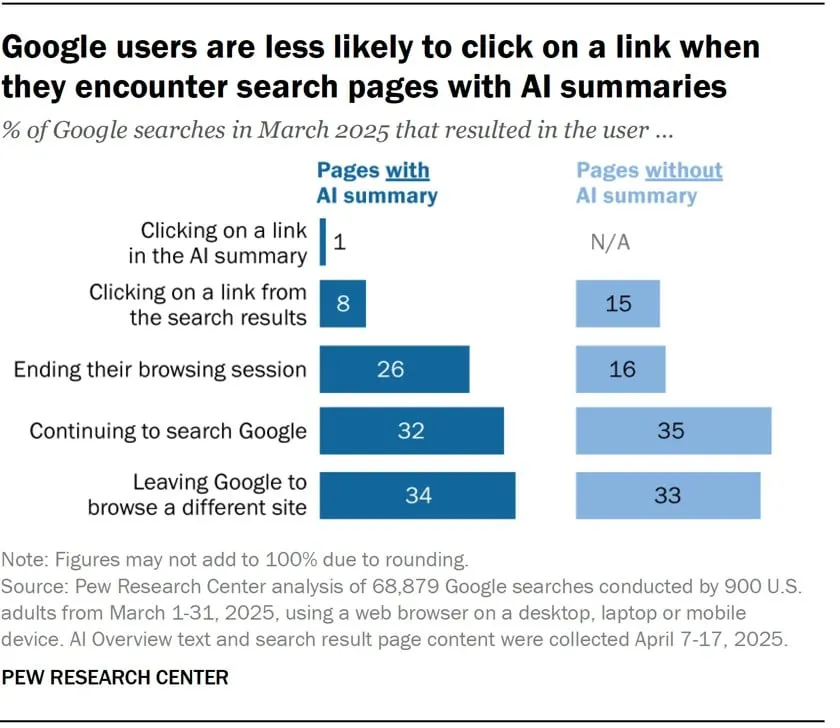
AI summaries and search engines now answer questions outright, with nearly 60% of Google queries ending in on-page responses powered by Wikipedia content.
Publishers call the trend “existential,” accusing tech platforms of using their work without compensation.
>>>> gd2md-html alert: inline image link in generated source and store images to your server. NOTE: Images in exported zip file from Google Docs may not appear in the same order as they do in your doc. Please check the images!
—–>
The Wikimedia Foundation announced this week that human traffic to Wikipedia fell roughly 8% between May and August compared to the same period last year. The decline came into focus after the foundation discovered that sophisticated bots, primarily from Brazil, had been disguising themselves as human visitors.
After updating its detection systems in May, the foundation reclassified traffic data and found much of the unusually high traffic in May and June came from bots built to evade detection. The revised numbers revealed what many in publishing already knew: fewer people visit Wikipedia directly because search engines now provide answers on their own pages.
“After making this revision, we are seeing declines in human pageviews on Wikipedia over the past few months, amounting to a decrease of roughly 8% as compared to the same months in 2024,” Marshall Miller, wrote. “We believe that these declines reflect the impact of generative AI and social media on how people seek information, especially with search engines providing answers directly to searchers, often based on Wikipedia content.”
AI is not just killing Wikipedia. Data from Pew Research showed median year-over-year referral traffic from Google Search to premium publishers has decreased almost every week during May and June 2025, with losses outpacing gains two-to-one. Nearly 60% of all Google searches end up in an AI summary instead of promoting the reading of the actual source.
Publishers across industries are sounding alarms and resorting to lawsuits to get some protection. Danielle Coffey, who leads the News/Media Alliance representing more than 2,000 outlets, said Google is using publisher content without compensation while offering no meaningful way to opt out without disappearing from search entirely.
“It’s parasitic, it’s unsustainable, and it poses a real existential threat to many in our industry,” she said.
The volume of AI content online is rising fast. Research from SEO firm Graphite found that as of November 2024, almost half of new web articles were generated using AI in some form, up from just 5% before ChatGPT’s launch. A post by Ask Perplexity on X claimed AI content went from around 5% in 2020 to 48% by May 2025, with projections saying 90% or more by next year.
The Wikimedia Foundation said fewer visits to Wikipedia could mean that fewer volunteers grow and enrich the content, and fewer individual donors support the work. The foundation is responding by enforcing policies for third-party access, developing a framework for attribution, and experimenting with ways to bring free knowledge to younger audiences on platforms like YouTube and TikTok.
The foundation said Wikipedia’s human knowledge is more valuable to the world than ever before, 25 years since its creation. The question is whether the platforms using that knowledge will support the ecosystem that creates it.
The Wikipedia Foundation did not immediately respond to a request for comments by Decrypt.
Generally Intelligent Newsletter
A weekly AI journey narrated by Gen, a generative AI model.
The FSNN News Room is the voice of our in-house journalists, editors, and researchers. We deliver timely, unbiased reporting at the crossroads of finance, cryptocurrency, and global politics, providing clear, fact-driven analysis free from agendas.
We and our selected partners wish to use cookies to collect information about you for functional purposes and statistical marketing. You may not give us your consent for certain purposes by selecting an option and you can withdraw your consent at any time via the cookie icon.
Cookies are small text that can be used by websites to make the user experience more efficient. The law states that we may store cookies on your device if they are strictly necessary for the operation of this site. For all other types of cookies, we need your permission. This site uses various types of cookies. Some cookies are placed by third party services that appear on our pages.
Your permission applies to the following domains:
https://fsnn.net
Necessary
Necessary cookies help make a website usable by enabling basic functions like page navigation and access to secure areas of the website. The website cannot function properly without these cookies.
Statistic
Statistic cookies help website owners to understand how visitors interact with websites by collecting and reporting information anonymously.
Preferences
Preference cookies enable a website to remember information that changes the way the website behaves or looks, like your preferred language or the region that you are in.
Marketing
Marketing cookies are used to track visitors across websites. The intention is to display ads that are relevant and engaging for the individual user and thereby more valuable for publishers and third party advertisers.


 Freedom Index