Close Menu
FSNN | Free Speech News NetworkFSNN | Free Speech News Network
  • Home
  • News
    • Politics
    • Legal & Courts
    • Tech & Big Tech
    • Campus & Education
    • Media & Culture
    • Global Free Speech
  • Opinions
    • Debates
  • Video/Live
  • Community
  • Freedom Index
  • About
    • Mission
    • Contact
    • Support
Trending

Ctrl-Alt-Speech: For Meta Or Worse

17 minutes ago

Elon Musk Should Let Nikita Bier Fix Revenue Sharing on X

19 minutes ago

Trump’s Edifice Complex

31 minutes ago
Facebook X (Twitter) Instagram
Facebook X (Twitter) Discord Telegram
FSNN | Free Speech News NetworkFSNN | Free Speech News Network
Market Data Newsletter
Thursday, March 26
  • Home
  • News
    • Politics
    • Legal & Courts
    • Tech & Big Tech
    • Campus & Education
    • Media & Culture
    • Global Free Speech
  • Opinions
    • Debates
  • Video/Live
  • Community
  • Freedom Index
  • About
    • Mission
    • Contact
    • Support
FSNN | Free Speech News NetworkFSNN | Free Speech News Network
Home»Opinions»Debates»Why the New International Economic Order Failed
Debates

Why the New International Economic Order Failed

News RoomBy News Room2 months agoNo Comments4 Mins Read1,257 Views
Share Facebook Twitter Pinterest Copy Link LinkedIn Tumblr Email VKontakte Telegram
Why the New International Economic Order Failed
Share
Facebook Twitter Pinterest Email Copy Link

Listen to the article

0:00
0:00

Key Takeaways

Playback Speed

Select a Voice

There are roughly 195 countries in the world, depending on how one counts. According to the World Bank, 87 qualify as “high-income economies,” with a per capita GDP above US$14,000. These countries account for only around 1.5 billion people out of a global population exceeding 8.2 billion.

That figure, however, is about to rise dramatically. China’s per capita income currently hovers around US$13,000. Once it crosses that line, the number of people living in rich countries will jump to around three billion. India may follow in two decades if it can sustain its current unusually high growth for a prolonged period, potentially raising the figure to 4.5 billion. Even in that optimistic scenario, however, billions will remain impoverished, and they will be concentrated overwhelmingly in Sub-Saharan Africa. Over the past thirty years, global extreme poverty has declined sharply, but this is not because the poorest countries have become slightly richer, but because in 1990, most of the world’s poor lived in countries like China, India, and Vietnam, which later experienced sustained growth.

Total population living in extreme poverty by world region, 1990–2040. Source.

Today, by contrast, extreme poverty is concentrated in economies that have stagnated for decades. In countries such as Burundi, Mozambique, Madagascar, and the Democratic Republic of Congo, population has outpaced income, leaving poverty rates stubbornly high. Redistribution cannot solve this problem. When average income falls below the poverty line, equal division only leaves everyone poor. On current trends, global economic growth is likely to stall, leaving hundreds of millions trapped in extreme poverty.
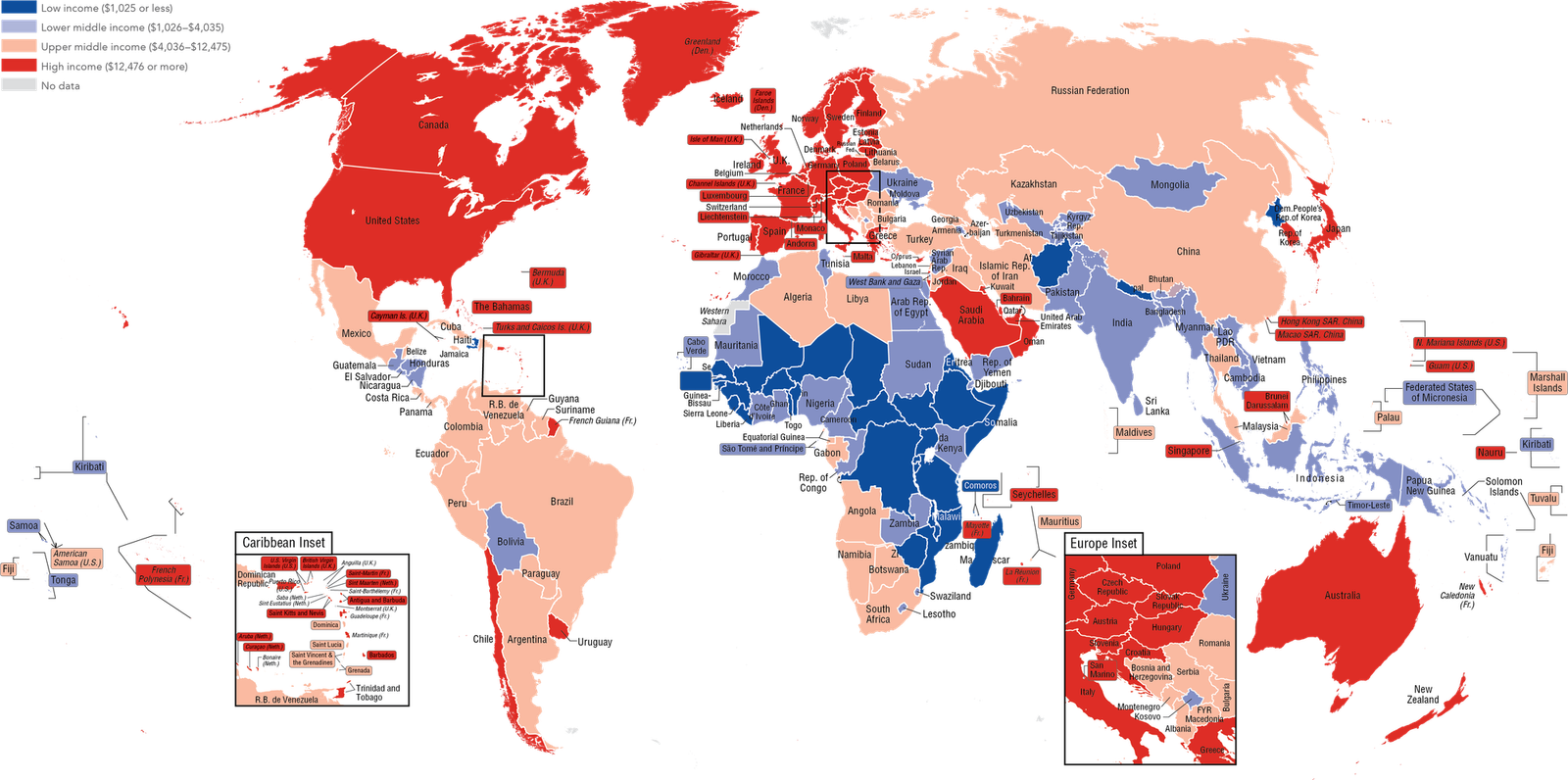
World Bank Classification of income levels. Source

No country in mainland Africa is currently classified as high-income. The only African nation to enjoy that classification is Seychelles—an island economy with unusual geographic and institutional features. Unfortunately, many African countries remain trapped in cycles of civil conflict, ethnic fragmentation, and resource dependence from which escape has proven exceptionally difficult. Meanwhile, most high-income countries fall into one of four groups: Western economies, East Asian economies, hydrocarbon exporters in the Gulf, and Israel. 

The central question of development economics is how countries that are still poor can achieve sustained prosperity, and what stands in their way. Economists like Daron Acemoglu and Esther Duflo have devoted their careers to explaining why some countries grow rich while others do not, yet there is no settled consensus among economists on the relative roles of institutions, geography, culture, human capital, and historical contingency.

However, the Group of 77 (G77), an intergovernmental coalition of developing countries within the United Nations, advanced a simplistic but politically resonant claim: that underdevelopment is primarily the result of an unfair global economic order. That belief found its most ambitious expression in the New International Economic Order (NIEO).
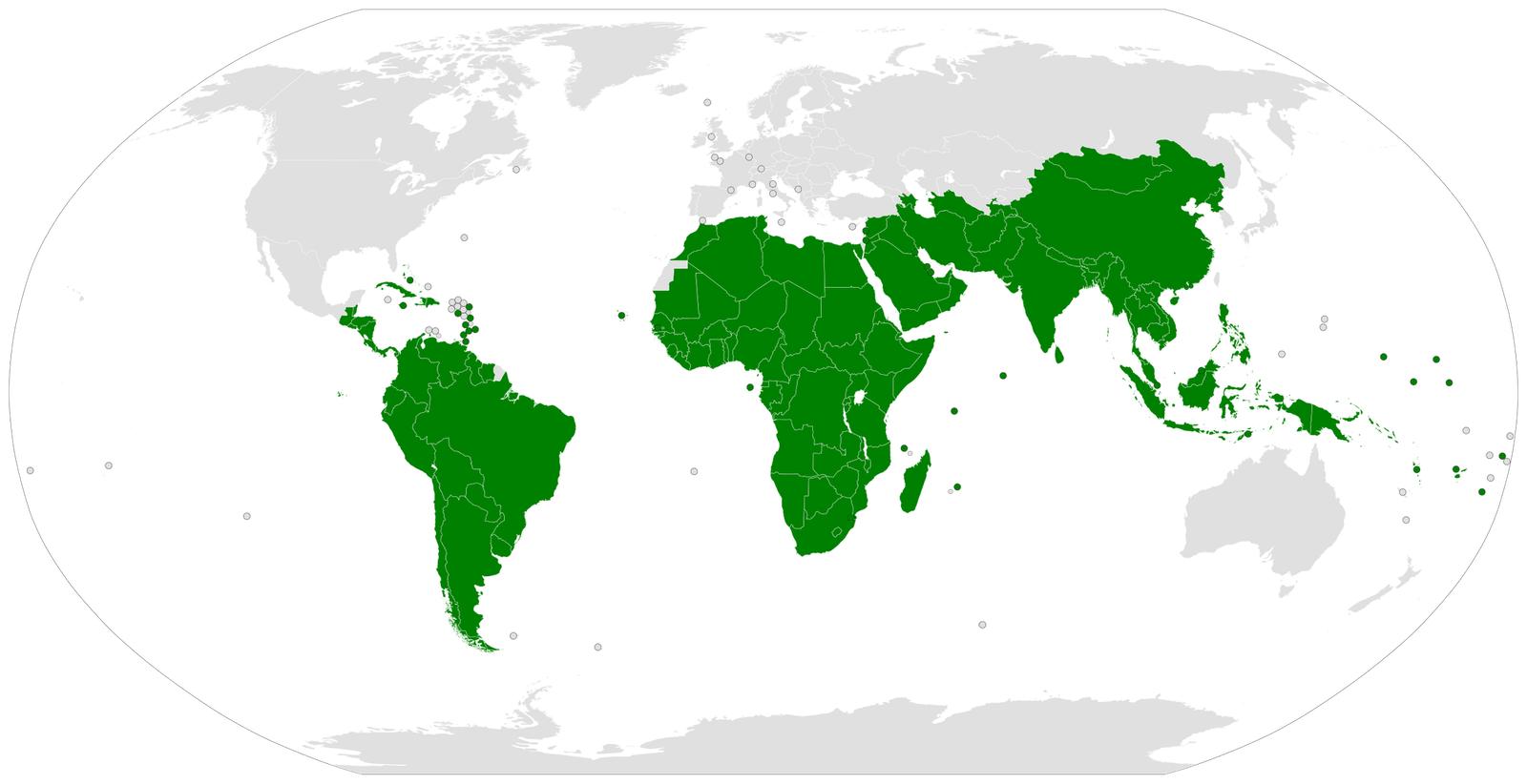
G77 countries in 2013. Source: Wikipedia.

The G77 emerged in 1964 at the first United Nations Conference on Trade and Development (UNCTAD). Initially a coalition of 77 developing countries seeking coordinated bargaining power, it has since expanded to over 130 members. Today, it includes nearly every country outside the developed world. The members of the original G77 shared a set of concrete economic grievances that shaped their view of the international order. Many were heavily dependent on commodity exports and were therefore exposed to extreme price volatility. Sudden commodity price collapses routinely wiped out their export earnings, destabilising their public finances and constraining their access to foreign exchange.

At the same time, these countries were affected by a long-term decline in the share of primary commodities in global trade and a corresponding rise in manufactured and industrial goods. To many G77 governments, this shift appeared less like an organic transformation of the global economy and more like a continuation of economic hierarchy by other means, transferring value from raw-material exporters in the developing world to industrial producers in advanced economies.

The Kennedy round of negotiations (1964–67) under the General Agreement on Tariffs and Trade (GATT) significantly reduced tariffs on manufactured goods, which benefited industrialised economies, while many commodity exports continued to face barriers. Even when formal tariffs were reduced, developed countries frequently relied on quotas and sector-specific protections to shield politically sensitive industries. Textiles provided a particularly stark example: although their labour-intensive production should have favoured poorer countries with abundant low-cost labour, agreements negotiated under GATT imposed quotas and restrictions, most notably by the United States, that severely limited developing countries’ access to these markets.

G77 members also argued that access to technology was essential for development. They expected advanced economies to help them develop technologically through concessional finance and development-bank lending.


Read the full article here

Fact Checker

Verify the accuracy of this article using AI-powered analysis and real-time sources.

Get Your Fact Check Report

Enter your email to receive detailed fact-checking analysis

5 free reports remaining

Continue with Full Access

You've used your 5 free reports. Sign up for unlimited access!

Already have an account? Sign in here

Share. Facebook Twitter Pinterest LinkedIn Tumblr Email Telegram Copy Link
News Room
  • Website
  • Facebook
  • X (Twitter)
  • Instagram
  • LinkedIn

The FSNN News Room is the voice of our in-house journalists, editors, and researchers. We deliver timely, unbiased reporting at the crossroads of finance, cryptocurrency, and global politics, providing clear, fact-driven analysis free from agendas.

Related Articles

Media & Culture

Ctrl-Alt-Speech: For Meta Or Worse

17 minutes ago
Media & Culture

Elon Musk Should Let Nikita Bier Fix Revenue Sharing on X

19 minutes ago
Debates

Trump’s Edifice Complex

31 minutes ago
Cryptocurrency & Free Speech Finance

First Sora, Now Sexy Chat? OpenAI Cancels Erotic ChatGPT Mode

47 minutes ago
Media & Culture

How Will Congress Fund a $300 Billion War With Iran?

1 hour ago
Cryptocurrency & Free Speech Finance

Trump Policy Has Crypto Privacy Developers in a ‘Very Bad State’, Says Coin Center

2 hours ago
Add A Comment

Comments are closed.

Editors Picks

Elon Musk Should Let Nikita Bier Fix Revenue Sharing on X

19 minutes ago

Trump’s Edifice Complex

31 minutes ago

Top Democrat on House committee questions Kraken’s Federal Reserve account

39 minutes ago

SEC is no longer a 'cop on the beat‘ on crypto, says US lawmaker

44 minutes ago
Latest Posts

First Sora, Now Sexy Chat? OpenAI Cancels Erotic ChatGPT Mode

47 minutes ago

How Will Congress Fund a $300 Billion War With Iran?

1 hour ago

Trump extends Iran strike pause, trimming price decline

2 hours ago

Subscribe to News

Get the latest news and updates directly to your inbox.

At FSNN – Free Speech News Network, we deliver unfiltered reporting and in-depth analysis on the stories that matter most. From breaking headlines to global perspectives, our mission is to keep you informed, empowered, and connected.

FSNN.net is owned and operated by GlobalBoost Media
, an independent media organization dedicated to advancing transparency, free expression, and factual journalism across the digital landscape.

Facebook X (Twitter) Discord Telegram
Latest News

Ctrl-Alt-Speech: For Meta Or Worse

17 minutes ago

Elon Musk Should Let Nikita Bier Fix Revenue Sharing on X

19 minutes ago

Trump’s Edifice Complex

31 minutes ago

Subscribe to Updates

Get the latest news and updates directly to your inbox.

© 2026 GlobalBoost Media. All Rights Reserved.
  • Privacy Policy
  • Terms of Service
  • Our Authors
  • Contact

Type above and press Enter to search. Press Esc to cancel.

🍪

Cookies

We and our selected partners wish to use cookies to collect information about you for functional purposes and statistical marketing. You may not give us your consent for certain purposes by selecting an option and you can withdraw your consent at any time via the cookie icon.

Cookie Preferences

Manage Cookies

Cookies are small text that can be used by websites to make the user experience more efficient. The law states that we may store cookies on your device if they are strictly necessary for the operation of this site. For all other types of cookies, we need your permission. This site uses various types of cookies. Some cookies are placed by third party services that appear on our pages.

Your permission applies to the following domains:

  • https://fsnn.net
Necessary
Necessary cookies help make a website usable by enabling basic functions like page navigation and access to secure areas of the website. The website cannot function properly without these cookies.
Statistic
Statistic cookies help website owners to understand how visitors interact with websites by collecting and reporting information anonymously.
Preferences
Preference cookies enable a website to remember information that changes the way the website behaves or looks, like your preferred language or the region that you are in.
Marketing
Marketing cookies are used to track visitors across websites. The intention is to display ads that are relevant and engaging for the individual user and thereby more valuable for publishers and third party advertisers.