

 Freedom Index

Listen to the article
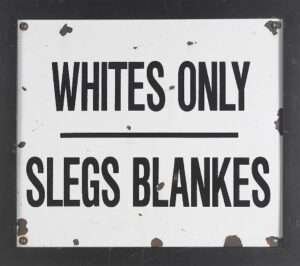
In an insightful recent post, economist Tarnell Brown explains why the economic effects of immigration restrictions are similar to those of racial discrimination and segregation. He builds on Nobel Prize winner Gary Becker’s famous theory of discrimination and South African economist W.H. Hutt’s classic critique of apartheid, The Economics of the Colour Bar:
Racism and immigration restrictions are often sold as hard-headed realism: protecting “our” jobs, “our” communities, “our” way of life. The sales pitch leans on a simple story—exclude the “wrong” people and the “right” people will prosper. Gary Becker and William Hutt both spent careers dismantling that story, and the empirical record has been quietly backing them up ever since. Once you translate prejudice into costs, discrimination looks less like realism and more like an especially expensive luxury good.
As Brown explains, Becker and Hutt’s insights explain that racial discrimination and segregation are economically harmful because they force employers to forego more productive workers from the disfavored group in favor of less productive ones from the dominant group. That obviously harms the excluded group. But it also lowers economic growth and innovation, ultimately harming even most members of the more privileged group. Immigration restrictions have much the same effects:
If Becker’s discriminator is willing to pay more for the same output, and Hutt’s white unionist is willing to shrink the industry to protect his wage, immigration restrictionists are willing to shrink the labor force itself. The logic is familiar: fewer immigrants mean less competition for “our” jobs and higher wages for native workers. The empirical record looks more like a modern color bar.
Contemporary studies highlight three mechanisms.
· Slower labor force growth. Immigrants have been the main driver of U.S. labor force expansion for decades. Tightening legal channels and ramping up enforcement reduces the number of working-age adults, especially in sectors with high demand and few native applicants, depressing potential GDP growth.
· Sectoral bottlenecks. When immigration restrictions bite hardest in agriculture, caregiving, hospitality, and construction, employers either cut back output, automate, or simply cannot meet demand. The result is higher prices, delayed projects, and foregone economic activity—not some clean transfer of “jobs from them to us.”
· Innovation and entrepreneurship. Immigrants are disproportionately represented among patent holders, startup founders, and STEM workers. Curtailing inflows therefore clips not just current output but future growth, by lowering the rate at which new products, firms, and technologies appear.
The historical analogy to Hutt’s South Africa is not rhetorical. The Chinese Exclusion Act of 1882, a classic piece of racially explicit labor protectionism, offers a clean test case. Recent research finds that areas that lost Chinese workers experienced dramatic declines in manufacturing—output down more than 60%, the number of establishments down 54–69%—as labor shortages rippled through the local economy. White workers were not “protected”; they were stranded in less dynamic labor markets with fewer opportunities and slower wage growth.
The modern U.S. has not reenacted Chinese Exclusion word-for-word, but the pattern is similar: a tightening of legal migration channels and aggressive enforcement campaigns in the name of “protecting” native workers. The Dallas Fed and others now warn that declining immigration will weigh on GDP growth for years, with little to show in terms of sustained wage gains for the least skilled natives. In Becker’s terms, the country is paying more for the same work; in Hutt’s terms, it is choosing a smaller pie so that a political coalition can claim symbolic victories.
I mad similar points – in a less sophisticated way – in a 2024 post on how mass deportations destroy more jobs for native-born Americans than they create:
The key theoretical point is that, while deporting immigrants often does create jobs for natives who directly compete with them, it destroys more elsewhere in the economy. For example, immigrant workers produce goods that are used by other enterprises, thereby creating jobs there. Immigrants start new businesses at higher rates than natives. That, in turn, creates new jobs for both natives and immigrants. And, of course, immigrant workers produce goods and services that greatly improve the options available to native-born consumers (thereby indirectly making them wealthier)….
One helpful way to think about the issue is to ask whether the twentieth-century expansion of job market opportunities for women and blacks helped white male workers, on net, or harmed them. Some white men likely were net losers. If you were a marginal white Major League Baseball player displaced by Jackie Robinson or other black baseball stars after MLB was integrated, it’s possible that you would never find another job you liked as much as that one. But the vast majority of white men were almost certainly net beneficiaries by virtue of the fact that opening up opportunities for women and blacks greatly increased the overall wealth and productivity of society.
If, today, we barred women from the labor force, or restricted them to the kinds of jobs open to them a century ago, some male workers would benefit. For example, freed of competition from female academics, I might get a pay increase or become a professor at a higher-ranked school.
But, overall, men would be much poorer, by virtue of living in a far less productive and innovative society. And many men would lose jobs or suffer decreases in wages because their own productivity depends in part on goods and services produced by women. While I might have a more prestigious job, I would likely be poorer, overall, because I could no longer benefit from many of the goods, services, and innovations produced by female workers.
Similar consequences would occur if we were to reinstitute racial segregation, thereby severely restricting the job opportunities of black workers. While some whites would come out ahead, most would be net losers, as our economy becomes much less productive.
The key point to remember is that the economy – including the labor market – is not a zero-sum game. Men and women, blacks and whites – and immigrants and natives – can all prosper together, if only the government would let them.
Economic effects are not the only way in which immigration restrictions resemble racial segregation. The two policies are also both unjust by virtue of restricting freedom and opportunity based on morally arbitrary circumstances of ancestry and birth. I develop and defend that point in this article, and in Chapter 5 of my book Free to Move: Foot Voting, Migration, and Political Freedom.
Read the full article here
Fact Checker
Verify the accuracy of this article using AI-powered analysis and real-time sources.