

 Freedom Index
Listen to the article
Key takeaways
-
Luke Gromen still believes governments will rely on inflation and weaker currencies to manage heavy debt.
-
He is more cautious on Bitcoin in the short term and sees a possible move toward the $40,000 range in 2026.
-
His main red flags are Bitcoin lagging gold, trend damage on key moving averages and “quantum risk” headlines weighing on sentiment.
-
The takeaway is process-driven: Track the BTC-to-gold ratio, a simple trend filter and ETF flows instead of copying anyone’s trades.
Who is Luke Gromen?
Luke Gromen is a global macro analyst. He founded FFTT (Forest For The Trees) in early 2014 and publishes macro research for investors, including his Tree Rings product.
His core thesis is the “debasement trade.” In simple terms, when a country carries too much debt, it can make that burden easier to manage by allowing inflation to run and letting the currency lose purchasing power over time. This dynamic pushes some investors toward assets that are harder to create in unlimited supply, such as gold and, for many years, Bitcoin.
As of December 2025, Gromen has not abandoned the debasement view. What has changed, however, is his short-term outlook on Bitcoin (BTC).
On the RiskReversal podcast, he said BTC looks weak enough that a move toward the $40,000 range in 2026 is possible. He also described Bitcoin as a position that can be scaled down as conditions deteriorate and said gold and some equities currently express the debasement theme better than BTC.
He points to a few practical warning signs: Bitcoin lagging gold, breaks below key moving averages and growing discussion around quantum risk.
Understanding “debasement” the way Gromen uses the term
When Gromen uses the term “debasement,” he means the following: If a government carries too much debt, it can make that burden feel lighter over time by allowing inflation to rise and the currency to lose value. The nominal debt stays the same, but it buys less in real terms.
That outcome is what matters. In a debasement environment, people often look for assets that are harder to “print,” such as gold and sometimes Bitcoin because they are seen as better at preserving purchasing power than cash.
In short, Gromen’s base view is that debasement will trickle down into Bitcoin.
Gromen’s key point is also about time. He does not treat this as a quick trade with a clear end date. Instead, he sees it as a long process in which pullbacks can occur without meaning the broader thesis is finished.
Did you know? “Debasement” started as a literal trick. In ancient and medieval times, rulers reduced the precious metal content of coins to stretch the money supply, either by shaving tiny amounts off the edges of coins or by melting them down and mixing in cheaper metals. The coin still carried the same face value, but it contained less silver or gold, meaning people were effectively paid in “lighter” money.
Why he’s fading Bitcoin now
Gromen’s 2025 message is straightforward: The debasement theme can still be valid, while Bitcoin can still be a poor setup in the short term. That is why he talks about trimming BTC risk even as he remains bullish on the broader macro direction.
On RiskReversal, he argues that gold and some equities are expressing the debasement trade more clearly right now than Bitcoin. He also outlines a scenario in which BTC could slide toward the $40,000 range in 2026.
The first signal he highlights is Bitcoin priced in gold. He views it as a warning sign when BTC fails to make new highs relative to gold. The ratio adds important context. The number of ounces of gold needed to buy one BTC fell to about 20 ounces, down from roughly 40 ounces in December 2024. In his framing, this suggests that the “hard asset hedge” spotlight has shifted away from Bitcoin for now.
The second signal is technicals. He points to breaks below key moving averages as a reason the risk-reward looks less attractive. Not “Bitcoin is dead,” but rather that the chart is not rewarding heavy exposure.
The third is macro pressure and narratives, especially quantum risk. He points to rising chatter around quantum computing as another headwind. The topic keeps resurfacing in part because there have been proposals and discussions about moving Bitcoin away from older signature schemes as part of a longer post-quantum migration path.
He is not alone in being cautious, but he is also not speaking for everyone. Some Bitcoin-focused analysts push back strongly. Onchain analyst Checkmate and researcher Troy Cross have argued that this looks like selling into weakness and that the quantum angle is being treated more like an internet narrative than an immediate threat.
How to track Gromen’s signals
If you want to follow the idea without copying anyone’s trades, keep it mechanical. One approach is to check the same three signals each week: BTC versus gold, trend health and flows.
1) Start with BTC priced in gold as your “store of value” test
Gromen’s warning is less about Bitcoin priced in dollars and more about Bitcoin failing to lead against gold. If the BTC-to-gold ratio keeps sliding, it is hard to argue that Bitcoin is the primary “debasement hedge” right now, even if the long-term story remains intact.
2) Add a trend filter so you’re not guessing
A simple option is the 200-day simple moving average (200D SMA). It is widely used as a rough dividing line between long-term uptrends and downtrends because it smooths noise across roughly 200 trading days.
The point is not that the 200D SMA is magic. The point is to decide in advance what “trend damage” means so that you are not making emotional decisions on red days.
3) Use ETF flows as confirmation, not as the main signal
For a quick public pulse check, you can track daily US spot Bitcoin exchange-traded fund (ETF) flows using Farside’s tables.
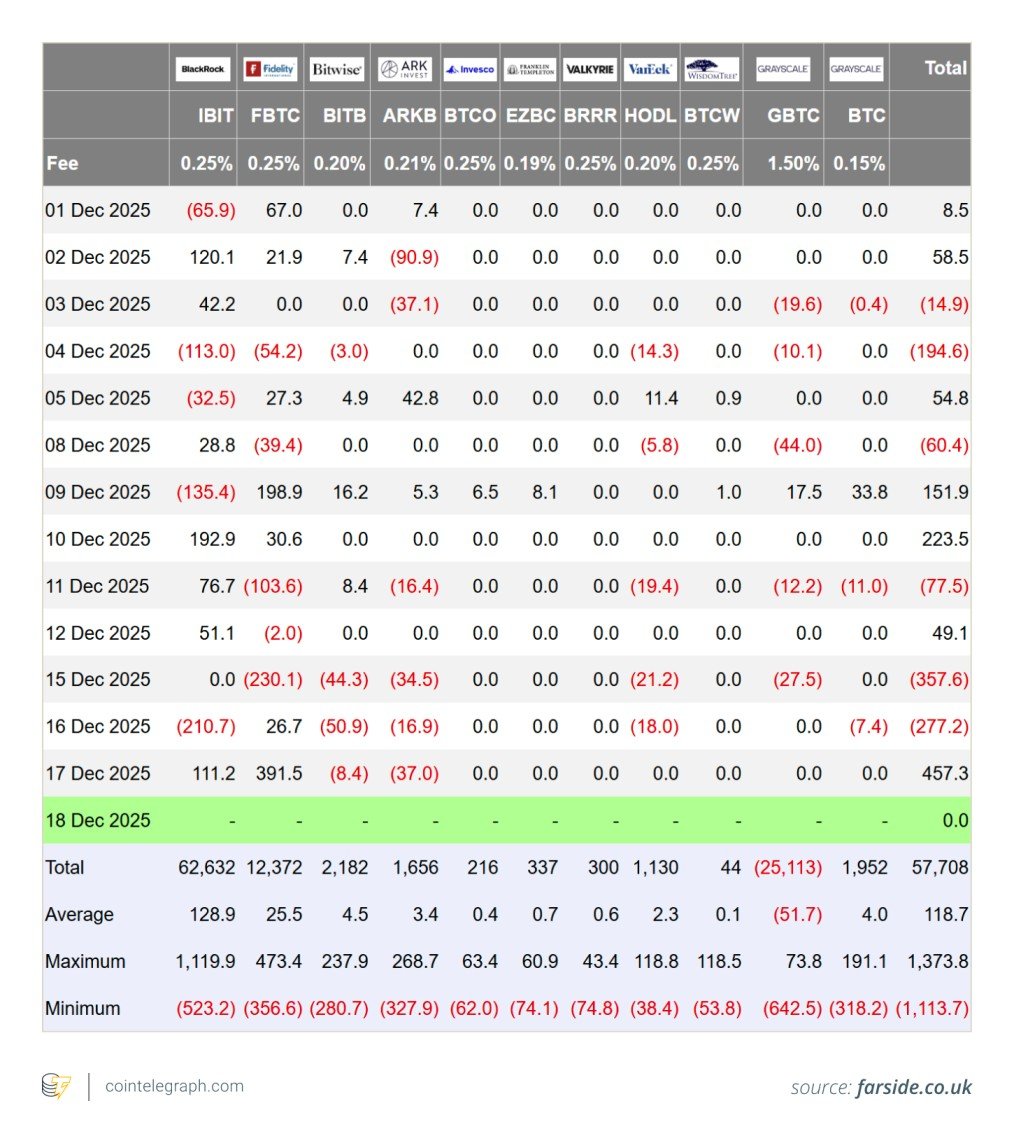
Flows will not explain every move, but persistent outflows alongside weak BTC-to-gold performance and a broken trend form the kind of a “three strikes” setup that, in Gromen’s framework, would justify reducing exposure.
A weekly check can be this simple:
-
BTC-to-gold: Improving or getting worse?
-
Trend: Above or below the 200D SMA?
-
ETF flows: Mostly inflows or outflows lately?
Did you know? The simple moving average (SMA) is the average of the last N closing prices — e.g., the past 200 days. It is called “moving” because each new day replaces the oldest day in the calculation, allowing the line to update continuously and smooth out short-term noise.
How to “fade BTC” without abandoning the debasement thesis
In Gromen’s framing, “fading Bitcoin” is simply about risk control. You can still believe in debasement while admitting that Bitcoin may not be the best expression of that view right now.
Here is one illustrative way he frames this thinking, presented for educational purposes rather than as a strategy.
1) Split your thinking into “core” and “tactical”
-
“Core” refers to what you are willing to hold through multi-year cycles.
-
“Tactical” refers to what you reduce when the setup breaks, based on relative performance and trend.
This is essentially rebalancing logic. A rules-based approach can reduce risk and may add a modest return benefit over time.
2) Define what would make you add BTC back
Keep it tied to the same three signals:
-
BTC-to-gold stops falling and starts trending higher.
-
Price repairs key trend levels: for example, moving back above the 200D SMA.
-
ETF flows stop confirming sustained selling pressure.
3) Don’t ignore the real-world friction
In higher-volatility, lower-correlation markets, the trade-off between how far you drift and how much you trade becomes more pronounced, meaning you may need wider bands and fewer forced moves. Wellington makes this point directly in its discussion of rebalancing trade-offs.
Quantum risk: Separating market fear from real timelines
Quantum risk matters for two reasons.
-
First, it is a real, long-term security issue. If powerful quantum computers ever become practical at scale, some of today’s cryptography would require upgrades.
-
Second, it is a short-term market narrative. Even if the technology is not imminent, headlines can still scare investors and prompt risk reduction. That is why it appears in Gromen’s list of reasons Bitcoin can look fragile in the near term.
If you want a calm baseline on timing, a16z crypto argues that the arrival of a cryptographically relevant quantum computer in the 2020s is highly unlikely.
However, moving large systems to post-quantum cryptography is operationally difficult and can take years. The National Institute of Standards and Technology finalized its first post-quantum cryptography standards in August 2024, publishing FIPS 203 (ML-KEM) for key exchange and encryption, along with FIPS 204 (ML-DSA) and FIPS 205 (SLH-DSA) for digital signatures. Adoption across industries is expected to take significant time.
For Bitcoin, the developer ecosystem is already debating possible migration paths. One example is a Bitcoin-Dev mailing list thread describing an informational post-quantum signature proposal often referenced as Bitcoin Improvement Proposal 360. In parallel, Bitcoin Optech maintains a dedicated “quantum resistance” topic page to track developments in this area.
The synthesis
Gromen’s message makes more sense if you separate the regime from the vehicle.
-
The regime call is debasement: High-debt governments have incentives to allow inflation and currency weakness to reduce the real burden of debt over time.
-
The vehicle call is tactical: He is questioning whether Bitcoin is the best way to express that view right now.
In his framework, Bitcoin can still fit the long-term debasement story. At the same time, it can be a position you trim when the setup worsens, especially if BTC is lagging gold, the chart is damaged and a noisy narrative like quantum risk is weighing on sentiment.
If you can track BTC vs. gold, a simple trend filter and a basic flow check, you can understand the call without turning it into hero worship or panic selling.
This article does not contain investment advice or recommendations. Every investment and trading move involves risk, and readers should conduct their own research when making a decision. While we strive to provide accurate and timely information, Cointelegraph does not guarantee the accuracy, completeness, or reliability of any information in this article. This article may contain forward-looking statements that are subject to risks and uncertainties. Cointelegraph will not be liable for any loss or damage arising from your reliance on this information.
Read the full article here
Fact Checker
Verify the accuracy of this article using AI-powered analysis and real-time sources.