

 Freedom Index

Listen to the article
Key takeaways
-
Ether staking has grown significantly, with nearly 1 million validators and around 30% of ETH staked. However, operational complexity continues to prevent many institutions from participating directly, despite the potential yield opportunity.
-
Developers are working toward “one-click staking,” a simplified deployment model that allows institutions to run validators through automated, standardized systems without requiring deep technical expertise.
-
A key enabler of this shift is DVT-lite, which allows multiple nodes to jointly manage a validator, improving fault tolerance while reducing setup complexity and minimizing risks such as slashing penalties.
-
If successfully implemented, one-click staking could drive institutional adoption, increase validator diversity, strengthen network resilience and support Ethereum’s next phase of growth.
The Ethereum network’s proof-of-stake (PoS) framework has become a core part of the decentralized finance (DeFi) ecosystem. Following the landmark transition from proof-of-work (PoW) during the 2022 Merge, a major software upgrade that eliminated energy-intensive mining, validator participation has increased significantly.
However, as Ethereum co-founder Vitalik Buterin has suggested, a critical barrier remains. The technical complexity of staking is still prohibitively high for both retail participants and large institutions.
To bridge this gap, engineers are exploring ways to streamline validator setup. In particular, they are moving toward a one-click user experience. This initiative, using “DVT-lite” or simplified distributed validator technology, would allow organizations to manage nodes without needing specialized technical staff.
This article explores why Ethereum developers are pushing for one-click staking to simplify validator setup for institutions, reduce reliance on intermediaries, enhance decentralization and unlock broader validator participation.
Why Ethereum is revisiting the institutional staking user experience
Ethereum is revisiting the staking user experience (UX) for institutions because, despite significant growth in participation, major players remain reluctant to engage directly due to operational hurdles.
Ether (ETH) staking has expanded substantially in recent years. As of early 2026:
-
Approximately 37 million to 38 million Ether is staked.
-
This equates to roughly 30% to 32% of the circulating supply.
-
The network now supports nearly one million active validators.
-
Typical base staking yields fall in the 2% to 3% annual range.
These figures demonstrate the ecosystem’s increasing maturity. Yet the staking ratio also suggests considerable room for further expansion.
Large organizations such as crypto funds, fintech firms and corporations holding Ether on their balance sheets tend to avoid direct staking. The deterrent lies less in the potential rewards and more in the operational complexities involved.
Direct validator operation typically demands:
-
Detailed infrastructure setup and planning
-
Robust key management protocols
-
Ongoing validator client updates and maintenance
-
Constant monitoring to ensure uptime
-
Careful risk assessment and mitigation against slashing penalties
For institutions familiar with the streamlined processes of traditional finance, these technical and ongoing responsibilities often appear overly burdensome and misaligned with their standard operating frameworks.
Did you know? The concept of distributed validator technology has roots similar to multi-signature wallets, in which control is shared across participants. Instead of relying on a single key holder, multiple nodes cooperate, reducing the risks tied to a single point of failure.
What one-click staking means
When Buterin refers to one-click staking, he means simplifying the deployment of native validators, not custodial earn products offered by centralized exchanges.
The approach is designed to make direct validator operation easier for institutions. Under this model, an institution would:
-
Choose the computers or servers that will run the validator nodes.
-
Prepare a configuration file containing shared validator details, such as a common key across nodes.
-
Launch a standardized, containerized setup.
Once initiated, the system would automatically manage:
Buterin has proposed using Docker containers, Nix images or similar standardized formats. This would allow node operators to deploy validators much like modern cloud applications, with a single click or a simple command on each node.
This would turn staking infrastructure into something closer to routine software deployment rather than a niche blockchain operation.
Why today’s validator setup still intimidates institutions
Ethereum’s current validator setup continues to deter many institutions, despite the protocol’s emphasis on security and decentralization, primarily because of its technical complexity.
Operating a validator requires managing several distinct software components:
-
Consensus clients: Handle the Beacon Chain, proof-of-stake logic, validator duties and network consensus
-
Execution clients: Process transactions, execute smart contracts and maintain the Ethereum Virtual Machine (EVM) state
-
Validator clients: Perform attestation and block proposal duties on the consensus layer
-
Secure key storage systems: Protect validator signing keys
Institutions must also contend with key operational risks, including:
-
Slashing penalties: Losses triggered by protocol violations such as double-signing or other forms of misbehavior
-
Downtime penalties: Reduced rewards or inactivity leaks when validators fail to attest or propose blocks because of outages
-
Security vulnerabilities: Particularly those involving the exposure or compromise of validator private keys
Even organizations with substantial resources often lack the specialized in-house blockchain expertise needed to manage these requirements efficiently. As a result, they frequently turn to third-party staking providers.
If too many validators are operated by the same large service providers, this reliance can create concentration risks.
Did you know? Some institutional investors already earn yield on idle assets through traditional systems such as repo markets. Ether staking is often compared to this, acting as a crypto-native yield layer for treasury-held Ether.
Why Buterin opposes expert-only staking
Buterin strongly opposes a staking ecosystem limited to specialist or professional operators, viewing it as a direct threat to Ethereum’s core decentralization principles.
He has criticized the idea that validator operation should remain a complex, expert-only task, describing that mindset as harmful and explicitly opposed to decentralization.
If staking infrastructure ends up dominated by a narrow set of professional providers:
-
Validation power could become excessively concentrated in a few hands.
-
The network could become more vulnerable to regulatory pressure or coercion directed at those dominant operators, potentially affecting the entire chain.
-
Overall system resilience could suffer, as failures, attacks or coordinated downtime among large operators could disrupt consensus more severely.
For these reasons, Buterin sees simplifying validator deployment through approaches such as one-click setups and lower operational barriers as a deliberate strategy to preserve decentralization.
This is why simplifying validator deployment is viewed not just as a user experience upgrade but also as a decentralization strategy.
How DVT helps
DVT plays a central role in efforts to make staking more accessible.
Rather than relying on a single machine that controls a validator through one private key, DVT allows multiple nodes to operate a single validator collaboratively.
In this setup:
-
Signing responsibilities are shared across several machines
-
No individual node possesses the full validator key
-
If one node goes offline, the remaining nodes can continue operations
This structure enhances fault tolerance and significantly reduces the risk of slashing penalties caused by downtime or failures.
Various projects in the Ethereum ecosystem have advanced DVT implementations in recent years.
Did you know? Ethereum validators do not compete the way miners once did. Instead of racing to solve puzzles, validators are randomly selected to propose and attest to blocks, making the system more energy efficient and predictable.
What sets DVT-lite apart
Full DVT can deliver significant benefits, but it often involves substantial technical complexity. To accelerate broader adoption, Buterin has advocated a streamlined variant called DVT-lite.
This simplified approach preserves the core advantages while eliminating more burdensome elements:
-
Shared validator responsibilities distributed across multiple nodes
-
Automatic network configuration
-
Built-in distributed key generation
The goal is to minimize unnecessary complexity, allowing institutions to deploy validators rapidly and efficiently.
Instead of building bespoke, highly customized staking setups, organizations can use standardized, automated tools that handle most of the configuration process.
The Ethereum Foundation’s 72,000 Ether experiment
The Ethereum Foundation has already begun testing this simplified approach. According to Buterin, the Foundation is currently staking 72,000 Ether through a DVT-lite system.
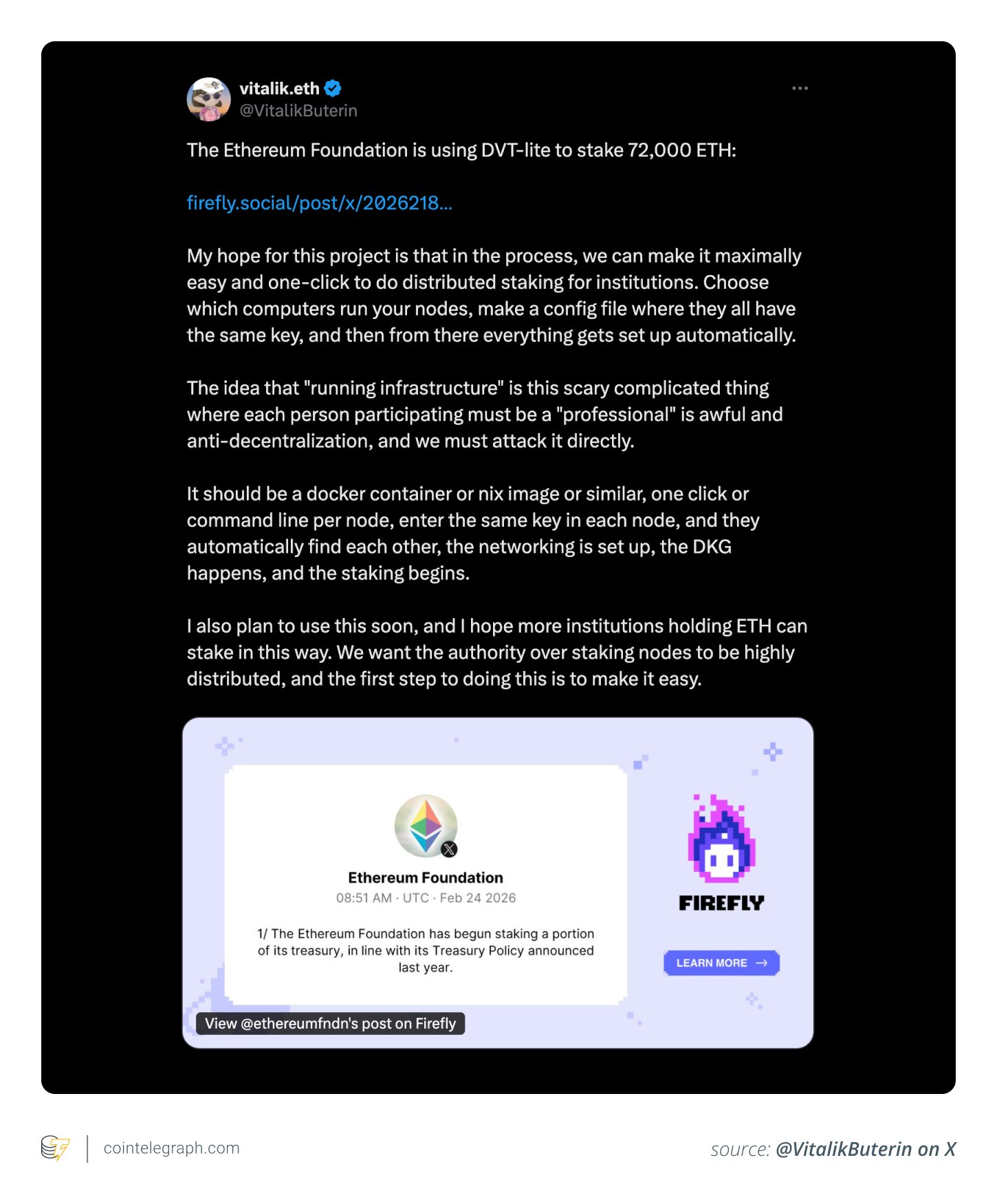
This real-world pilot evaluates whether streamlined distributed staking can function reliably at an institutional scale.
A successful outcome could offer a practical template for crypto funds, corporations and digital asset treasuries seeking to stake their Ether directly rather than through intermediaries.
The experiment also underscores that Ethereum developers view improved validator accessibility as a critical priority for the network’s future development.
Why institutions may finally begin staking
If one-click staking materializes, it could fundamentally alter the economics of institutional Ether holdings.
Entities already sitting on substantial Ether reserves would be able to earn staking yield internally without delegating to third parties.
Key potential advantages include:
-
Significantly lower infrastructure and operational overhead
-
Reduced reliance on centralized staking providers
-
Greater operational transparency
-
Stronger resilience enabled by distributed validator configurations
For organizations managing thousands of Ether, these changes could tip the balance decisively in favor of direct staking participation.
Why developers believe simpler staking improves decentralization
From a protocol standpoint, expanding validator participation strengthens the Ethereum network.
A larger and more diverse set of participants running validators leads to:
-
Greater geographic distribution of nodes
-
Reduced concentration of validation power
-
Greater resistance to censorship
-
Increased resilience in the face of failures or disruptions
By lowering barriers through easier staking tools, both institutions and individual operators can participate more readily as validators, reinforcing Ethereum’s security model.
This approach is consistent with Ethereum’s longstanding emphasis on broad participation over reliance on centralized infrastructure.
Why the timing is significant in 2026
Several concurrent developments across the network are making direct institutional staking more feasible.
Upcoming Ethereum upgrades focus on improving validator efficiency and scalability. For instance, proposals tied to the Pectra upgrade would raise the maximum effective balance for validators from 32 Ether to 2,048 Ether. This would allow operators to manage larger stakes within a single validator instance and reduce the operational burden of running numerous separate validators.
When paired with simplified DVT deployments, these changes could substantially reduce the technical and managerial hurdles involved.
Meanwhile, the staking ecosystem continues to show momentum:
-
Validator entry queues occasionally hold millions of Ether awaiting activation
-
Exit queues remain relatively small
-
Annual staking rewards now exceed $2 billion
Such indicators reflect sustained, long-term confidence in Ethereum’s staking mechanism.
Did you know? The idea of “one-click deployment” in crypto is inspired by cloud computing platforms such as Amazon Web Services (AWS) and Kubernetes, where complex infrastructure can be launched with minimal manual setup.
Challenges that persist in Ethereum development
Even with the potential of one-click staking, hurdles remain. Among the primary challenges are:
-
User interface design: Institutions require interfaces that streamline deployment while still surfacing essential security considerations
-
Regulatory uncertainty: Entities must navigate and comply with evolving cryptocurrency regulations in their respective jurisdictions
-
Operational oversight: Automated systems still require ongoing monitoring, auditing and adherence to security best practices
Developers must carefully balance ease of use with adequate safeguards to ensure automation does not create unforeseen vulnerabilities.
Could simpler staking introduce new risks?
Overly simplified tools might inadvertently create new centralization risks:
-
Widespread adoption of the same staking software stack among institutions could reduce infrastructure diversity
-
Standardized systems could emerge as high-value targets for exploits or attacks
-
Users could become overly reliant on automation, potentially overlooking underlying operational risks
Ethereum developers must therefore prioritize accessibility while also maintaining a diverse and resilient validator infrastructure.
What success would look like
If the one-click staking vision comes to fruition, it could lead to several changes:
-
Increased direct staking by institutions holding Ether
-
Broader distribution of validators across diverse organizations and geographic regions
-
Reduced dependence on centralized staking services
-
Greater overall network resilience
In that scenario, running a validator would become a standard infrastructure task rather than a highly specialized technical undertaking.
Cointelegraph maintains full editorial independence. The selection, commissioning and publication of Features and Magazine content are not influenced by advertisers, partners or commercial relationships.
Read the full article here
Fact Checker
Verify the accuracy of this article using AI-powered analysis and real-time sources.