

 Freedom Index
Listen to the article
On Saturday, U.S. District Judge Karin Immergut issued a temporary restraining order (TRO) against President Donald Trump’s deployment of federalized Oregon National Guard members in Portland. In response to a lawsuit by Oregon and the city of Portland, Immergut concluded that the deployment exceeded the president’s statutory authority and violated the state autonomy protected by the 10th Amendment.
Trump responded to that decision by ordering the deployment of federalized California and Texas National Guard troops to Portland. On Sunday, Immergut rejected that switcheroo, saying it was “in direct contravention of the court’s order issued yesterday.” To underline that point, she expanded her TRO to cover “the relocation, federalization or deployment of members of the National Guard of any state or the District of Columbia in the state of Oregon.”
Since Trump himself appointed Immergut, it would be hard to characterize her TRO as the work of a “Radical Left Lunatic” bent on obstructing his agenda for political reasons—his go-to explanation whenever judges rule against him. Rather, her decision upholds the principle that the president is not above the law, which in this case means he is not free to ignore the restrictions that Congress has imposed on his use of the National Guard.
“This case involves the intersection of three of the most fundamental principles in our
constitutional democracy,” Immergut writes in the opinion she issued when she approved the initial TRO. “The first concerns the relationship between the federal government and the states. The second concerns the relationship between the United States armed forces and domestic law enforcement. The third concerns the proper role of the judicial branch in ensuring that the executive branch complies with the laws and limitations imposed by the legislative branch. Whether we choose to follow what the Constitution mandates with respect to these three relationships goes to the heart of what it means to live under the rule of law in the United States.”
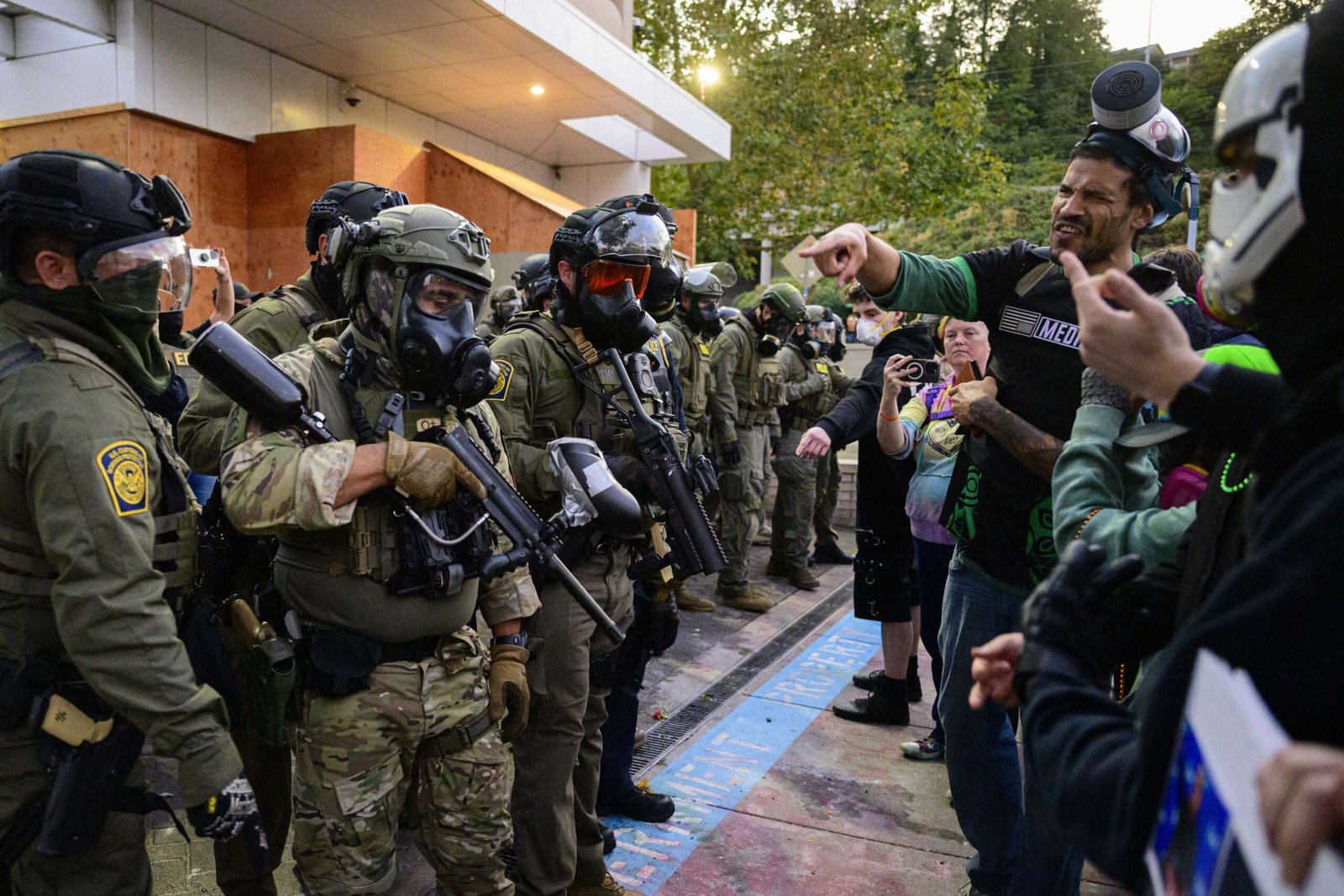
Trump presented the Portland deployment, which he announced in a Truth Social post on September 27, as a response to protests at the city’s Immigration and Customs Enforcement (ICE) facility. “At the request of [the] Secretary of Homeland Security, Kristi Noem,” he wrote, “I am directing [the] Secretary of War, Pete Hegseth, to provide all necessary Troops to protect War ravaged Portland, and any of our ICE Facilities under siege from attack by Antifa, and other domestic terrorists. I am also authorizing Full Force, if necessary. Thank you for your attention to this matter!”
As he did when he deployed California National Guard troops in response to Los Angeles protests against immigration raids in June, Trump invoked his authority under 10 USC 12406. That statute authorizes federalization of National Guard personnel in three circumstances: 1) when “the United States, or any of the Commonwealths or possessions, is invaded or is in danger of invasion by a foreign nation”; 2) when “there is a rebellion or danger of a rebellion against the authority of the Government of the United States”; or 3) when “the President is unable with the regular forces to execute the laws of the United States.”
Trump argues that both of the latter two conditions existed in Portland as of late September. Immergut disagrees.
In a June 19 decision addressing the Los Angeles deployment, the U.S. Court of Appeals for the 9th Circuit, which includes Oregon, ruled that the president’s findings under Section 12406 are entitled to “a great level of deference.” But the appeals court rejected Trump’s “primary argument” that his use of that law is “completely insulated from judicial review.” It said courts “may at least review the President’s determination to ensure that it reflects a colorable assessment of the facts and law within a ‘range of honest judgment.'”
While the 9th Circuit thought the Los Angeles deployment probably met that test, Immergut says Trump’s rationale for sending National Guard members to Portland does not. From June 11 through June 25, she acknowledges, the protests in Portland “included violent behavior and required an increased law enforcement presence.” But after June 25, she adds, “the protests were generally peaceful in nature with only sporadic incidents of violence and disruptive behavior.” And “by late September, these protests typically involved twenty or fewer people.”
To back up Trump’s assessment of the situation in Portland, Immergut notes, the government cited “only four incidents of protesters clashing with federal officers in the month of September.” They included “a makeshift guillotine” that protesters erected to “intimidate federal officials”; two incidents in which protesters shined flashlights in the eyes of drivers at the ICE facility; and an online picture of “an unmarked ICE vehicle.” While “these incidents are inexcusable,” Immergut says, “they are nowhere near the type of incidents that cannot be handled by regular law enforcement forces,” and “they occurred at least two weeks before President Trump issued his directive.”
More generally, Immergut writes, recent events in Portland are “categorically different from the violent incidents” that the government described in Los Angeles. Trump’s assertion that he was “unable with the regular forces to execute the laws of the United States,” she concludes, “was simply untethered to the facts.”
That determination, the government argued, was supported by the need to deploy additional federal law enforcement personnel from other states. But that “proposed test,” Immergut says, “would allow the President to call in the National Guard whenever one law enforcement office receives support from another office, which is a routine aspect of law enforcement activity. If the President could equate diversion of federal resources with his inability to execute federal law, then the President could send military troops virtually anywhere at any time.”
Immergut was similarly unimpressed by the government’s description of “violence elsewhere in the country,” which it said supported the concern that “peaceful protests in Portland might escalate into violence ‘at any moment.'” Neither “violence in a different state” nor “the mere potential for future escalation” can “provide a colorable basis” for invoking Section 12406, she says. “To accept Defendants’ arguments would be to render meaningless the extraordinary requirements of [Section 12406] by allowing the President to federalize one state’s National Guard based on events in a different state or mere speculation about future events. In other words, violence elsewhere cannot support troop deployments here, and concern about hypothetical future conduct does not demonstrate a present inability to execute the laws using nonmilitary federal law enforcement.”
What about Trump’s claim that he faced “a rebellion or danger of a rebellion” against the federal government’s authority? Although the 9th Circuit did not address that prong of Section 12406 in the California case, U.S. District Judge Charles Breyer did, and Immergut found his conclusions about the historical meaning of rebellion persuasive.
“First,” Breyer wrote, “a rebellion must not only be violent but also be armed. Second, a rebellion must be organized. Third, a rebellion must be open and avowed. Fourth, a rebellion must be against the government as a whole—often with an aim of overthrowing the government—rather than in opposition to a single law or issue.”
Applying that definition, Immergut concludes that “the protests in Portland were not ‘a rebellion’ and did not pose a ‘danger of a rebellion,’ especially in the days leading up to the federalization.” While the government “presented evidence of sporadic violence against federal officers and property damage to a federal building,” she says, it did not offer “any evidence demonstrating that those episodes of violence were part of an organized attempt to overthrow the government as a whole.”
Because Trump’s federalization of the Oregon National Guard was not authorized by statute, Immergut says, it “also violates the Tenth Amendment,” which reserves to the states powers “not delegated to the United States by the Constitution.” The Constitution authorizes Congress to “provide for calling forth the Militia to execute the Laws of the Union, suppress Insurrections and repel Invasions.” The president therefore “lacks constitutional authority to federalize the National Guard once he exceeds the constitutional authority that Congress granted him.”
Since Trump is “federalizing the Oregon National Guard absent constitutional authority, his actions undermine the sovereign interest of Oregon as protected by the Tenth Amendment,” Immergut writes. “Oregon has a Tenth Amendment power to control its National Guard to the extent it is not cabined by the Militia Clause.” In other words, she says, Trump “‘interfere[d] with the constitutional balance of power between the federal and state governments’ by federalizing state National Guardsmen for federal service when no statutory or constitutional authority permitted their federalization.”
As Reason‘s Autumn Billings notes, a lawsuit that Illinois filed today raises similar objections to Trump’s National Guard deployment in Chicago. While it’s not clear how the courts will assess the situation there, the decisions in the 9th Circuit—including the ruling that allowed the Los Angeles deployment to continue—suggest that facts do make a difference as a matter of law. At the very least, the president can invoke Section 12406 only based on “a colorable assessment of the facts and law within a ‘range of honest judgment.'” Although Trump prefers to invent his own reality, that is not good enough to meet the legal requirements for calling out the National Guard.
Read the full article here
Fact Checker
Verify the accuracy of this article using AI-powered analysis and real-time sources.