

 Freedom Index
Listen to the article
Tomorrow is Halloween, so let’s talk about monsters. Specifically, let’s talk about the monstrous government censors who once hacked and slashed their way through Hollywood’s original horror classics.
You’re reading Injustice System from Damon Root and Reason. Get more of Damon’s commentary on constitutional law and American history.
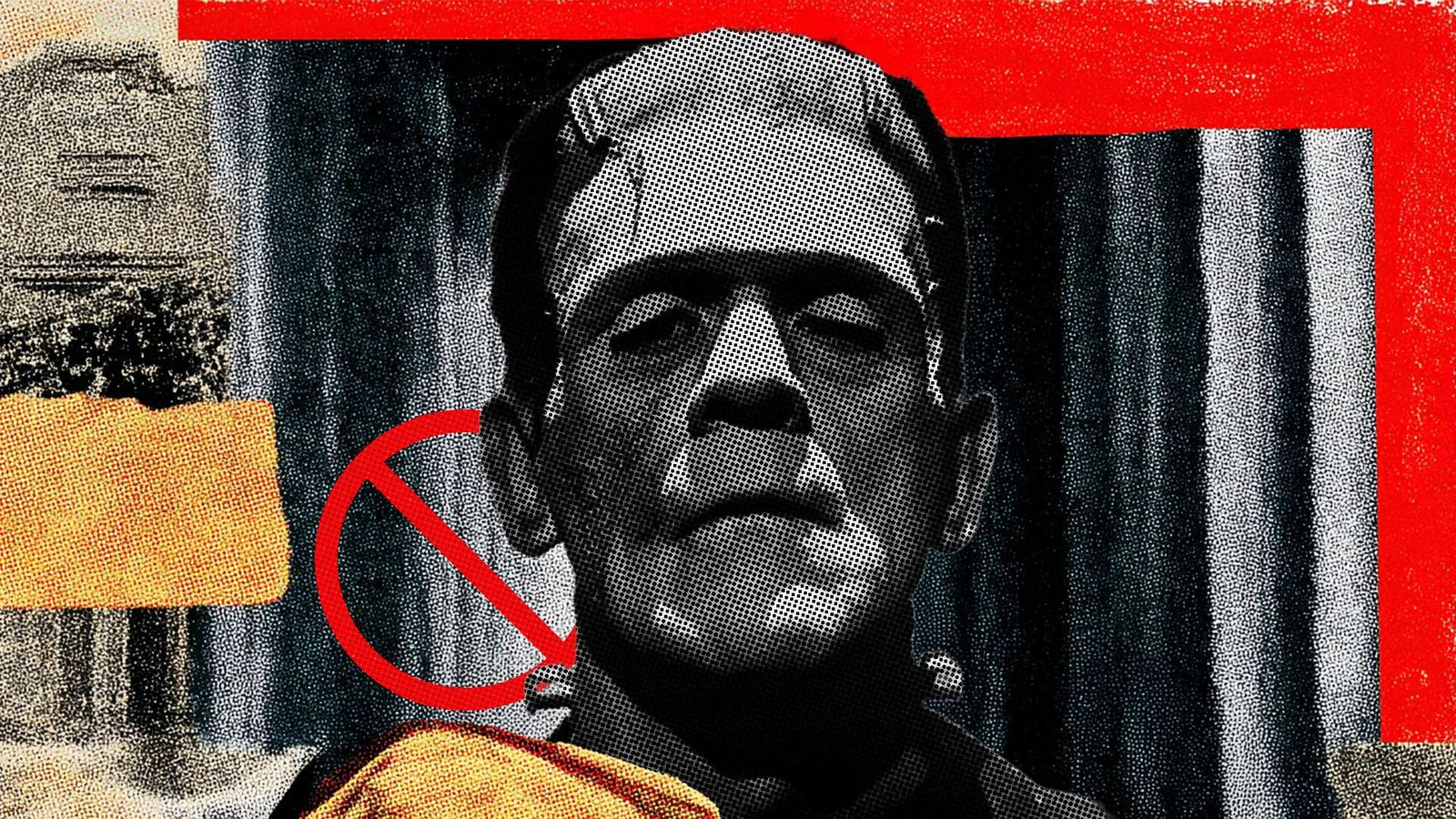
In 1931, Universal Studios released a pair of films that still haunt American culture. The first to emerge from the shadows was Dracula, starring Bela Lugosi as the titular vampire who creeps by night to feed on the blood of his victims. Then, shambling in the bloodsucker’s wake, came Frankenstein, starring Boris Karloff as the tragic creature who was pieced together from dead body parts and brought to unnatural life by the titular mad scientist.
Some modern horror fans might find these films to be too slow or tame for their liking. But we must remember that they were genuinely frightening or disturbing to many audiences back in the day. They were so upsetting to some people, in fact, that the official censorship boards that then existed in multiple states took a page from Dr. Frankenstein and sliced off the best parts.
Today, the idea of an official state censor requiring specific cuts to a mainstream Hollywood movie in order for that movie to be shown to paying adult customers would be laughed out of court on First Amendment grounds.
But no such robust First Amendment jurisprudence existed in the 1930s. In fact, it was not until 1925 that the U.S. Supreme Court first recognized that the First Amendment’s guarantee of freedom of speech applied to the actions of state and local governments. And, as we will see, it was not until 1952 that the First Amendment’s protections against state censorship were extended to the movies.
So Dracula and Frankenstein both faced the censors’ knives when they were first released. For example, in his invaluable book, The Monster Show: A Cultural History of Horror, David J. Skal noted that Massachusetts mandated several cuts to all Sunday screenings of Dracula, including the removal of a shot “showing part of a skeleton in a casket as well as one of a beetle-like insect emerging from a miniature coffin.”
As for Frankenstein, Skal reported that one of the most commonly maimed scenes involved the creature encountering a young girl who was tossing flowers onto a lake and watching them float. Seemingly charmed by the girl’s joyful actions, the creature, behaving with a sort of child-like innocence of its own, tosses the girl onto the water to watch her float like a flower. But the girl (predictably) drowns, compounding the creature’s pathos and isolation.
Many censors objected to that upsetting scene and it was typically cut in a way that removed the sight of the creature actually tossing the girl onto the water. Yet, as Skal observed, such an edit “ironically [left] some viewers with the impression that they had been spared the spectacle of some shocking molestation.” In other words, the censors arguably made the scene even more disturbing by forcing audiences to draw their own conclusions about the full nature of the girl’s fatal meeting with the creature. The censors thus defeated the point of their own clumsy censorship.
Several years later, Frankenstein‘s even better (in my view) sequel, The Bride of Frankenstein, faced its own angry mob of censors. The “list of eliminations ordered by the Ohio Censor Board,” complained one Universal staffer, in a report quoted by Skal, were “very drastic and very harmful to the success of this picture.”
Perhaps the fullest record we have of that era’s heavy-handed government crackdown on horror movies comes from a 1933 pamphlet published by the National Council on Freedom From Censorship titled What Shocked the Censors: A Complete Record of Cuts in Motion Picture Films Ordered by the New York State Censors from January, 1932 to March, 1933.
Here, for example, is what RKO Radio Pictures was forced to cut from King Kong in order for the giant ape to lawfully terrorize Empire State moviegoers:
REEL 8.— Eliminate all views of monster holding girl as he tears clothing from her body.
REEL 9.—Eliminate all views of monster with natives in his mouth as he tears them apart. Eliminate all views of monster crushing natives with foot.
REEL 10.—Eliminate all views of monster biting man whom he holds in his mouth.
I don’t know about you, but those cuts represent exactly the sort of stuff that I hope to see in a flick about an oversized beast running amok.
The New York censors also demanded extensive cuts to Universal’s lesser-known shocker, Murders in the Rue Morgue, in which Dracula himself, Bela Lugosi, starred in an extremely loose adaptation of Edgar Allan Poe’s great tale of mystery and the macabre. Here, for example, are some of the cuts ordered to that movie by the state board: “Eliminate all distinct views (5) of girl bound and tied to cross beams in Dr. Mirakle’s laboratory—all views of her writhing in agony—all views of Doctor standing over her, holding her arm while he tortures her.”
As noted above, this killjoy regime of state censorship lasted until the late date of 1952, when it finally suffered defeat before the Supreme Court. The landmark case that did the job is known as Burstyn v. Wilson. It arose after the Paris Theater in New York City began showing an Italian art film called The Miracle, in which a girl imagines that she has given birth to Jesus Christ.
Noisy protesters soon gathered in front of the theater to object to the film’s “blasphemous” content. Then, in a clear win for the heckler’s veto, state officials sided with the protesters and ordered the theater to cease operations. Theater owner Joseph Burstyn sued and ultimately prevailed.
“We conclude that expression by means of motion pictures is included within the free speech and free press guaranty of the First and Fourteenth Amendments,” declared the Supreme Court. “The basic principles of freedom of speech and the press, like the First Amendment’s command, do not vary. Those principles, as they have frequently been enunciated by this Court, make freedom of expression the rule. There is no justification in this case for making an exception to that rule.”
So if you happen to find yourself visiting the cinema this Halloween for some spooky fun, take a moment to appreciate the fact that you are also exercising your inalienable right to enjoy a scary movie free from the grasp of those unwholesome state officials who once disfigured both the movies and the Constitution.
Read the full article here
Fact Checker
Verify the accuracy of this article using AI-powered analysis and real-time sources.