Close Menu
FSNN | Free Speech News NetworkFSNN | Free Speech News Network
  • Home
  • News
    • Politics
    • Legal & Courts
    • Tech & Big Tech
    • Campus & Education
    • Media & Culture
    • Global Free Speech
  • Opinions
    • Debates
  • Video/Live
  • Community
  • Freedom Index
  • About
    • Mission
    • Contact
    • Support
Trending

Vitalik Buterin to spend $43 million on Ethereum development

26 minutes ago

Bybit Faces Compliance Hurdles With Neobank Push

31 minutes ago

China Executes Eleven Members of Crime Family Linked to Myanmar Scam Hubs

39 minutes ago
Facebook X (Twitter) Instagram
Facebook X (Twitter) Discord Telegram
FSNN | Free Speech News NetworkFSNN | Free Speech News Network
Market Data Newsletter
Friday, January 30
  • Home
  • News
    • Politics
    • Legal & Courts
    • Tech & Big Tech
    • Campus & Education
    • Media & Culture
    • Global Free Speech
  • Opinions
    • Debates
  • Video/Live
  • Community
  • Freedom Index
  • About
    • Mission
    • Contact
    • Support
FSNN | Free Speech News NetworkFSNN | Free Speech News Network
Home»Opinions»Debates»Venezuela Coup Shows Return of Decisive American Power
Debates

Venezuela Coup Shows Return of Decisive American Power

News RoomBy News Room3 weeks agoNo Comments5 Mins Read1,140 Views
Share Facebook Twitter Pinterest Copy Link LinkedIn Tumblr Email VKontakte Telegram
Venezuela Coup Shows Return of Decisive American Power
Share
Facebook Twitter Pinterest Email Copy Link

Listen to the article

0:00
0:00

Key Takeaways

Playback Speed

Select a Voice

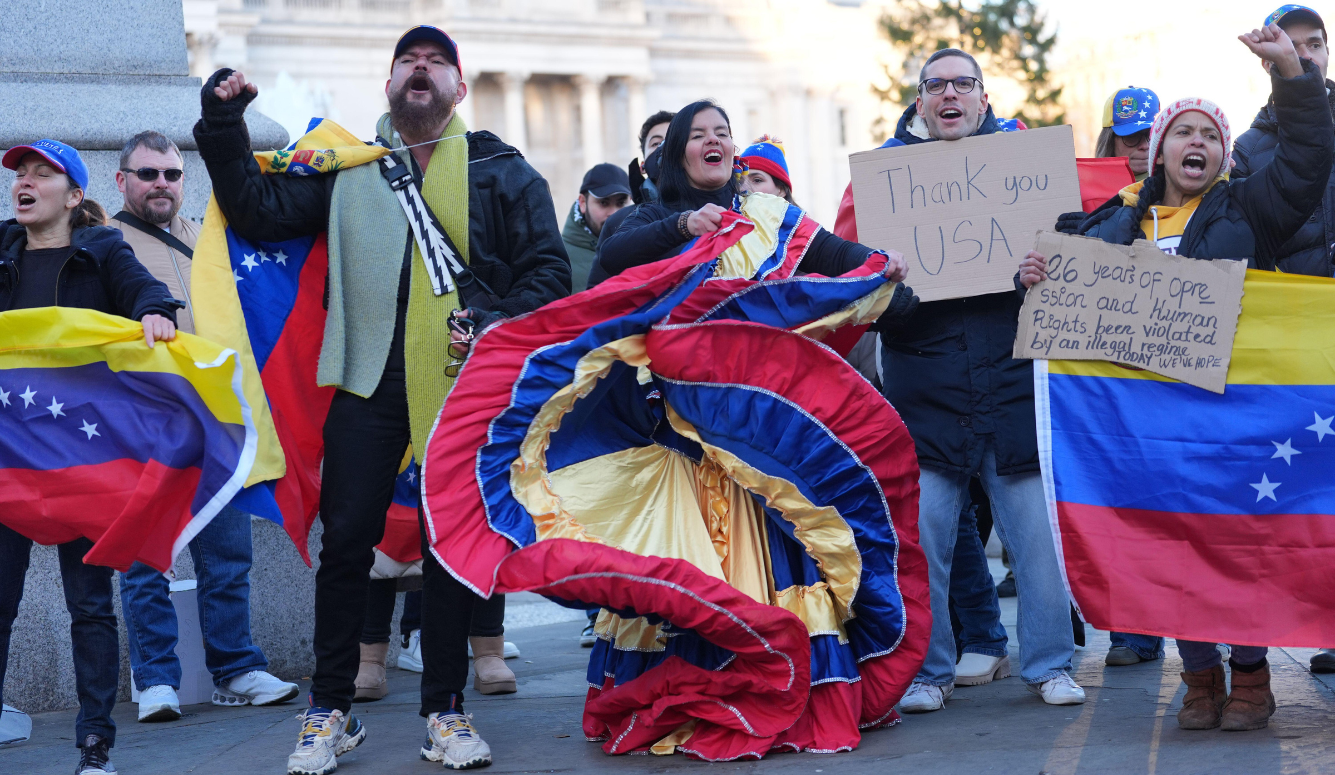
I was in Miami when it began. I had extended my stay in South Florida to help my younger brother move north to Tallahassee. Before we left, he hosted a noisy, affectionate, unmistakably South Florida goodbye at our house—with Americans, Colombians, and Venezuelans in attendance. Exiled Venezuelans are a familiar fixture in places like Doral and Weston, towns that have increasingly functioned as forward operating bases for a diaspora that never truly unpacks its bags, living in a state of permanent, high-alert nostalgia. Westonzuela and Doralzuela, some jovially call them.

It was late, convivial, and fratty—until videos began playing and phones ringing. Around 2am, one of the Venezuelans at the party stopped smiling. He checked his phone again and again. He called his mother. Bombs, he said, were exploding in Caracas.

La Carlota had been hit—not far away from where his mother lives. She picked up, she was fine. But even in his fear at the moment, his happiness was also tangible: an emotional mess that, in a way, encapsulates the feeling of a nation. Hundreds of thousands of displaced Venezuelan citizens feared a bombing but longed for change. La Carlota is not some distant military outpost. It sits in the middle of Caracas, a base embedded in civilian life, pressed into a valley and ringed by mountains. Imagine an airfield planted in the centre of Manhattan; that is La Carlota. That is where the night broke open.

The calls followed immediately. Some from my policy wonk buds in DC, but dozens from sources inside Venezuela itself. One told me he could hear jets flying over his house. Another described an explosion near El Volcán, where communication antennas are carved into the southeastern hills. Within minutes, the reports had multiplied. There had been detonations at Maiquetía, the main international airport in La Guaira—the one every Venezuelan knows, with its Cruz-Diez colours underfoot. That airport is not merely infrastructure; it is memory. It is where hundreds of thousands left from. Bombs fell in the Nueva Esparta archipelago and in Fuerte Tiuna, the Venezuelan equivalent of the Pentagon. There were bombs everywhere, like fireworks on the Fourth of July.

By this stage, it was clear that whatever was happening had transcended mere improvisation; it smelled like the clinical application of an Anti-Access/Area-Denial (A2AD) framework. The objective: total systemic paralysis. The goal was to dismantle communication nodes and neutralise response capabilities to render the battlespace—both physical and electromagnetic—entirely uncontested. In plain terms, the enemy was being blinded. Something major was clearly imminent.

Venezuela and the Half-Truths of Noam Chomsky

Chomsky has spent his career attacking the crimes and incompetence of the US but excuses the same in its enemies.

The US operation was a strategic gambit predicated on the collapse of the adversary’s command-and-control architecture before it could even mount a defence. The goal was clear: a total win without a single drop of American blood. Such a sophisticated operation is not undertaken if one expects the status quo to survive the night. It didn’t. Within only two and a half hours, the country’s autocrat, Nicolás Maduro, and his wife had been taken. President Donald Trump announced it. 

What unfolded that night was among the most tactically impressive large-scale operations ever conducted. One hundred and fifty US aircraft coordinated with a Delta Force team on the ground to do in a few hours what speculators had thought would be impossible to achieve in years.

The lazy consensus broke: the one that had taken hold, that suggested Venezuela was untouchable—that the casualties would be catastrophic, that the US would just perpetually bomb dinghies, that the regime’s supposed millions of “militiamen” would turn any military operation into a slaughter. Anyone with even a cursory understanding of Venezuela knew that this was nonsense. Militiamen in this context often meant little more than disorganised, scrawny teenagers in red berets—but why would an adversarial media care to unpack the reality? It is always easier to fear a phantom army. Yet the truth lay right in front of us: with prudence, not perfidy, concrete goals can be achieved.

Reporting remains incomplete, but what is clear is that this was a targeted, disciplined operation—quirúrgica (“surgical”), as Venezuelans themselves describe it. Rumours of some isolated civilian deaths exist, as well as reporting from Venezuelan reporters like Carla Angola that indicate that soldiers were gunned down as Maduro ran into a safe room. 

Topping it all, because humiliation is still part of the strategy after all, in a moment heavy with symbolism, strikes hit the mausoleum of Hugo Chávez—the des-Chávezification I wrote about in these pages two years ago has reached another level, from defacing statues to exploding his tomb. It was not a military target; it was designed to send a clear signal that this is the end of an era. 

So, what happens next? Removing an autocrat does not automatically produce democracy or stability. Venezuela is more socially cohesive than many countries that have fractured after a decapitation; the country lacks the ethnic and religious factionalism of the Middle East. Still, citizenry-level cohesion does not eliminate uncertainty.


Read the full article here

Fact Checker

Verify the accuracy of this article using AI-powered analysis and real-time sources.

Get Your Fact Check Report

Enter your email to receive detailed fact-checking analysis

5 free reports remaining

Continue with Full Access

You've used your 5 free reports. Sign up for unlimited access!

Already have an account? Sign in here

Share. Facebook Twitter Pinterest LinkedIn Tumblr Email Telegram Copy Link
News Room
  • Website
  • Facebook
  • X (Twitter)
  • Instagram
  • LinkedIn

The FSNN News Room is the voice of our in-house journalists, editors, and researchers. We deliver timely, unbiased reporting at the crossroads of finance, cryptocurrency, and global politics, providing clear, fact-driven analysis free from agendas.

Related Articles

Cryptocurrency & Free Speech Finance

China Executes Eleven Members of Crime Family Linked to Myanmar Scam Hubs

39 minutes ago
Media & Culture

Brickbat: Won’t Make the Cut

1 hour ago
Cryptocurrency & Free Speech Finance

Gold, Silver Liquidations Spike on Hyperliquid Amid Trading Frenzy

2 hours ago
Cryptocurrency & Free Speech Finance

DePIN Tokens Lag, Revenues Rise as Sector Is ‘Forced Into Fundamentals’

3 hours ago
Media & Culture

The Moving Property Problem in Fourth Amendment Law

3 hours ago
Cryptocurrency & Free Speech Finance

SEC Chair Atkins Walks Back Timeline for Crypto Innovation Exemptions

4 hours ago
Add A Comment

Comments are closed.

Editors Picks

Bybit Faces Compliance Hurdles With Neobank Push

31 minutes ago

China Executes Eleven Members of Crime Family Linked to Myanmar Scam Hubs

39 minutes ago

Brickbat: Won’t Make the Cut

1 hour ago

Bulls lose $70 million as Ripple-linked token plunges 7%

1 hour ago
Latest Posts

DOJ Finalizes $400M Helix Forfeiture in Early Bitcoin Darknet Case

2 hours ago

Gold, Silver Liquidations Spike on Hyperliquid Amid Trading Frenzy

2 hours ago

Gold, silver, copper profit-taking triggers $120 million unwind in tokenized metals

2 hours ago

Subscribe to News

Get the latest news and updates directly to your inbox.

At FSNN – Free Speech News Network, we deliver unfiltered reporting and in-depth analysis on the stories that matter most. From breaking headlines to global perspectives, our mission is to keep you informed, empowered, and connected.

FSNN.net is owned and operated by GlobalBoost Media
, an independent media organization dedicated to advancing transparency, free expression, and factual journalism across the digital landscape.

Facebook X (Twitter) Discord Telegram
Latest News

Vitalik Buterin to spend $43 million on Ethereum development

26 minutes ago

Bybit Faces Compliance Hurdles With Neobank Push

31 minutes ago

China Executes Eleven Members of Crime Family Linked to Myanmar Scam Hubs

39 minutes ago

Subscribe to Updates

Get the latest news and updates directly to your inbox.

© 2026 GlobalBoost Media. All Rights Reserved.
  • Privacy Policy
  • Terms of Service
  • Our Authors
  • Contact

Type above and press Enter to search. Press Esc to cancel.

🍪

Cookies

We and our selected partners wish to use cookies to collect information about you for functional purposes and statistical marketing. You may not give us your consent for certain purposes by selecting an option and you can withdraw your consent at any time via the cookie icon.

Cookie Preferences

Manage Cookies

Cookies are small text that can be used by websites to make the user experience more efficient. The law states that we may store cookies on your device if they are strictly necessary for the operation of this site. For all other types of cookies, we need your permission. This site uses various types of cookies. Some cookies are placed by third party services that appear on our pages.

Your permission applies to the following domains:

  • https://fsnn.net
Necessary
Necessary cookies help make a website usable by enabling basic functions like page navigation and access to secure areas of the website. The website cannot function properly without these cookies.
Statistic
Statistic cookies help website owners to understand how visitors interact with websites by collecting and reporting information anonymously.
Preferences
Preference cookies enable a website to remember information that changes the way the website behaves or looks, like your preferred language or the region that you are in.
Marketing
Marketing cookies are used to track visitors across websites. The intention is to display ads that are relevant and engaging for the individual user and thereby more valuable for publishers and third party advertisers.