

 Freedom Index
Listen to the article
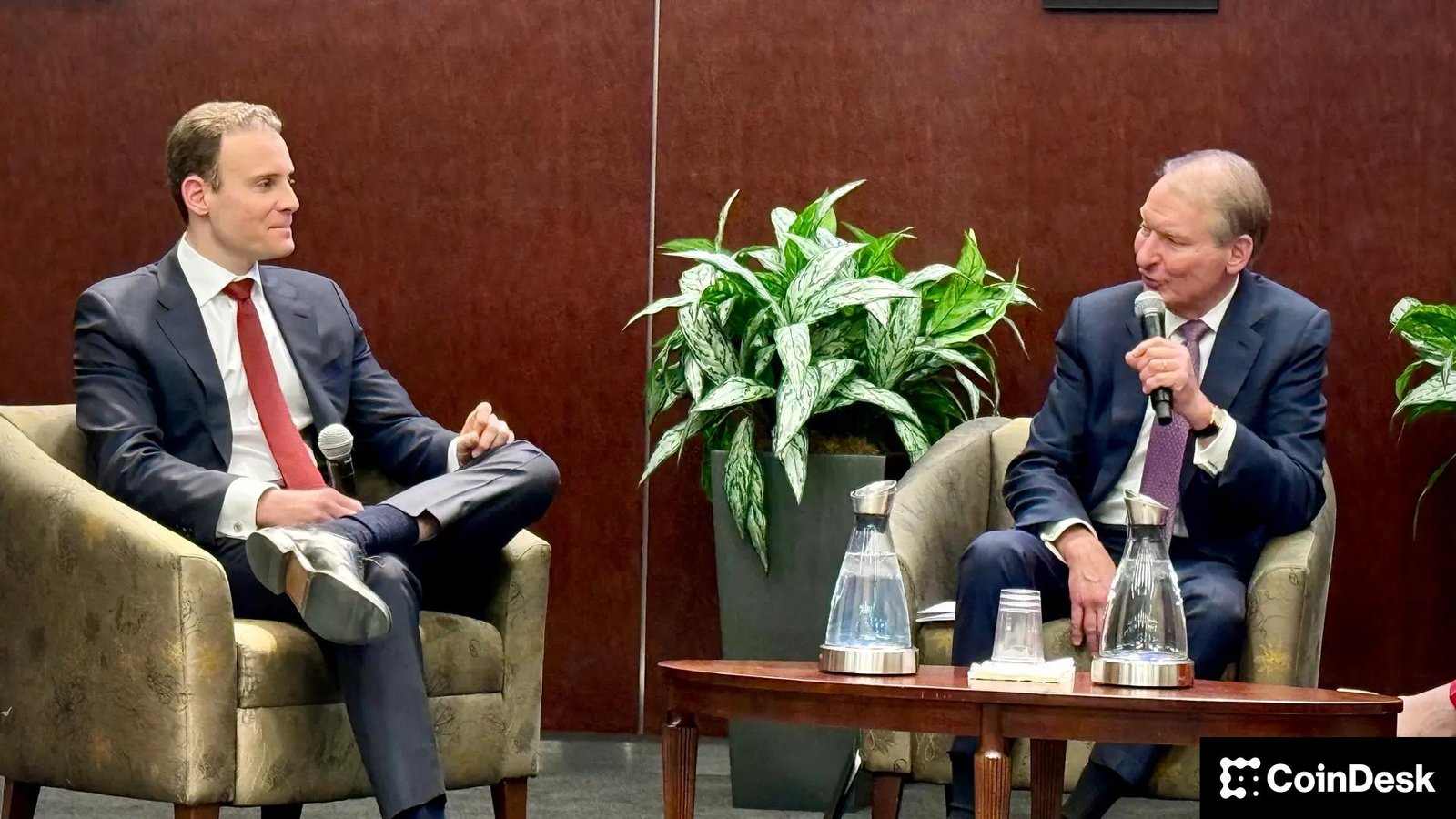
The leaders of the two federal agencies that have U.S. crypto’s fate most in their hands stood together at an event on Thursday, and they said they’d pursue common policies to define digital assets jurisdictions.
Even as crypto legislation moves in fits and starts through Congress, the U.S. Securities and Exchange Commission and the Commodity Futures Trading Commission have been trying to advance regulatory policy to give the industry some comfort in doing U.S. business. The CFTC has a new leader, Mike Selig, who was sworn in last month after his Senate confirmation and is already moving forward on crypto initiatives, using his remarks to outline a new agenda that will include rules on defining crypto and regulating prediction markets.
The CFTC will seek to join the SEC’s “commonsense crypto asset taxonomy” to make it clear that digital commodities, collectibles and tools aren’t securities. Selig said he’s directed his staff to work together with the SEC “to consider joint codification of this framework as an interim measure while Congress finalizes legislation.”
In his first public remarks on the job, Selig said Thursday’s event marked “the beginning of a new chapter for the CFTC.”
“We are witnessing the foundation of modern markets take shape,” he said. “As this transformation unfolds, the CFTC has an opportunity to build on its historic role as a forward looking regulator.”
He said the CFTC’s work known as its “crypto sprint” will become a partnership in Project Crypto.
“Chairman Selig brings to the CFTC precisely what this moment demands: a deep respect for market integrity, paired with a practical understanding of how innovation drives prosperity for the American people.,” said SEC chairman Paul Atkins, whose first year at the helm has already represented a sharp reversal of Democratic predecessor Gary Gensler’s stance on the digital assets sector.
Atkins said the agencies will be “deploying every tool at our disposal to reduce friction, to harmonize standards and definitions where appropriate, and to equip markets with confidence as Congress completes its vital work.”
The SEC is responsible for securities, and that will include tokenization and any cryptocurrencies that are deemed to check that box, though leading tokens such as bitcoin and Ethereum’s ether are under the CFTC’s jurisdiction.
The event was in part a redux of a previous joint meeting between Atkins and Selig’s immediate predecessor, then-Acting Chairman Caroline Pham, though its now been repeated by the two full-time agency aheads appointed by President Donald Trump and included Selig’s detailed outline of policy intentions.
On his new agenda, Selig said he’s directed staff on several points:
- to work on a rule “to enable the responsible deployment of additional forms of eligible tokenized collateral”;
- “use the tools at its disposal to onshore perpetual and other novel derivative products so that they can flourish across both centralized and decentralized markets”;
- “a commitment to establish clear and unambiguous safe harbors for software developers”;
- and “to explore the creation of a new category of [Designated Contract Market] registration that is tailored specifically to retail leveraged, margined, or financed crypto asset trading.”
Selig also said he’d pursue a new approach on prediction markets, an area in which the agency had long been mired in legal battles over the legality of those businesses.
“Looking ahead, and in the spirit of markets that trade on expectations, I have directed CFTC staff to move forward with drafting an event contracts rulemaking,” Selig said.
UPDATE (January 29, 2025, 19:44 UTC): Adds comments from CFTC Chairman Selig.
Read the full article here
Fact Checker
Verify the accuracy of this article using AI-powered analysis and real-time sources.