

 Freedom Index
Listen to the article
Karl Marx said that when history repeats itself, we’re supposed to get tragedy first, then farce. But Donald J. Trump has spent his life flouting all the rules. Why should we expect him to obey the historical dialectic?
In Trump’s two presidencies, farce came first. From the jump, his first turn at the helm was a head-spinning spectacle. He talked like a caudillo crossbred with an insult comic and seemed like a strongman auditioning for the part. In practice, however, Trump proved something of a “low energy” authoritarian. Very few of 45’s autocratic fancies—from unilaterally revoking birthright citizenship to”hereby order[ing]” American companies out of China—ever made the transition from tweet to law of the land.
Trump 1.0 arguably ended up a less imperial president than George W. Bush, Barack Obama, or Joe Biden. Even on COVID-19—a workable excuse for an executive power grab if ever there was one—45 proved the rare president willing to let a good crisis go to waste.
Midway through Trump’s shambolic first term,I warned in these pages that we should count ourselves lucky things hadn’t gone worse, and should “set about reimposing limits on the office’s powers before a competent authoritarian comes along.”
I never imagined it would be the same guy. And yet it’s Trump’s second presidency that’s delivered a mix of tragedy and genuine peril. Somehow, during the interregnum, Trump discovered you can just do things. In the process, he’s revealed just how few meaningful constraints remain against one-man rule.
On day 1 of his first term, Trump issued only a single executive order. The Beltway freak-out over the new administration was largely about presidential style rather than policy substance. An NPR item—”Yes, All This Happened. Trump’s First 2 Weeks As President”—captured the reigning zeitgeist. “All This” included some pro forma hand-wringing about actual policies, like the travel ban, but the real focus was Trump’s lack of decorum: Look at this guy with his “alternative facts” about the crowd size at his inauguration! He made a travesty out of the National Prayer Breakfast! (“And I want to just pray for Arnold, if we can, for those [Celebrity Apprentice] ratings, OK,’ the president said.”) You can’t take him anywhere!
In the reality-show arc, Trump 1.0 showed us what happens when the presidency stops being polite; Trump 2.0 was when it started getting real. On Day 1 of his second term, Trump came out of the gate with 26 executive orders. By the 100-day mark he’d issued 143—more than triple Biden’s near-record-setting pace—while signing fewer bills into law than any first-year president since Dwight D. Eisenhower.
Everything everywhere all at once—or “flood the zone with shit,” as Trump’s former chief strategist Steve Bannon once put it. All told, it was an unmistakable inflection point: the moment our long slide toward pen-and-phone governance took a dizzying lurch downward.
Crank tweets from the first term became executive orders in the second. One purported to rewrite the 14th Amendment by eliminating birthright citizenship; another dusted off the 1798 Alien Enemies Act as authority for summary deportations and warrantless searches of homes.
In his first term, Trump sent the markets into a tailspin with an August 2019 tweet (“Our great American companies are hereby ordered to immediately start looking for an alternative to China”), following up with a statutory citation: “try looking at the Emergency Economic Powers Act of 1977. Case closed!” Nothing came of it until 2025, when Trump recovered the presidential pen and issued a series of directives using the International Emergency Economic Powers Act (IEEPA) to hike duties on Mexico, Canada, and China, purportedly for failure to stem fentanyl trafficking, and then to impose new tariffs worldwide—declaring the longstanding U.S. trade deficit a “national emergency.”
In so doing, he converted the 50-year-old foreign-policy sanctions statute into his personal Oval Office “tariff button”—allowing him to launch trade wars from his desk as easily as ordering a Diet Coke.
Outside U.S. borders, Trump forged new frontiers in presidential warmaking. With a September 2025 airstrike against a suspected cartel boat off the coast of Venezuela, he took the war on drugs from metaphor to reality. In January, Trump followed up by sending Delta Force to capture Venezuelan President Nicolás Maduro. Then, in the early morning hours of February 28, Trump unleashed Operation Epic Fury—a huge, coordinated U.S.–Israeli air bombardment that hit more than 1,000 Iranian sites and killed key regime figures, including Ayatollah Ali Khamenei.
Like the rest of us, Congress learned about Epic Fury from a video on Trump’s Truth Social account, in which the president warned Iranian fighters to “lay down your weapons [or] face certain death” and urged the Iranian public, “When we are finished, take over your government.” Colin Powell’s Pottery Barn rule is another the president considers optional: You can just break things, no need to buy them.
Some of these moves, like the president’s IEEPA gambit, were genuinely new. But most of them tapped into a vast reservoir of power that presidents have always enjoyed—because we’ve let them.
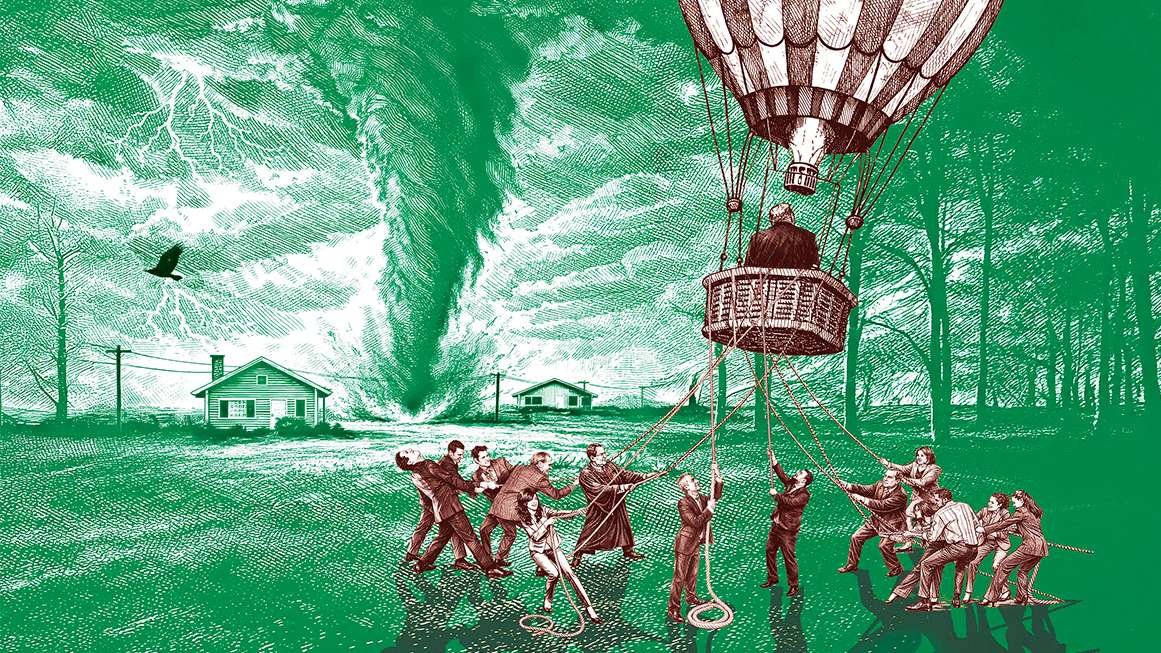
The modern presidency comes preloaded with emergency powers, unilateral trade authority, administrative control over vast swaths of economic life, and the practical ability to wage war at will. If Trump has any claim to being a “transformational president,” it’s because his contempt for power-constraining norms has brought our dilemma into bold relief, revealing the dark possibilities the office has long contained.
Well before Trump came down that golden escalator in 2015, presidents enjoyed virtually unchecked power to wage war. The War Powers Resolution—passed over President Richard Nixon’s veto in 1973—aimed to restore Congress’ constitutional power to decide the question of war or peace, but it’s barely inconvenienced any president in the five decades since. In our system, like it or not, one man decides.
Over the course of decades, Congress has handed the president a vast arsenal of statutory powers—more than 130, by the Brennan Center for Justice’s count—that he can unlock by saying the magic words “national emergency.” And yet, to date, nearly 70 percent of those powers have never been triggered.
The plain language of the Insurrection Act makes it shockingly easy for a president to put boots on the ground in American cities, using overt language of discretion (allowing military force “whenever the president considers” that unlawful assemblages “make it impracticable to enforce the laws”). Yet despite Trump’s recent threats, it hasn’t been triggered in over three decades.
Earlier this year, when asked whether anything meaningfully constrains his power, Trump told The New York Times: “Yeah, there is one thing. My own morality. My own mind. It’s the only thing that can stop me, and that’s very good.”
That’s not terribly comforting. Is there anything else that can do the trick?
In 1994, after market pressure forced the Clinton administration to dial back some of its more ambitious plans, James Carville cracked that if there’s reincarnation, “I want to come back as the bond market. You can intimidate everybody.”
If the president can’t be constrained by law, maybe a Wall Street sell-off can pull him back from the brink. That’s what many people have been banking on lately, and that bet comes with a cutesy acronym: TACO, for Trump Always Chickens Out. The coinage comes courtesy of Financial Times reporter Robert Armstrong, who in May 2025 posited that the administration “does not have a very high tolerance for market and economic pressure, and will be quick to back off when tariffs cause pain”—a prediction that was borne out through Trump’s repeated post–”Liberation Day” climbdowns from his most aggressive trade threats.
There’s another TACO dynamic at play with public opinion: Plummeting polls occasionally force presidents to back down. Earlier this year, some 1,500 U.S. soldiers stood ready to join the federal surge into Minneapolis, The New York Times reported, “but the shooting death by immigration officers of a second U.S. citizen, Alex Pretti, on Jan. 24 galvanized public sentiment against the federal government’s tactics and forced the administration to retreat.”
Public opinion can stay the president’s hand even where his powers are broadest. Since President Harry Truman got burned in Korea, no modern president has been stupid enough to risk a mass-casualty ground war without congressional authorization.
All of this is pretty cold comfort, however. Market discipline can occasionally force presidents into tactical retreats on a narrow suite of issues investors care about. Even there, it may have diminishing returns. “The TACO trade has proven a reliably winning one on Wall Street,” the Los Angeles Times reported in January, but “if TACO means investors don’t need to panic when Trump signals aggressive policy action after another, then there are no market collapses violent enough to spook him into backing down like he did on tariffs last year.”
And while public backlash can sometimes compel presidents to stand down, that check has become steadily weaker. Modern presidents increasingly govern for the base. So long as he holds it, low-40s approval ratings overall seem not to have deterred Trump much.
At best, these informal checks add up to some reason to think “surely he won’t do anything crazy.” They’re no guarantee he won’t wake up one morning thinking, if you want to take Greenland, take Greenland.
In fact, the TACO discourse is itself a stark reminder of just how bad we’ve got it. Trump’s second presidency has made clear that American prosperity and domestic tranquility rest on a brittle foundation of presidential self-restraint—and now we’re framing forbearance as cowardice.
Perversely, Trump’s political opponents have been using the acronym as a taunt. In June, the Democratic National Committee parked a taco truck, featuring a picture of Trump in a chicken suit, on Capitol Hill. Senate Minority Leader Chuck Schumer (D–N.Y.) used the gibe in an apparent attempt to scuttle negotiations over Iran’s nuclear program: “If TACO Trump is already folding on Iran, the American people need to know about it.” As Jim Antle put it in The American Conservative, “It is exceedingly strange to try to bait someone you regard as a narcissistic madman into pursuing policies you dislike and consider dangerous to the country.”
Especially when the man is so eminently baitable. That same week, Trump blew up at a CNBC reporter who referenced the acronym. “He’s clearly super irritated by it,” a Trump ally told Politico, adding that “it’s like a challenge to his very manhood now.” Armstrong now wishes he’d never coined the term: “If this gets into [Trump’s] head and he digs in his heels,” he lamented last year, “that is really a disaster for which I am very, very sorry.” It’s surreal to think somebody might provoke a trade crisis—or a war—just by whispering “bawk bawk” at a thin-skinned 79-year-old man, but here we are.
Always was always doing far too much work in the acronym. The president shouldn’t have unilateral power to drag us into economic or military disaster in the first place. To ensure he doesn’t, there’s no substitute for formal checks from coordinate branches of government.
Is the judiciary up to the task? Lately the courts have been doing a more than passable job living up to their assigned role as “bulwarks of a limited Constitution.”
At the district-court level, Trump has suffered setbacks, some of them coming from judges he’s appointed. In May 2025, the Supreme Court rebuffed his attempt to use the Alien Enemies Act for summary deportations; in February 2026, it rejected his attempt to convert IEEPA into an all-purpose trade-war weapon.
And yet historically, the Supremes have been much more effective at pulling recalcitrant states into line than picking fights with a “co-equal” branch. They tend to take that risk only when they’re facing a weak president: ruling against an embattled Truman in the steel seizure case, yielding to a dominant FDR on Japanese internment.
And what Alexander Hamilton called “the least dangerous branch” offers no hope of restraining the president where he’s most dangerous: his power to wage war. How could it? The president has the guns, while the courts have nothing but gavels. Meanwhile, Congress has the money and “all legislative power” granted by the Constitution. In order to check the president, we need it back in the game.
It’s at this point that we’re usually left delivering “a halftime pep-talk imploring [Congress] to pull up its socks and reclaim its rightful authority,” as the legal scholar John Hart Ely once put it. We pay their salaries; why won’t they do their jobs? Congress’ long decline in public respect has roughly coincided with its total abdication of power and responsibility. Some years back, smart-aleck researchers at Public Policy Polling asked voters to rank Congress against a parade of maladies, and reported that, on the whole, Americans prefer witches, the IRS, and hemorrhoids to the federal legislature.
Congress has a terrible reputation, and it mostly deserves it. But its inability to check the president isn’t entirely its fault. Look what happens when it tries.
In Trump’s first term, Congress passed resolutions reversing arms sales to Saudi Arabia and the United Arab Emirates, ending U.S. support for the Saudis’ murderous war in Yemen, overturning the president’s bogus border wall “emergency,” and—after the drone strike assassination of Iranian General Qassem Soleimani—restraining his ability to wage undeclared war on Iran. Trump nullified each of those measures with a stroke of his pen. Eight of the 10 vetoes that 45 issued during his first term beat back congressional attempts to reverse unilateral actions the majority opposed. The resolutions currently before the House and the Senate to cut off the illegal war with Iran face the same hurdle.
That’s not the way it’s supposed to work. The 1973 War Powers Resolution empowered Congress to halt hostilities via concurrent resolution; the National Emergencies Act of 1976 allowed Congress to terminate presidential emergencies at any time by majority vote. But thanks to a 1983 Supreme Court decision, a simple congressional majority isn’t good enough anymore. Attempts to check presidential action, the Court held in INS v. Chadha, must themselves run the gauntlet of the ordinary legislative process, and be presented to the president for his signature or veto. Since the president can be expected to veto congressional attempts to restrain him, in practice it takes a veto-proof majority to undo what he’s done—an even higher bar than impeaching and removing him from office.
The upshot is that wars and states of emergency are easy for the president to start and nearly impossible for Congress to stop. Chadha‘s effect was to flip the default setting of the American government toward one-man rule: The president proposes and the president disposes.
Even so, we don’t lack for smart legislative proposals to shift it back. The path toward restoring congressional checks after Chadha is fairly straightforward: If we don’t want the president to be able to unlock new statutory powers by declaring national emergencies, we can amend the National Emergencies Act so those powers quickly expire without affirmative approval from Congress. The REPUBLIC Act, which was introduced by Sen. Rand Paul (R–Ky.) and passed out of committee in the last Congress, would have zeroed out unapproved emergency declarations in 30 days and barred the use of IEEPA as a trade-war weapon. Other recent measures apply the same approve-or-expire framework to presidentially imposed trade restrictions and to domestic troop deployments under the Insurrection Act. The 2021 National Security Powers Act put forward by Sens. Mike Lee (R–Utah), Bernie Sanders (I–Vt.), and Chris Murphy (D–Conn.) would give the War Powers Resolution teeth by linking presidential compliance to power of the purse, and automatically terminating funding for unauthorized military operations.
Of course, each of these reforms would also have to either win the president’s signature or garner enough support to make it past his veto. Deimperializing the presidency is a manageable task in terms of legislative design; as a political matter, it’s a dauntingly heavy lift.
That lift would be well worth the strain, because the dangers that Trump’s reckless second presidency has revealed won’t recede when he goes back up that escalator.
In 1944, Friedrich Hayek chastised “socialists of all parties” for embracing the comforting delusion that “it is not the system which we need fear, but the danger that it might be run by bad men.” So too with our power-swollen presidency. Through multiple administrations I’ve made the case that our real problem is the office, not the man. Still, sometimes it’s both/and.
It’s true: We have a very bad man in the presidency. But an overwhelming focus on Trump’s enormities, the view that he’s sui generis, risks encouraging the comforting delusion that maybe we can wait him out. We can’t.
Relimiting the presidency will take a large-scale reform effort that seems nearly unthinkable now. Yet as Jack Goldsmith wrote last year: “the consequential 1970s post-Vietnam, post-Watergate reforms of the presidency were unfathomable just a few years before they occurred. A reckoning after Trump 2.0—or after the retaliation it provokes—could mirror the 1970s moment and offer a chance to constrain the presidency and to restore congressional primacy.”
Still, we should be clear-eyed about what getting to that constitutional moment might require. Last time around, it took Watergate, the Vietnam War, and the Church Committee’s revelations of mass domestic spying for America to hit the rock bottom that we needed to hit to admit we had a problem. The bad news is things may have to get a lot worse before America is ready for that reckoning.
This article originally appeared in print under the headline “Who Can Stop the President?.”
Read the full article here
Fact Checker
Verify the accuracy of this article using AI-powered analysis and real-time sources.