

 Freedom Index
Listen to the article
Throughout his second term in office, President Donald Trump has applied tariffs on other countries seemingly at whim. On Tuesday, the House of Representatives narrowly defeated House Resolution 1042, which would have prevented members of the chamber from challenging Trump’s tariffs.
“With the Supreme Court expected to rule by summer on the constitutionality of delegating tariff authority to the President, I think it would be unwise to alter the status quo until we know the full scope and implications of the decision, at which time Congress can address the matter fully,” Rep. Tom McClintock (R–Calif.) said in a statement about H.R. 1042. “Accordingly, I support the President and I support the rule.”
Speaker Mike Johnson (R–La.) apparently used similar language in a meeting with House Republicans behind closed doors, saying they should wait on the Supreme Court’s ruling. (Just last month, Johnson said he had “no intention” of bringing the issue to a vote at all.)
Trump says the duties are necessary, and justified, to respond to national emergencies. But as Republicans were whipping votes to protect the president from their own oversight, he suggested that includes another world leader hurting his feelings.
Trump imposed “reciprocal” tariffs on nearly every country in the world last year, citing the “unusual and extraordinary threat to the national security and economy of the United States” that “large and persistent annual U.S. goods trade deficits” posed. This included a 31 percent tariff on goods from Switzerland. He later modified rates in July, which included raising Switzerland’s to 39 percent.
“The wealthy Alpine nation has been hit with one of the Trump administration’s highest tariff percentages,” Justin Klawans wrote in The Week at the time. “This has led to people across Switzerland, a country that typically stays out of global conflicts, wondering why the nation is in Trump’s crosshairs and what it means for the Swiss economy.”
Why, indeed. As Reason’s Eric Boehm wrote after the initial round, “last year, the average Swiss tariff on U.S. goods was a minuscule 0.2 percent, while the U.S. charged an average tariff of 1.4 percent on goods imported from Switzerland.” Switzerland then lowered the rate to zero, making it even more nonsensical for Trump to impose “reciprocal” duties of 31 percent. (Further adding to the confusion, Trump dropped the rate to 15 percent in November—not after economic concessions but when the Swiss gave him expensive gifts.)
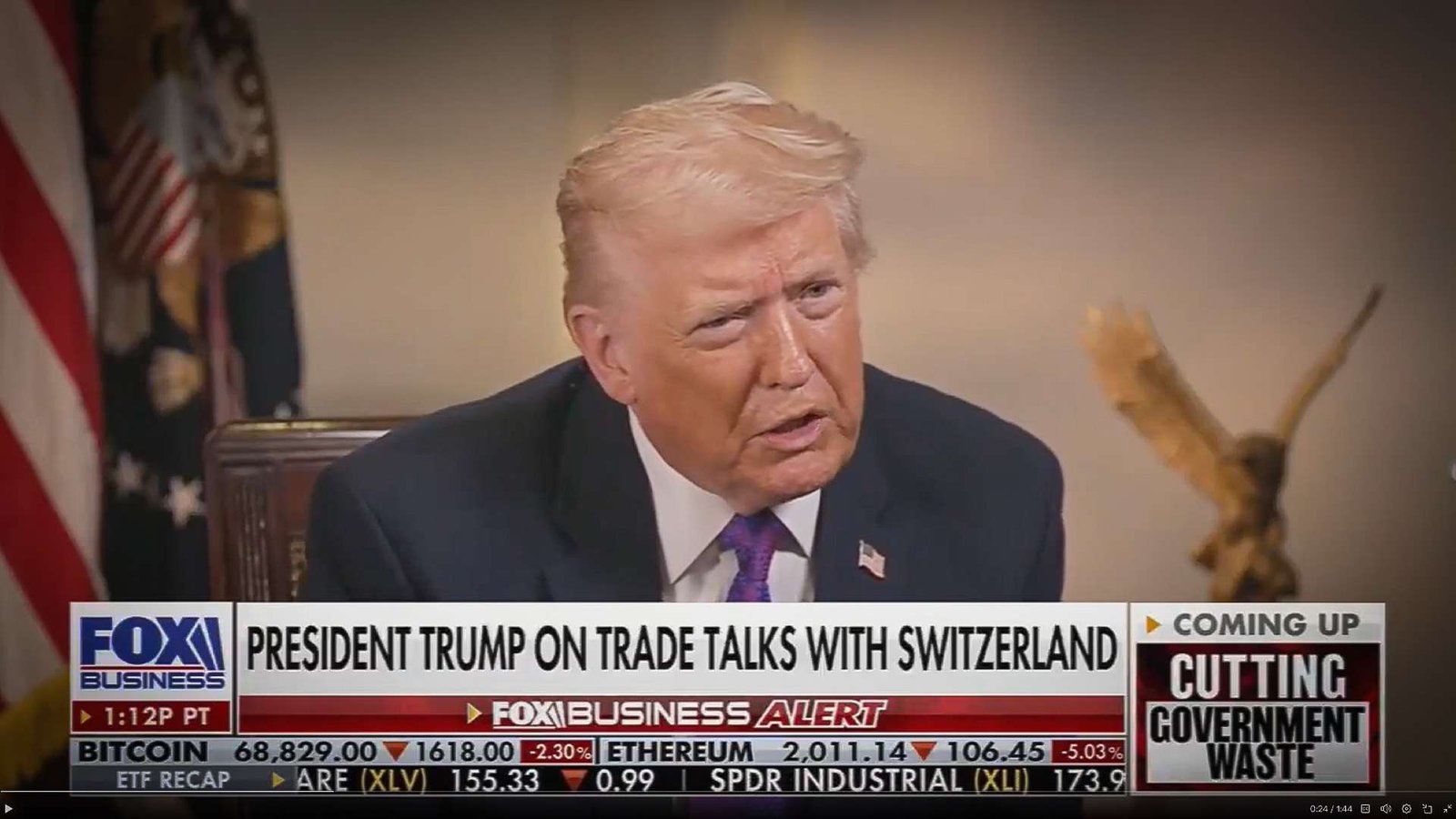
In a Fox Business interview that aired Tuesday, Trump told Larry Kudlow he imposed the original tariff on Switzerland because of a $42 billion trade deficit with the country, but he raised it because its leader was rude to him.
“I got an emergency call from, I believe, the prime minister of Switzerland,” Trump said, “and she was very aggressive, but nice, but very aggressive. ‘Sir, we are a small country, we can’t do this, we can’t do this,’ I couldn’t get her off the phone….And I didn’t really like the way she talked to us, so instead of giving her a reduction, I raised it to 39 percent.”
Trump: “So I put on a 30% tariff, which is very low. I got an emergency call from I believe the prime minister of Switzerland. She was very aggressive … I didn’t really like the way she talked to us, so instead of giving her a reduction, I raised it to 39%.” pic.twitter.com/covIESz4u2
— Aaron Rupar (@atrupar) February 10, 2026
The clip contains a number of Trump hallmarks, like fudging simple facts—Switzerland is governed by a seven-member council—misinterpreting basic macroeconomic principles, and bragging about abusing his power for petty personal reasons.
But Trump also succinctly made the case for exactly why Congress should reclaim its power from him.
After all, Trump’s justification for why he should have the singular authority to set tariff rates is that trade deficits constitute a national emergency that must be corrected by wielding America’s economic might.
That’s ridiculous for several reasons. A trade deficit just means we buy more from another country than that country buys from us; it is not a problem needing to be fixed any more than the fact that you buy food from grocery stores that buy nothing from you in return.
Besides, the Founders established “Power To lay and collect Taxes, Duties, Imposts and Excises” with Congress, not the president.
Trump’s anecdote, which he clearly shared to brag about his negotiating prowess, instead undercut his argument that he should have the singular authority to set tariff rates in response to something as trivial as a perceived personal slight.
“Under current law, the President may declare an emergency and apply tariffs in response,” McClintock said in his statement. But on the same day, Trump revealed that he considers his own hurt feelings on the level of an emergency requiring federal government response. No matter how the Supreme Court rules on the issue, Congress should find its backbone and take back its constitutionally delegated authority from a thin-skinned executive.
Read the full article here
Fact Checker
Verify the accuracy of this article using AI-powered analysis and real-time sources.