

 Freedom Index
Listen to the article
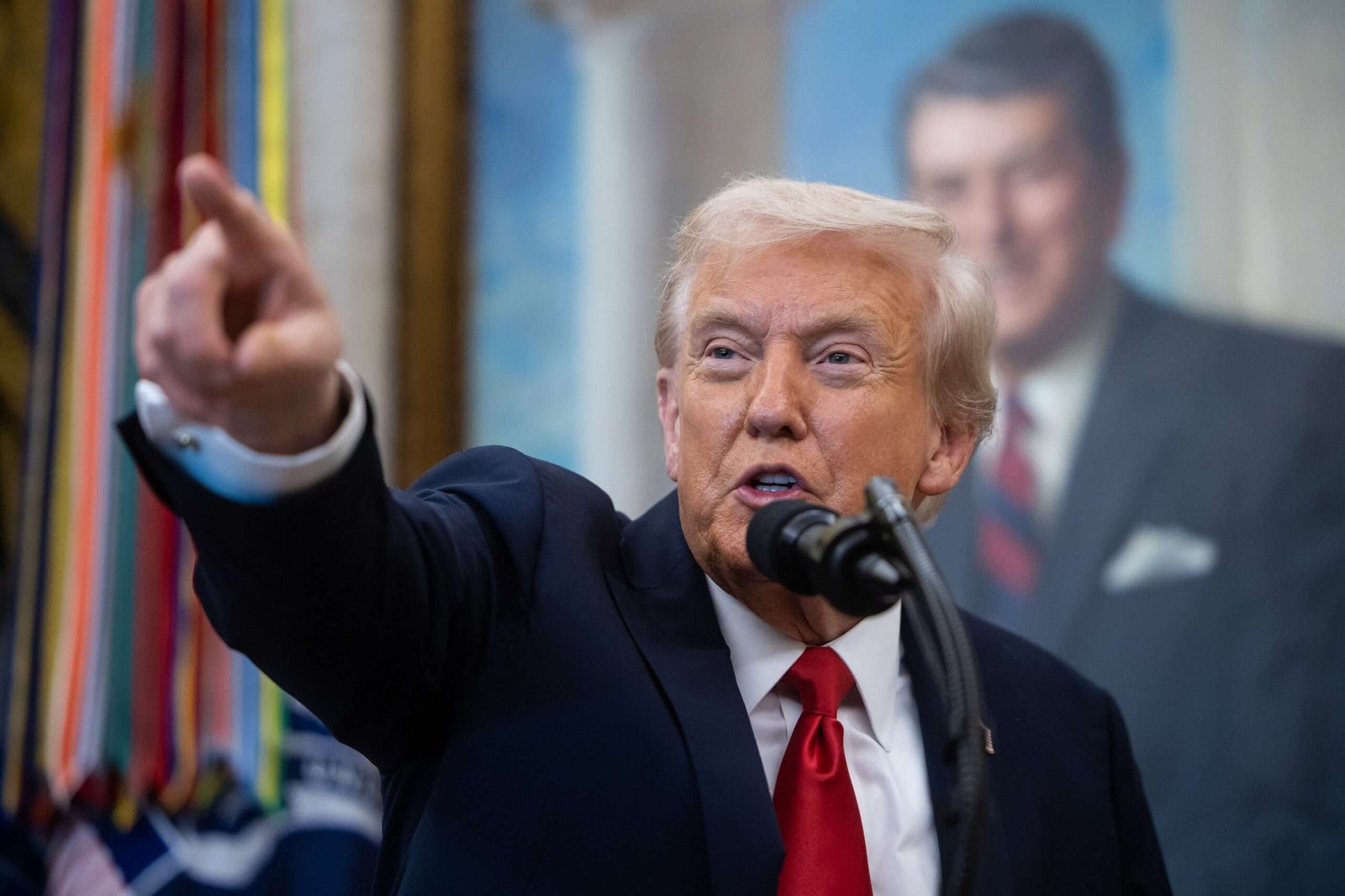
During a press conference in the Oval Office this week, a reporter asked President Donald Trump about his new policy of summarily executing suspected drug smugglers in the Caribbean Sea, which so far has included five military strikes on speedboats, killing a total of at least 27 people. “Why not have the Coast Guard stop them,” as it is “empowered by law to do?” the reporter wondered. That way, he suggested, “you can confirm who’s on the boat” and “ensure that they’re doing what you suspect.”
Trump’s answer was not that drug smuggling is tantamount to violent aggression, as he has repeatedly claimed, or that it merits the death penalty, as he has long argued. Nor did he aver that blowing up the boats is consistent with the law of war because the United States is engaged in an “armed conflict” with drug cartels, as the White House recently told Congress. Rather, Trump claimed his literalization of the war on drugs was necessary because the usual interdiction methods have been “totally ineffective” for “30 years.”
The latter assessment is accurate; for more than a century, in fact, the government has been trying and failing to prevent politically disfavored intoxicants from reaching American consumers. But Trump is wrong to think that the added deterrent of simply killing people suspected of transporting illegal drugs will finally accomplish that impossible mission, and his overestimation of that policy’s benefits is coupled with a disregard for its costs. Ordering the military murder of drug suspects simultaneously corrupts the mission of the armed forces, erasing the traditional distinction between civilians and combatants, and obliterates longstanding principles of criminal justice, dispensing with the need for charges or proof.
Historically, Trump said, 30 percent of illegal drugs imported into the United States would “come in through the seas.” Caribbean boats like the ones he is targeting account for a fraction of that fraction. “Despite the Trump administration’s portrayal of the Caribbean and Venezuela as a rampant conduit for drugs killing Americans,” The New York Times notes, “the vast majority of maritime drug trafficking bound for the United States actually occurs on the Pacific,” according to U.S. and United Nations data.
Even in the Caribbean, the impact of Trump’s bloodthirsty program has been more subtle and complicated than he suggests. “We’ve almost totally stopped it by sea now,” he declared on Wednesday.
Well, not really. “With the Trump administration cracking down on the U.S. southern border and flooding the Caribbean with military assets, drug traffickers are finding different ways to push drugs from Colombia, the world’s largest cocaine producer, to various markets,” the Times reports. According to “experts and law enforcement officials,” it says, “some smugglers are increasingly using cargo vessels in the Caribbean to hide contraband,” which “makes it particularly difficult to detect because the drugs are mixed in with legal goods, such as produce.”
In Trinidad and Tobago, “the Trump administration’s crackdown in the region has led to a sudden surge in the number of illegal air flights from South America dropping bales of drugs at sea, to be picked by larger vessels.” In Jamaica, “anti-narcotics officials say drug dealers are moving drugs in smaller quantities to lessen their loss if their loads are confiscated.” According to one of those officials, “we are seeing changes in modus operandi,” meaning “more covert means are being used to transship drugs.”
Blowing up speedboats in the Caribbean, in short, may affect smuggling patterns, but it cannot reasonably be expected to have a noticeable impact on the supply available to American consumers. Trump is attacking a specific smuggling method, but there are many alternatives, including other sea routes, transportation in vehicles across the southern border, smuggling by air and tunnels, and shipment by mail and courier services.
Because there are so many ways to evade any barriers the government manages to erect, there is only so much that interdiction, no matter how violent, can accomplish. At most, it imposes costs on traffickers that may ultimately be reflected in retail prices. But that strategy is complicated by the fact that illegal drugs acquire most of their value close to the consumer. The cost of replacing seized intercepted shipments is therefore relatively small, a tiny fraction of the “street value” trumpeted by law enforcement agencies. As you get closer to the retail level, the replacement cost rises, but the amount that can be seized at one time falls.
Trump sees no such difficulties, even as he complains that interdiction thus far has been “totally ineffective.” As he tells it, blowing up a drug boat reduces the supply to Americans by whatever amount the vessel was carrying. “Every boat that we knock out, we save 25,000 American lives,” he averred at the press conference.
That claim is based on a dubious calculation that divides the weight of intercepted drugs by the estimated lethal dose. Trump’s logic implies that, by destroying five drug boats, he saved 125,000 lives, which exceeds the annual estimate of drug-related deaths in the United States. This is the same fallacious reasoning on which Attorney General Pam Bondi relied when she absurdly asserted that the Trump administration had “saved…258 million lives” by intercepting shipments of illicit fentanyl.
That is not the only problem with Trump’s claim. He referred repeatedly to fentanyl, which accounts for more than two-thirds of drug deaths, implying that was the drug the boats were carrying. “Every boat is saving 25,000 lives,” he said. “The boats get hit, and you see that fentanyl all over the ocean.” But illicit fentanyl in the United States overwhelmingly travels by land across the border with Mexico, while the Caribbean traffic consists mainly of cocaine. Although “the Caribbean continues to be an important hub for the trafficking of Colombian cocaine, with some of it passing through Venezuela,” the Times notes, that country “plays no role in the movement of fentanyl.”
Trump’s conflation of cocaine with fentanyl does not inspire confidence in his assertion that all of the destroyed boats were in fact carrying drugs, or that all of the people whose deaths he ordered were in fact “narcoterrorists.” As Sen. Rand Paul (R–Ky.) notes, “Coast Guard statistics show that about one in four interdictions finds no drugs,” which suggests the potential for lethal error.
Trump himself has repeatedly alluded to that risk. After the first strike, he joked about it: “I think anybody that saw that is going to say, ‘I’ll take a pass.’ I don’t even know about fishermen. They may say, ‘I’m not getting on the boat. I’m not going to take a chance.'” On Wednesday, Trump again suggested that the threat posed by the boat attacks is not limited to drug smugglers: “I don’t know about the fishing industry. If you want to go fishing, a lot of people aren’t deciding to even go fishing.”
NBC News reports that “Republicans and Democrats on Capitol Hill have left briefings about the strikes frustrated with the lack of information.” Some legislators “have asked for unedited video of the strikes, reflecting the kind of basic information they seek, but the administration has so far refused to provide it.”
Lawmakers “are also asking the administration to explain who was killed in the strikes, how they were positively identified as legitimate targets for lethal force, what intelligence indicated that they had possible links to drug trafficking gangs and what information showed that they were heading to the United States with drugs.” Even “Republicans who broadly support the attacks and the administration generally” are “concerned about the level of precision of the intelligence used to determine targets and the possibility that an American citizen could be killed in the operations.”
These are all good questions. But there is no getting around the uncertainty inherent in killing people “assessed” to be drug smugglers. By treating drug law enforcement as a military matter, Trump avoids the inconvenience of arresting suspects and presenting evidence against them in court. In effect, he is imposing the death penalty, which does not ordinarily apply in drug trafficking cases, without statutory authorization or any semblance of due process. And he is doing all that based on the manifestly mistaken assumption that he has found the key to finally winning the unwinnable war on drugs.
Read the full article here
Fact Checker
Verify the accuracy of this article using AI-powered analysis and real-time sources.