

 Freedom Index
Listen to the article
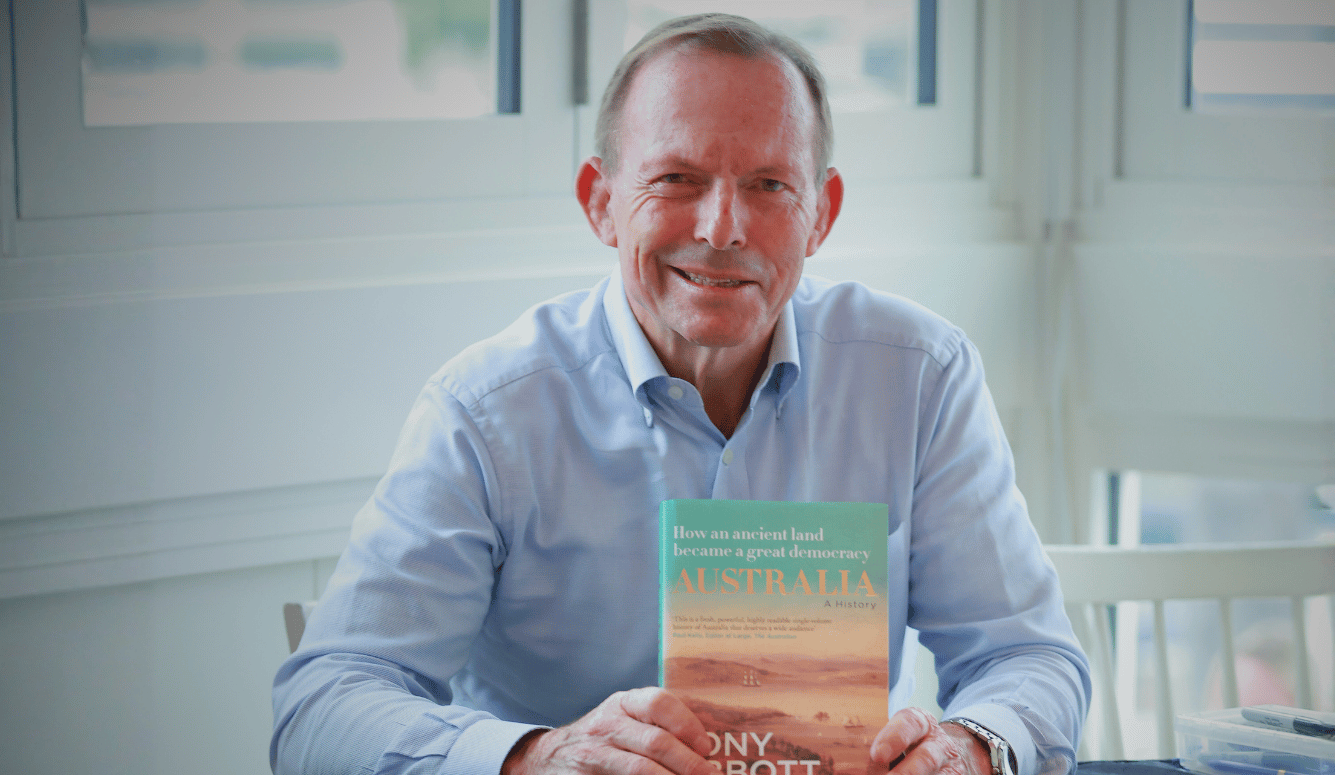
A Review of Australia: A History by Tony Abbott, 448 pages, Harper Collins AU (February 2026).
It is not often a former Prime Minister writes a history of his country. Winston Churchill wrote numerous books on British and Imperial history, some sprawling over multiple volumes. By contrast, Tony Abbott’s single volume, Australia: A History, is short. Its brevity is facilitated by the brevity of Australia’s history (construed as what is written down) as distinct from its prehistory (which is passed on through oral traditions or is inferred from archaeological digs and the like). This is not a criticism.
The written history of Australia prior to 1788 is sparse. There were a few dozen documented landings on the north, west, and south coasts, all of which recorded much the same thing: The natives are naked and hostile; or they are naked and evasive. There is no sign of gold, silver, nutmeg or any other spice of value. Zero investment potential here. Move on. Among the most widely quoted assessment is that of the English pirate turned Royal Navy officer, William Dampier, who described the Australian Aborigines as “the miserabilist people in the world,” owing to their nudity and lack of material possessions.
Tony Abbott was prime minister of Australia from 2013–15. He also came close to winning the 2010 election, which resulted in a hung parliament, but Labor rival Julia Gillard was able to cobble together a majority by negotiating with three independents and a Green. When he did come to power at the next election, his background as a Catholic seminarian who competed in surf races wearing budgie smugglers was widely derided, as were the two Oxford Blues he won as a boxer. Nicknamed “the Mad Monk”—his name was frequently misspelled as Abbot—he was a cartoonist’s dream and his Catholic observances were far more heavily scrutinised in the 2013 election than the Anglican ones of his opponent, Kevin Rudd.
Abbott went to Oxford on a Rhodes Scholarship, a prestigious award, not generally handed out to dunces. While often characterised as a pugilistic thug and attack dog in politics, his writing is lucid, clear, and well argued. He makes the point that while Australian history has some dark episodes, for the most part it is a history Australians can be proud of, whatever their race and wherever they come from. To be Australian, he says, is to win the lottery of life.
He states his agenda early on, in an Author’s Note:
This is the book that should never have been needed. Until quite recently it was taken for granted that Australia was a country that all its citizens could take pride in, even the Aboriginal people, for whom the 1967 referendum marked full, if belated, acceptance into the Australian community. But a generation of anxiety over Indigenous dispossession, and the academic triumph of what Geoffrey Blainey has called the “black armband view” of Australian history, has left many Australians ambivalent about our past, even though it is far more good than bad.
Abbott rejects the “Invasion Day” narrative that sees dispossession of the indigenous population as a massive failure for which contemporary Australia must atone through the agenda of “Voice, Truth, and Treaty” proposed in the Uluru Statement from the Heart. Tellingly, he ends his history with the rejection of the Voice in the 2023 referendum. He says Australia did right to reject an exclusive “indigenous only” race-based addition to our constitution.
Abbott does not omit key facts about Aboriginal dispossession. He simply makes the argument that is should be a source of pride and wonder that a society established as a penal settlement turned out to be one of the most successful and stable liberal democracies in the world.
He points out that the Australian colonies pioneered democratic advances, overtaking the Mother Country on key metrics in the latter half of the nineteenth century. The secret ballot, nowadays standard around the world, used to be known as the Australian ballot. South Australia gave women the vote and the right to seek election in 1894. Technically, Aborigines got the vote on same basis as white men in 1856 at the inception of self-government there. Alas, few met the property qualifications, and few were interested in enrolling to vote. He also notes that it did not take a war to unite Australia or to keep it united, unlike America which had the Revolutionary War and the Civil War.
Like many politicians (when they want to) Abbott has a way of getting to key points without stalling, obfuscation, or meanderings through acres of academic irrelevance or minute detail. Unlike his brief term as prime minister, there are no erratic captain’s calls in Abbott’s history of Australia. Most of his interpretations are much the same as would have been taught when he was at school in Sydney. But there is no Great Australian Silence on the massacres and atrocities in his narrative. They have their place but they are not the sum total of the national story. He picks up Noel Pearson’s idea, elucidated in his book Mission, about the three great strands in Australia’s story: The ancient Aboriginal foundation, its British institutions, and the multicultural adornment of migration from all around the world.
Abbott writes of the “everywhen” of the Dreamtime and narrates the essential facts in the evolution of British constitutional monarchy from Magna Carta through to the Glorious Revolution. He briskly narrates the stories of the first explorers (e.g. Torres, Tasman, Dampier, and Cook) and the First Fleet. He describes the events of the first Australia Day on 26 January 1788 when men cleared ground, put up a flagpole, ran up the Union Jack, and drank toasts to the health of the King and the success of the Colony.
He refers to the Australian settlement, which is the view that the government will provide a minimum required for sustenance. In Australia, what we now call the welfare state started with the government store, which provided rations for all. When food shortages struck in the early colony, as attempts to grow crops failed, the supply ship Sirius was wrecked off Norfolk Island, and rations were cut, Governor Arthur Phillip hanged convicts for stealing food. He hanged Marines for doing the same thing. All got the same rations, himself included. The Royal Navy ran on meritocratic principles and in extremes, all were treated equally. As Abbott observes, leadership comes from the top. Australia was fortunate in its first leader.
Australia Day: A Contentious Celebration
The founding of Australia is still worthy of commemoration.

Abbott’s selection of what is historic is conventional. There’s no injection of contemporary obsessions with queerness, intersectionality, and oppression, or any attempts to give voice to the voiceless. As an ex-prime minister, he focuses on the great political and economic questions of the day. Unsurprisingly for a man who led the Liberal Party of Australia into office in 2013, he stresses the “liberality” of Lord Sydney’s project to establish a penal settlement at Botany Bay. It was small-l liberal because it was more focused on rehabilitation than on punishment. This was a stance that became controversial in the later years of colonial rule as a result of the Bigge Review’s recommendations of more severe punishment for transported felons. There was outrage in England that felons were writing to their relatives saying, come out here, because life as a transported convict was better than life as a free man in England.
Read the full article here
Fact Checker
Verify the accuracy of this article using AI-powered analysis and real-time sources.