

 Freedom Index
Listen to the article
Reason has a rule against starting essays with quotes from Friedrich Hayek. After all, one could start nearly every essay in this magazine with a bon mot from the Austrian-born economist and classical liberal hero. But sometimes things get bad enough that only a Hayek quote will do.
In this month’s cover story, where Eric Boehm documents how the GOP has been slouching toward socialism, he kicks things off with Hayek’s warning that economic nationalism can be “the bridge from conservatism to collectivism” and that thinking in terms of “our” industries is only a short step from demanding that they be “directed in the national interest.”
President Donald Trump’s second-term “national champion” economic strategy has metastasized from tariffs and jawboning to direct control: a golden share in U.S. Steel and government equity stakes in Intel, MP Materials, Lithium Americas, and Trilogy Metals. No longer veiling every power grab under the guise of responding to an emergency, he is presenting these as necessary for national security and other ongoing national interests. The result, Boehm argues, will be more state control of the commanding heights, and that will invite politicized decision making, bad bets, and the well-documented underperformance that tends to follow when the state takes seats in corporate boardrooms.
Is this socialism? The word was chosen advisedly. What Trump is doing is more akin to state capitalism, for now. You might even consider whether the term fascism applies, if you want to pick a fight rather than change minds.
But once upon a time, Republicans were at least moderately chastened by accusations that their policies resembled socialism in any way. For at least a couple of decades, a staple among the conservative chattering classes was to lament that the kids these days keep telling pollsters they prefer socialism to capitalism. They’re still doing it: In an October Axios–Generation Lab poll of college students, 67 percent hold a positive or neutral association with the word socialism, compared with 40 percent with the word capitalism.
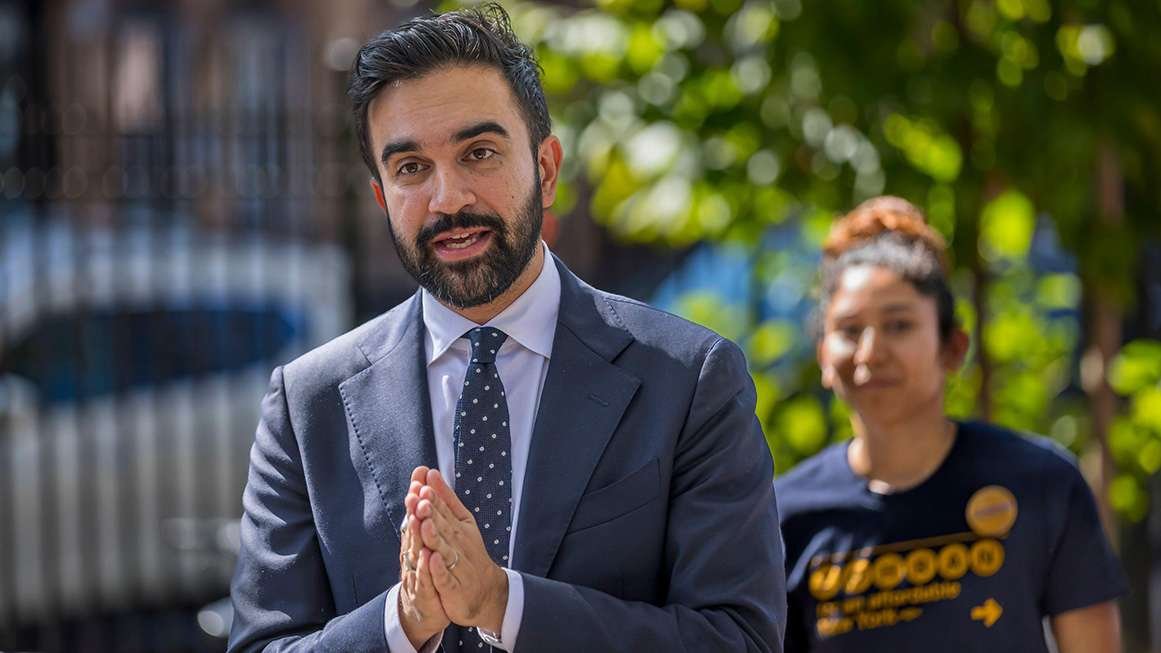
This political moment is captured perfectly in Hayek’s dedication of The Road to Serfdom: “To the socialists of all parties.” As Reason goes to press with an issue accusing the GOP of socialist tendencies, a self-described socialist has just been elected mayor of New York City. Zohran Mamdani ran on a platform of rent freezes, higher minimum wages, free buses, new taxes on the wealthy, and city-run grocery stores. The BBC, covering Mamdani’s successful campaign, noted that democratic socialism “has no clear definition”—fair enough—but then preposterously went on to say that it “essentially means giving a voice to workers, not corporations.”
Both in New York and in Washington, D.C., officials are still just taking baby steps toward state control of the economy. But baby steps in the wrong direction add up, especially when they build new precedents for government ownership as a routine policy tool rather than a last-ditch response to crisis.
When a government marries price controls, nationalizations, and an ever-expanding definition of “strategic” sectors, the end state is neither abundance nor resilience. Venezuela’s long slide—from petro-prosperity to hyperinflation, capital flight, shortages, and political repression—wasn’t caused by just one statute or one charismatic leader, but by a theory that essential industries must be steered from the center of political power. That theory eventually consumes everything it touches, including the price mechanism, the independence of firms, and the credibility of money.
When Hayek referred to socialism, he meant state control of the economy, not the welfare state in its many guises. (Though it is worth noting that both major parties have campaigned upon pledges not to cut, reform, or otherwise bring reasonable fiscal alignment to the largest entitlement programs.) On that narrower definition, the United States in 2025 is far from true socialism.
It is, however, troublingly closer than it once was. The habit of using state power to override market choices is growing on both left and right. Republicans increasingly justify industrial policy as a national security imperative; Democrats often insist on “public options” across sectors. In both cases, the mechanism is the same: Redefine “our” interests so broadly that almost any private decision becomes a public question.
This is where the GOP’s new enthusiasm for equity stakes should alarm anyone who ever identified as a fan of the free market. If Washington owns a golden share, a firm’s governance documents start to read like an executive branch wish list. If Washington owns 10 percent of a chipmaker, the political incentives point toward doubling down when the bet goes bad, not exiting and taking the loss. The more the state identifies with “national champions,” the more capital and attention flow toward the politically connected rather than the productive. If we aren’t yet on the road to serfdom, perhaps we’re pulling up to the highway on-ramp.
Meanwhile in New York, the new mayor’s platform highlights a different risk: the soft normalization of municipal ownership and price-setting as first-resort tools for meeting affordability goals. Even Mamdani’s admirers concede that many of his ideas will run headlong into state law, institutional veto points, and budget arithmetic. That is an argument not just about feasibility but about humility. Should a city government that struggles to maintain buses on schedule try to operate grocery logistics at scale? Should it even be operating buses? As Mamdani went from long-shot candidate to frontrunner, the more ideologically edgy elements of his platform started to rapidly fall away. But counting on him to keep scaling back bad ideas is too dangerous a gamble for America’s biggest city.
Whether the pretext is “national security” or “affordability,” the method is the same: replacing voluntary exchange with political allocation. Since we’re already indulging ourselves, let’s let Hayek have the last word: “The effect of the people’s agreeing that there must be central planning, without agreeing on the ends, will be rather as if a group of people were to commit themselves to take a journey together without agreeing where they want to go; with the result that they may all have to make a journey which most of them do not want at all.”
Read the full article here
Fact Checker
Verify the accuracy of this article using AI-powered analysis and real-time sources.