

 Freedom Index
Listen to the article
Bitcoin was the first asset to price the Iran war because it was the only liquid market open when U.S. and Israel first launched their attack on a Saturday, a few weeks ago.
It dropped 8.5% that day. Two weeks later, it has outperformed gold, the S&P 500, Asian equities, and the Korean stock market. Only oil and the dollar have done better, and both are direct beneficiaries of the conflict itself.
Bitcoin’s safe-haven status — a notion that was contested amid late last year’s price lull — seems to be back in investors’ minds. On top of that, it’s acting like the fastest shock absorber in global markets as escalations are getting bigger while drawdowns are getting smaller.
The pattern becomes clearer when looking at where bitcoin found buyers after each sell-off.
On Feb. 28, the day of the initial strikes, it bottomed at $64,000. On March 2, after Iran’s retaliatory missiles hit Gulf states, the floor was $66,000. By March 7, after a week of sustained conflict, the low was $68,000. After the tanker attacks on March 12, it held $69,400. And after Kharg Island on Saturday, the low was $70,596.
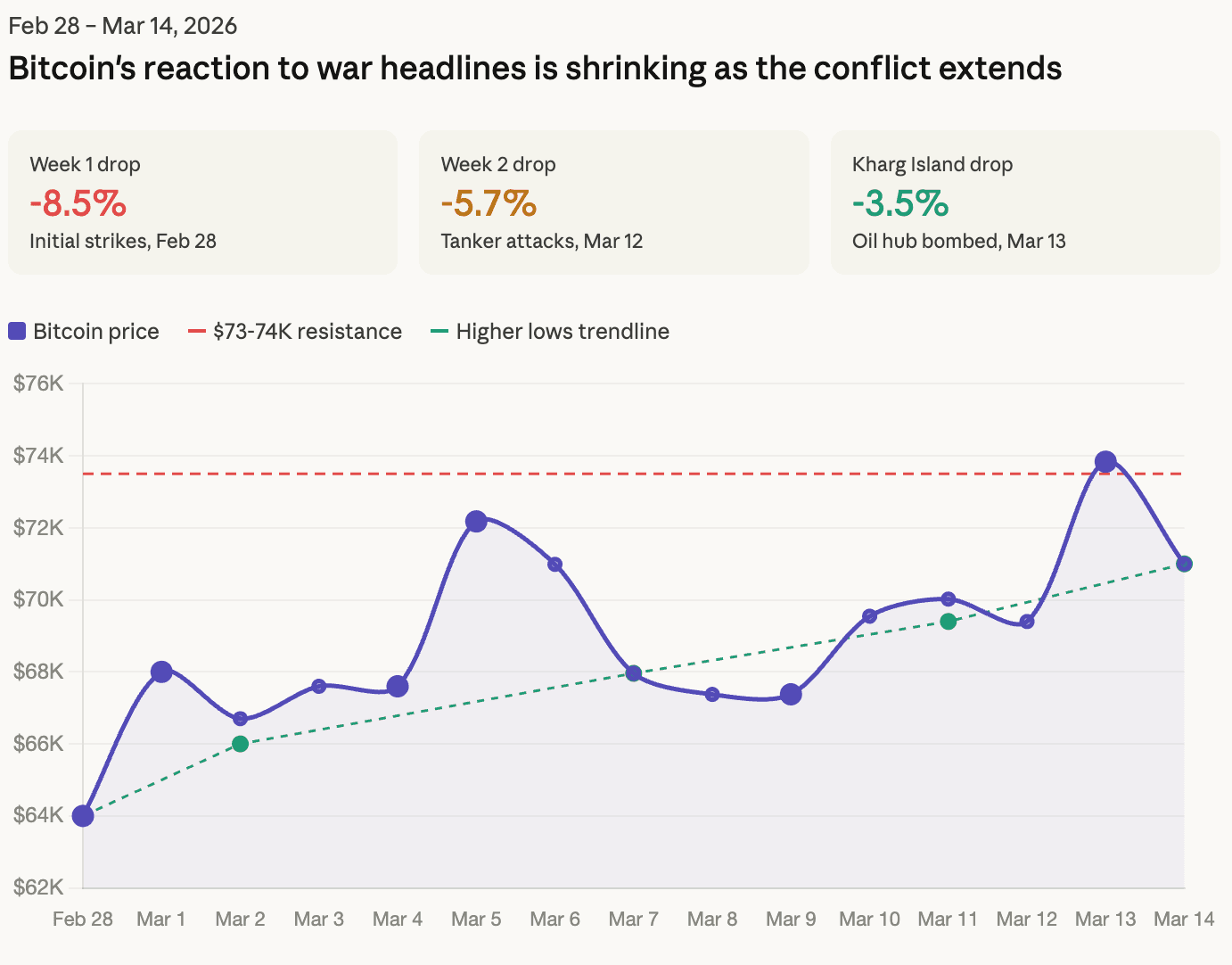
In simpler terms, each selloff finds buyers at a higher level than the last.
The trendline of higher lows has been rising by roughly $1,000-$2,000 per event, compressing the range from below, while $73,000-$74,000 holds as a ceiling that has now rejected bitcoin four times.
That compression has to resolve eventually. Either the floor catches the ceiling and bitcoin breaks above $74,000 on the next attempt, or the pattern breaks, and a larger escalation finally overwhelms the buying.
Holding strong
The most striking part is what bitcoin has done relative to other assets over the same two weeks.
Oil is up more than 40% since the war began, as the chart below shows. The S&P 500 is down. Gold has been volatile in both directions. Asian equities had their worst week since March 2020.

All this doesn’t mean bitcoin is suddenly a safe haven, however, as it still sells on every headline. But it recovers faster each time, and each recovery holds at a higher level.
The contrast with earlier this year is sharp. In early February, a sudden liquidation cascade wiped out $2.5 billion in leveraged positions over a single weekend as bitcoin plunged to $77,000, erasing roughly $800 billion in market value from its October peak.
That episode looked like the kind of event that could break market confidence for months. Instead, it appears to have cleared out the weakest hands and reset positioning, leaving a leaner market that has absorbed every war headline since without repeating that kind of forced selling.
The macro overlay adds context, meanwhile. Trump said late Friday he spared oil infrastructure on Iran’s oil-producing Kharg Island “for reasons of decency” but would “immediately reconsider” if Iran kept blocking the Strait of Hormuz. Iran responded that any strike on energy infrastructure would trigger retaliatory attacks on U.S.-linked facilities.
That conditional threat is new, and if it materializes, the supply disruption the IEA already called the largest in history will get dramatically worse.
But bitcoin’s adaptation to the war tells traders something about what this market has become.
It’s not a haven and not purely a risk asset. It has become a 24/7 liquidity pool that absorbs shocks faster than anything else because it’s the only thing trading when the shocks arrive.
Read the full article here
Fact Checker
Verify the accuracy of this article using AI-powered analysis and real-time sources.