

 Freedom Index
Listen to the article
The first thing you need to know about The Drama is that it’s not what you expect. Like really, really not what you expect.
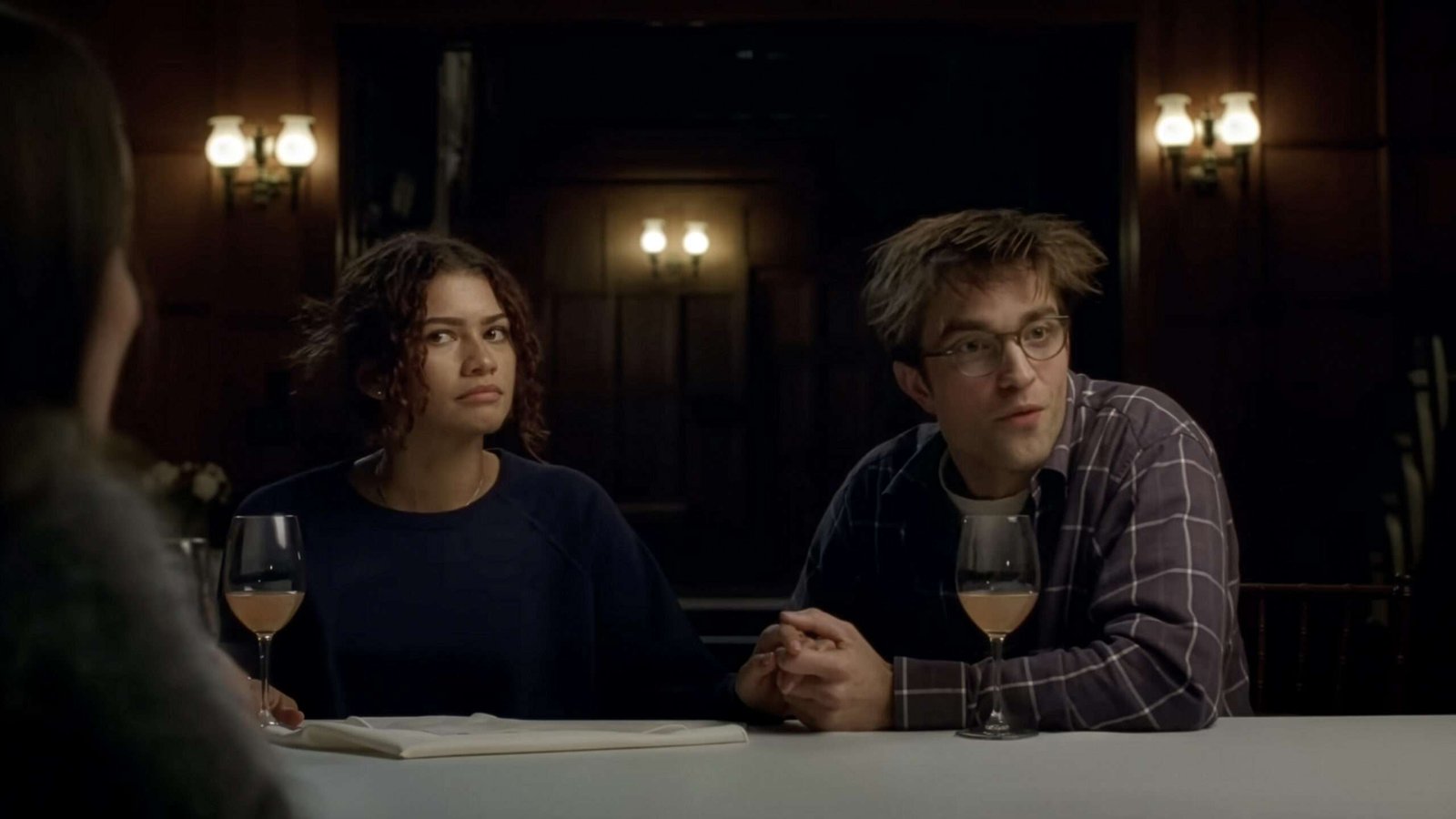
The marketing has positioned the film as an awkward twist on the rom-com with a pair of hot young stars, Robert Pattinson and Zendaya, batting eyes at each other as they stumble and mumble their way to a wedding. It’s got the A24 imprimatur and a low-light, Instagram aesthetic that suggests a skeptical, modern take on young love. It’s been sold as a very conventional kind of unconventional romance.
And, well, it is that—sort of. But it’s much weirder, much darker, and much more uncomfortable than you’ve been led to assume. It’s a movie about marriage and mind games, social taboos, and the difficulty of ever knowing, much less loving, another human being. It should have been called The Psychodrama.
Zendaya and Pattinson play Emma and Charlie, a young couple living in Boston. Their relationship begins with an amusing meet-cute in a coffee shop, when Charlie pretends to like the book she’s reading even though he hasn’t read it. Eventually he comes clean, they move in together, and soon they’re engaged.
On the cusp of their wedding, as they’re trying out wedding food with another couple—the best man and maid of honor—they have a little too much to drink and decide to play a game. What’s the worst thing each of them has ever done?
They all reveal something suitably awful yet sort of funny, mostly impulsive, antisocial acts from their youth. And then Emma reveals, well, something about herself. Something that no one knows how to respond to. Something that changes everything.
To say much more would be to spoil the movie’s central provocation, which amounts to the breaking, or at least bending, of a major cultural taboo. Neither Charlie nor the friends know quite what to do. And what ensues is, yes, a lot of drama.
Written and directed by Kristoffer Borgli, whose last film was the surrealist Nic Cage picture Dream Scenario, the film traffics in a similar sort of psycho-social strangeness, with dreamlike imagery interspersing scenes of Charlie’s escalating mania as he struggles to make sense of Emma’s revelation.
It’s a tricky tonal balance. Her confession is clearly meant to shock and upset viewers. It’s also supposed to be funny. Borgli not only manages to achieve both, he often manages to achieve both at the same time, often without a single clear directive as to which is appropriate. It’s a movie that’s intentionally, and effectively, designed to make viewers feel emotionally confused.
That emotional confusion stems partly from a sort of social confusion, as both the characters and viewers are confronted with a scenario for which there is no clear cultural playbook. The movie seems to be reacting against the common-on-social-media notion of situations that demand a single, obvious, uniform social and emotional response. Sometimes there is no clearly correct way to respond to a difficult or upsetting event. Sometimes reality demands, or at least supports, multiple conflicting and contradictory responses.
Occasionally, the film strains credulity in its psychological complexities. There are Big Ideas that it gestures at but can’t fully support. And the cringe-shock of its big reveal will almost certainly divide viewers, especially those expecting something more conventional.
But the movie’s strength is in its human smallness. It never feels like a sociological treatise or a series of tweets about how We Live In a Society. Instead, it’s a movie about people, and how they are strange and difficult and impossible to know. It’s a movie about marriage and relationships, and how even the most intimate partnerships involve telling lies and stories about yourself, and reintroducing yourself over and over again.
It’s drama. It’s life. It’s a pretty good movie.
Read the full article here
Fact Checker
Verify the accuracy of this article using AI-powered analysis and real-time sources.