

 Freedom Index
Listen to the article
Key Takeaways
Playback Speed
Select a Voice
In brief
- Some crypto ATMs were targeted by law enforcement in 2025.
- Meanwhile, some states took action against Bitcoin ATM operators.
- There were some renewed calls for restrictions on Capitol Hill.
Crypto ATMs faced heightened scrutiny in 2025, as authorities and lawmakers tried to confront a growing number of scams facilitated by these machines in the U.S.
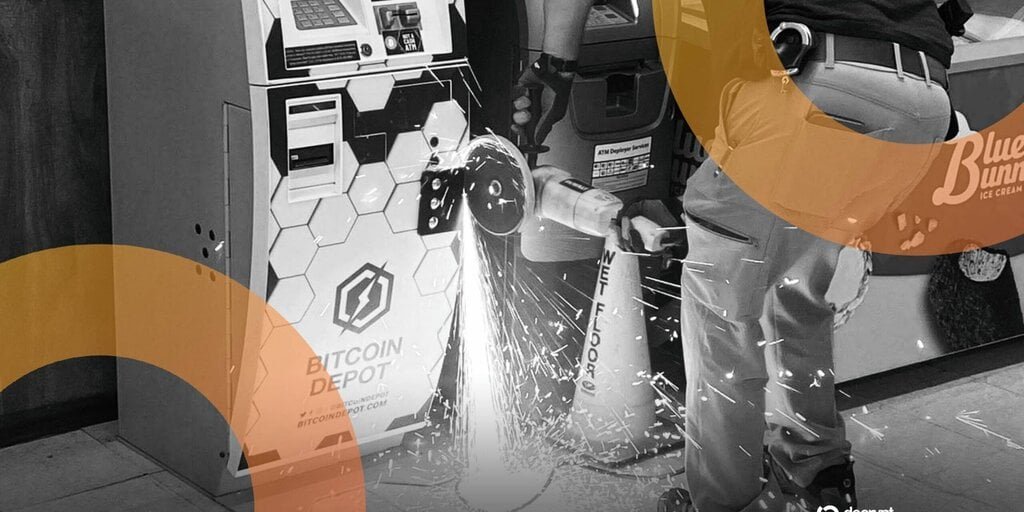
Some officials took matters into their own hands with power tools, while two attorneys general brought lawsuits against several of the biggest firms in the space. Meanwhile, agencies and other entities issued consumer alerts addressing the elderly.
Crypto ATM operators say their machines provide a valuable service, allowing anyone to buy digital assets like Bitcoin with physical cash. However, critics argue that these firms could do more to prevent older Americans from losing funds to scams—even if that’s bad for business.
Last year, Americans reported $246 million in losses from crypto ATMs to the Internet Crime Complaint Center, a 99% increase compared to the year prior, according to an annual report. Around 43% of those losses stemmed from Americans over the age of 60.
The scam is fairly straightforward: Older Americans are withdrawing cash from their bank accounts, converting it into crypto using operators’ machines, and then sending it to people who are impersonating the government, a business, or workers in tech support.
Still, some renditions are more creative than others, including a scam in Massachusetts where residents lost money to people demanding crypto payments for supposedly missing jury duty.
The irreversible nature of crypto transactions makes it challenging for victims to recover funds once scammers disappear, while the fine print of user agreements associated with these machines has emerged as another potential barrier in court.
The Iowa Supreme Court, for example, found in two cases this year that a crypto ATM operator was entitled to keep the cash associated with fraud, because the company’s terms and services require users to say they own the digital wallet receiving funds—not third-parties.
“Once that transaction is completed, when the user inserts their cash and their crypto is funded into the wallet of their choosing, that ends our involvement in the transaction,” Chris Ryan, chief legal officer of crypto ATM operator Bitcoin Depot, told Decrypt in June.
Bitcoin Depot works with local law enforcement to track victims’ crypto, but by breaking into the company’s machines, Ryan said authorities are creating more victims, leaving them with damaged property and missing cash at least a dozen times a year.
Earlier that month, Jasper County sheriffs sent sparks flying when they cut into one of Bitcoin Depot’s kiosks at a rural gas station in Texas. In total, law enforcement retrieved $32,000 in cash, which Bitcoin Depot said actually belonged to them.
‘Common-sense guardrails’
In Iowa, Bitcoin Depot and competitor CoinFlip have faced pressure from Attorney General Brenna Bird. In February, she filed a lawsuit against the companies, claiming that they profit off of scam victims while charging “massive, hidden transaction fees,” according to a fact sheet.
The criticism regarding hidden fees was later echoed by Washington, D.C. Attorney General Brian L. Schwalb, who filed a lawsuit against crypto ATM operator Athena Bitcoin in September. In some cases, the federal district’s residents were paying 26% undisclosed fees, he alleged.
Schwalb’s lawsuit, which accused Athena of exploiting elderly adults while violating consumer protection laws, argued that warnings displayed on the company’s machines were irrelevant, considering the circumstances under which most victims are approached them.
“Elderly scam victims standing terror-stricken in gas stations, pockets stuffed with uncomfortable amounts of cash, do not understand what it means to ‘generate’ a cryptocurrency wallet or have their own ‘personal Bitcoin wallet,’” the lawsuit’s complaint stated.
An Athena spokesperson told Decrypt that the firm strongly disagrees with the allegations and will defend itself in court. Bitcoin Depot and CoinFlip denied claims in Bird’s lawsuit, while highlighting procedures like ID checks and refunded transaction fees to ABC News.
This year, Sen. Dick Durbin (D-IL) introduced the Crypto ATM Fraud Prevention Act. The legislation would impose strict transaction limits on crypto ATMs, while requiring companies to offer full refunds to fraud victims if they report losses within a certain period.
Durbin said the legislation features “common-sense guardrails” that could protect the elderly, but the bill hasn’t progressed since it was introduced in the Republican-led Senate in February.
Although efforts to regulate crypto ATMs at the federal level have been unproductive this year, over a dozen states drafted or passed bills or regulations calling for limits on transactions, scam warnings, and refund options, or new licensing requirements, according to AARP.
In June, the nonprofit dedicated to older Americans found that 20 states had moved to address a growing number of scams facilitated by crypto ATMs, noting that it is “continuing to work with lawmakers in other states to adopt similar protections to prevent fraud using crypto kiosks.”
At the time, city council members in Spokane, Washington, had just passed a citywide ban on crypto ATMs, affecting around 50 kiosks located in the local area.
A couple of months later in August, Illinois became the first first state in the Midwest to pass bills aimed at curbing fraud related to crypto ATMs, requiring ATM operators to register with state regulators, cap transaction fees at 18%, and limit daily transactions to $2,500 for new users.
That same month, the Treasury Department’s Financial Crimes Enforcement Network issued an urgent warning on crypto ATMs, saying “the risk of illicit activity is exacerbated” by operators that don’t maintain proper procedures under the Bank Secrecy Act.
As of mid-November, around 30,750 crypto ATMs had been installed across the U.S., representing 78% of kiosks worldwide, according to Coin ATM Radar. Still, the global tally of machines has hovered around 40,000 since 2022.
Local governments in the U.S. have pursued restrictions on crypto kiosks, but some countries have taken a sweeping approach to safeguards. New Zealand, for example, outlawed the machines across the country in June, as part of efforts to choke off criminal finance.
Daily Debrief Newsletter
Start every day with the top news stories right now, plus original features, a podcast, videos and more.
Read the full article here
Fact Checker
Verify the accuracy of this article using AI-powered analysis and real-time sources.
Get Your Fact Check Report
Enter your email to receive detailed fact-checking analysis
Continue with Full Access
You've used your 5 free reports. Sign up for unlimited access!
Already have an account? Sign in here