

 Freedom Index
Listen to the article
The SAFE act, introduced by Senators Mike Lee (R-UT) and Dick Durbin (D-IL), is the first of many likely proposals we will see to reauthorize Section 702 of the Foreign Intelligence Surveillance Act (FISA) Amendments Act of 2008—and while imperfect, it does propose a litany of real and much-needed reforms of Big Brother’s favorite surveillance authority.
The irresponsible 2024 reauthorization of the secretive mass surveillance authority Section 702 not only gave the government two more years of unconstitutional surveillance powers, it also made the policy much worse. But, now people who value privacy and the rule of law get another bite at the apple. With expiration for Section 702 looming in April 2026, we are starting to see the emergence of proposals for how to reauthorize the surveillance authority—including calls from inside the White House for a clean reauthorization that would keep the policy unchanged. EFF has always had a consistent policy: Section 702 should not be reauthorized absent major reforms that will keep this tactic of foreign surveillance from being used as a tool of mass domestic espionage.
What is Section 702?
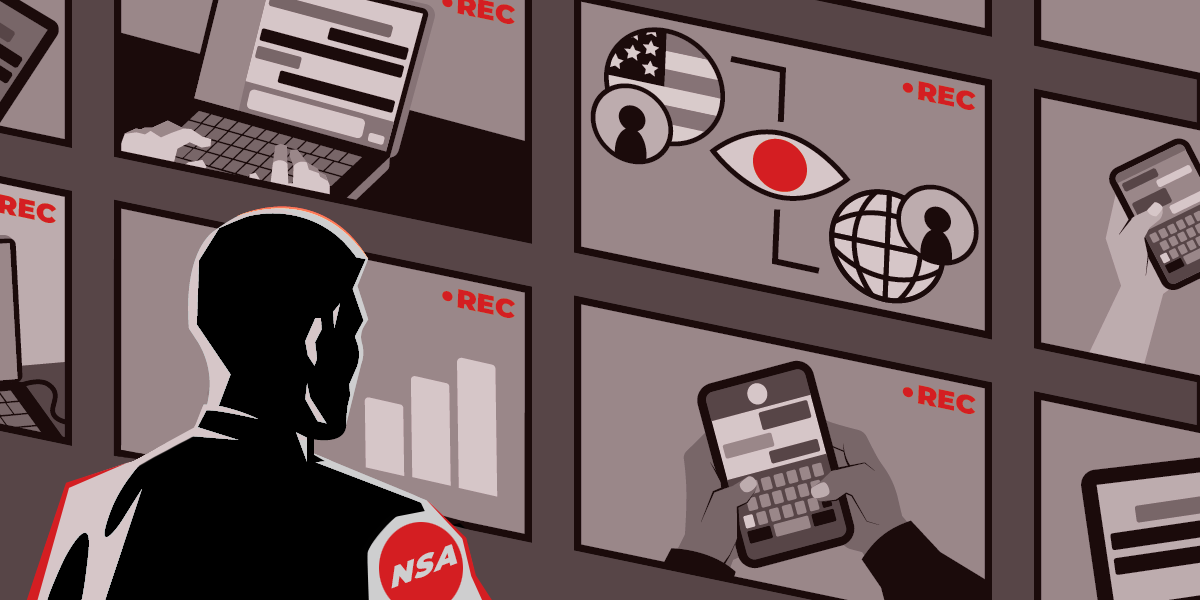
Section 702 was intended to modernize foreign surveillance of the internet for national security purposes. It allows collection of foreign intelligence from non-Americans located outside the United States by requiring U.S.-based companies that handle online communications to hand over data to the government. As the law is written, the intelligence community (IC) cannot use Section 702 programs to target Americans, who are protected by the Fourth Amendment’s prohibition on unreasonable searches and seizures. But the law gives the intelligence community space to target foreign intelligence in ways that inherently and intentionally sweep in Americans’ communications.
We live in an increasingly globalized world where people are constantly in communication with people overseas. That means, while targeting foreigners outside the U.S. for “foreign intelligence Information” the IC routinely acquires the American side of those communications without a probable cause warrant. The collection of all that data from U.S telecommunications and internet providers results in the “incidental” capture of conversations involving a huge number of people in the United States.
But, this backdoor access to U.S. persons’ data isn’t “incidental.” Section 702 has become a routine part of the FBI’s law enforcement mission. In fact, the IC’s latest Annual Statistical Transparency Report documents the many ways the Federal Bureau of Investigation (FBI) uses Section 702 to spy on Americans without a warrant. The IC lobbied for Section 702 as a tool for national security outside the borders of the U.S., but it is apparent that the FBI uses it to conduct domestic, warrantless surveillance on Americans. In 2021 alone, the FBI conducted 3.4 million warrantless searches of US person’s 702 data.
The Good
Let’s start with the good things that this bill does. These are reforms EFF has been seeking for a long time and their implementation would mean a big improvement in the status quo of national security law.
First, the bill would partially close the loophole that allows the FBI and domestic law enforcement to dig through 702-collected data’s “incidental” collection of the U.S. side of communications. The FBI currently operates with a “finders keeper” mentality, meaning that because the data is pre-collected by another agency, the FBI believes it can operate with almost no constraints on using it for other purposes. The SAFE act would require a warrant before the FBI looked at the content of these collected communications. As we will get to later, this reform does not go nearly far enough because they can query to see what data on a person exists before getting a warrant, but it is certainly an improvement on the current system.
Second, the bill addresses the age-old problem of parallel construction. If you’re unfamiliar with this term, parallel construction is a method by which intelligence agencies or domestic law enforcement find out a piece of information about a subject through secret, even illegal or unconstitutional methods. Uninterested in revealing these methods, officers hide what actually happened by publicly offering an alternative route they could have used to find that information. So, for instance, if police want to hide the fact that they knew about a specific email because it was intercepted under the authority of Section 702, they might use another method, like a warranted request to a service provider, to create a more publicly-acceptable path to that information. To deal with this problem, the SAFE Act mandates that when the government seeks to use Section 702 evidence in court, it must disclosure the source of this evidence “without regard to any claim that the information or evidence…would inevitably have been discovered, or was subsequently reobtained through other means.”
Next, the bill proposes a policy that EFF and other groups have nonetheless been trying to get through Congress for over five years: ending the data broker loophole. As the system currently stands, data brokers who buy and sell your personal data collected from smartphone applications, among other sources, are able to sell that sensitive information, including a phone’s geolocation, to the law enforcement and intelligence agencies. That means that with a bit of money, police can buy the data (or buy access to services that purchase and map the data) that they would otherwise need a warrant to get. A bill that would close this loophole, the Fourth Amendment is Not For Sale Act passed through the House in 2024 but has yet to be voted on by the Senate. In the meantime, states have taken it upon themselves to close this loophole with Montana being the first state to pass similar legislation in May 2025. The SAFE Act proposes to partially fix the loophole at least as far as intelligence agencies are concerned. This fix could not come soon enough—especially since the Office of the Director of National Intelligence has signaled their willingness to create one big, streamlined, digital marketplace where the government can buy data from data brokers.
Another positive thing about the SAFE Act is that it creates an official statutory end to surveillance power that the government allowed to expire in 2020. In its heyday, the intelligence community used Section 215 of the Patriot Act to justify the mass collection of communication records like metadata from phone calls. Although this legal authority has lapsed, it has always been our fear that it will not sit dormant forever and could be reauthorized at any time. This new bill says that its dormant powers shall “cease to be in effect” within 180 of the SAFE Act being enacted.
What Needs to Change
The SAFE Act also attempts to clarify very important language that gauges the scope of the surveillance authority: who is obligated to turn over digital information to the U.S. government. Under Section 702, “electronic communication service providers” (ECSP) are on the hook for providing information, but the definition of that term has been in dispute and has changed over time—most recently when a FISA court opinion expanded the definition to include a category of “secret” ECSPs that have not been publicly disclosed. Unfortunately, this bill still leaves ambiguity in interpretation and an audit system without a clear directive for enforcing limitations on who is an ECSP or guaranteeing transparency.
As mentioned earlier, the SAFE Act introduces a warrant requirement for the FBI to read the contents of Americans’ communications that have been warrantlessly collected under Section 702. However, the law does not in its current form require the FBI to get a warrant before running searches identifying whether Americans have communications present in the database in the first place. Knowing this information is itself very revealing and the government should not be able to profit from circumventing the Fourth Amendment.
When Congress reauthorized Section 702 in 2014, they did so through a piece of policy called the Reforming Intelligence and Securing America Act (RISAA). This bill made 702 worse in several ways, one of the most severe being that it expanded the legal uses for the surveillance authority to include vetting immigrants. In an era when the United States government is rounding up immigrants, including people awaiting asylum hearings, and which U.S officials are continuously threatening to withhold admission to the United States from people whose politics does not align with the current administration, RISAA sets a dangerous precedent. Although RISAA is officially expiring in April, it would be helpful for any Section 702 reauthorization bill to explicitly prohibit the use of this authority for that reason.
Finally, in the same way that the SAFE Act statutorily ends the expired Section 215 of the Patriot Act, it should also impose an explicit end to “Abouts collection” a practice of collecting digital communications, not if their from suspected people, but if their are “about” specific topics. This practice has been discontinued, but still sits on the books, just waiting to be revamped.
Read the full article here
Fact Checker
Verify the accuracy of this article using AI-powered analysis and real-time sources.