

 Freedom Index

Listen to the article
The New York Times has depicted Nicolás Maduro’s successor—Venezuelan dictator Delcy Rodríguez—as a pragmatic technocrat, a market-friendly reformer, and a “cosmopolitan” who helped to stabilize the Venezuelan economy. The Times claims that Hugo Chávez’s socialist revolution has evolved into a “brutal capitalism” under Rodríguez’s purview. “A relative moderate,” Times reporter Anatoly Kurmanaev wrote, “Ms. Rodríguez is the architect of a market-friendly overhaul that has stabilized the Venezuelan economy after a prolonged collapse.”
In a series of articles bylined or co-authored by Kurmanaev and Simón Romero, Rodríguez is credited with heading “a market-friendly overhaul which had provided a semblance of economic stability.” One article states that “hyperinflation was halted and economic growth returned” under her watch. The Times’ reporter Pranav Baskar has underscored Rodríguez’s credentials and style, writing that she presents “herself as a cosmopolitan technocrat in a militaristic and male-dominated government.” Romero and Kurmanaev have contrasted her “technocratic, numbers-heavy communication” approach with Maduro’s “folksy style.”
The article that provoked the most outrage in Venezuela’s expat community was published last September and bylined by Times reporter Julie Turkewitz, who was granted “a rare visa for foreign journalists” and traveled to Caracas for an interview with Rodríguez. The resulting article featured a portrait of the now-dictator, stylishly dressed, looking introspective and calm, as she peered through a window, casting a gentle glow on her face.
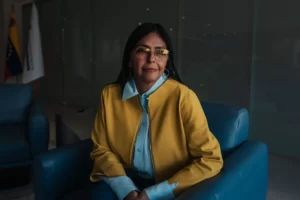
The accompanying article left out any mention of Rodríguez’s record of corruption and human rights abuses. “It’s bad journalism to qualify Delcy as a moderate,” opposition leader Freddy Guevara told Reason in a recent interview. Guevara pointed out that, among other things, Rodríguez had oversight of SEBIN, Venezuela’s secret police force, which is accused of torture, extrajudicial killings, and other human rights abuses.
Is Venezuela’s new socialist leader a “moderate”? That’s what the mainstream media is reporting.
Venezuelan oposition leader Freddy Guevara reacts on The Reason Interview podcast: pic.twitter.com/xh8e3OBQkb
— reason (@reason) January 22, 2026
What the Times characterized as “drastic economic liberalization” in Venezuela was the socialist regime’s enforcement capacity collapsing. After years of widespread scarcity and hyperinflation caused by price controls and irresponsible money printing, Maduro and his band of criminals could no longer maintain Venezuela’s planning apparatus. They had no choice but to abandon those policies, leading to what’s best described as economic anarchy minus the rule of law.
After hyperinflation obliterated the Venezuelan bolívar, the regime imposed price controls on basic goods. Providers were forced to sell at a loss, while the regime claimed it was a measure to help struggling Venezuelans. But price controls were selectively and unevenly enforced, allowing some importers to sell goods at market rates. The black market had grown so large that street vendors openly hawked eggs, chicken, and fish outside government supermarkets with bare shelves. Some Venezuelans even turned to a life as resellers, spending their days buying price-controlled goods to resell at market price later.
Currency controls followed the same pattern. The regime has channeled all dollar transactions through government agencies. The official exchange rate, kept artificially low as a subsidy for the politically connected, increasingly diverged from the market rate. Venezuelans turned to black-market traders operating across the Colombian and Brazilian borders, checking social media accounts that posted daily rates reflecting current supply and demand. The regime threatened businesses using the parallel rate with prison, but enforcement proved impossible. A steady flow of foreign currency, especially remittances sent by the Venezuelan diaspora, gradually came to underpin everyday transactions. By 2019, over half of all transactions nationwide happened in U.S. dollars. Maduro publicly described Venezuela’s de facto dollarization as an “escape valve” for a collapsing economy, contradicting his regime’s harassment over the last few decades. There was no choice.
The collapse of the socialist policies happened at the same time as intense human rights violations against dissidents. Opposition demonstrations were met with police brutality, and political prisoners filled the regime’s cells.
Much of the limited liberalization was initially spearheaded by Tareck El Aissami, the now-disgraced former oil minister, as economist Giorgio Cunto Morales argues. By 2023, when Delcy Rodríguez assumed full control of economic affairs following El Aissami’s demotion, Venezuela’s supposed recovery was already sputtering because of unaddressed structural problems. Exchange rate distortions grew throughout 2024, and when the central bank stopped publishing inflation statistics, the regime responded by jailing economists who discussed the issue. After five years of this “stabilization,” real gross domestic product had moved from 75 percent below its 2013 level to just 70 percent below. The result might be better than Stalinism, but it falls short of being a capitalist reform.
This period, framed by the Times as “economic liberalization,” was what Venezuelan political scientist Guillermo Tell Aveledo called the pax bodegónica: a corrupt elite’s shopping spree masquerading as economic improvement. Upscale grocery stores called bodegones filled Caracas and other big cities, stocked with imported delicacies and Costco products, catering to the boli-bourgeoisie (the Bolivarian bourgeoisie, regime-connected oligarchs) even as the regime claimed it was suffering under a U.S. blockade. The bodegones were mostly owned by Venezuela’s so-called enchufados, corrupt actors with deep political ties to the regime. Ordinary Venezuelans peer through the windows of these expensive shops.
Venezuela sits at or near the bottom of major global rankings measuring the rule of law and economic freedom in part because of Rodríguez’s policy record. She championed the opaque Anti-Blockade Law, which declared all contracts and administrative records classified, shielding them from public scrutiny. Under its provisions, Rodríguez has overseen approximately $3.2 billion in annual oil revenues collected and distributed without accountability, legalizing corruption on a massive scale. When the Venezuelan government had no choice but to eliminate exchange rate controls, Rodríguez insisted in a 2021 interview that it didn’t represent liberalization but rather “protection and defense” of Bolivarian socialism.
Property rights in Venezuela are only enforced at the regime’s pleasure. In June 2024, sisters Elis and Mileidis Hernández learned this lesson when they sold breakfast to opposition leader and future Nobel laureate María Corina Machado at their humble roadside restaurant. Hours after Machado left, tax inspectors and a National Guard officer arrived to shut down their 20-year-old business for alleged accounting violations, infractions that had never warranted inspection before and that went unenforced at every other establishment in town.
The fundamentals haven’t changed. Jorge Rodríguez, Delcy’s brother and the regime’s chief negotiator, appeared on state television last week, complaining that the dollar had fallen but stores in shopping malls hadn’t lowered their prices accordingly. “They raise the price because the dollar went up,” he said, “and now that the dollar goes down, they play dumb.” He said price controls were the solution. The socialist mindset lives on. Jorge Rodríguez and his sister have simply lost the capacity to enforce it.
Whether Delcy Rodríguez will double down on economic repression remains to be seen. But she’s no market-oriented technocrat, and state collapse isn’t economic liberalization. The Times has helped a brutal dictator in her campaign to gain international legitimacy, while the elected president of Venezuela, Edmundo González Urrutia, remains exiled in Spain.
Read the full article here
Fact Checker
Verify the accuracy of this article using AI-powered analysis and real-time sources.