

 Freedom Index

Listen to the article
Travis Fisher
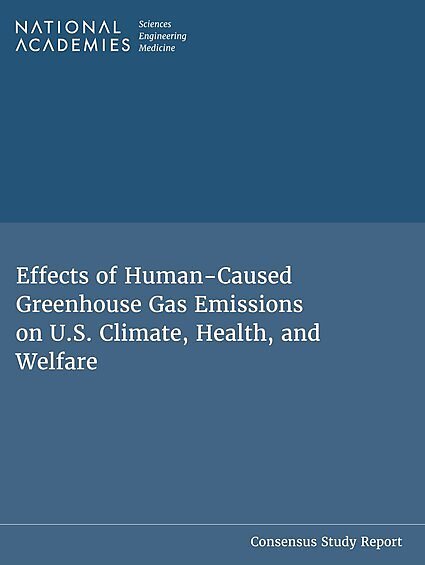
The National Academies of Sciences, Engineering, and Medicine (NASEM) released a report on Wednesday declaring that the Environmental Protection Agency’s (EPA’s) most sweeping climate policy—dating back to 2009—is “beyond scientific dispute.” The report was submitted to the EPA and surely will be used in litigation against the Trump administration. However, by jumping into the political food fight, the NASEM exposed itself as a political organization rather than a source of objective science. It also violated its congressional charter.
The EPA’s Endangerment Finding
In March of this year, EPA Administrator Lee Zeldin announced his intent to revisit the so-called “endangerment finding.” His announcement was bold: “Today is the greatest day of deregulation our nation has seen. We are driving a dagger straight into the heart of the climate change religion….” He was alluding to the finding made by Administrator Lisa Jackson in 2009 that greenhouse gases (GHGs) endanger public health or welfare. The EPA’s subsequent GHG regulations on vehicles and power plants—including the overturned “Clean Power Plan”—are built on this finding.
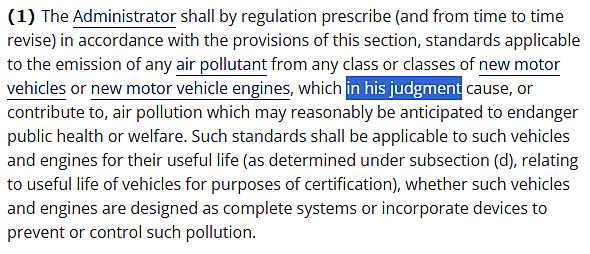
In Administrator Jackson’s defense, her finding was simply the slam dunk following the alley-oop from the Supreme Court in the case Massachusetts v. EPA, decided in 2007. In that case, a 5–4 majority found—erroneously if you ask me—that GHGs fall under the expansive definition of pollution in the Clean Air Act. All that remained for the Obama EPA to do, then, was to make the case that (in Administrator Jackson’s judgment) GHG pollution “may reasonably be anticipated to endanger public health or welfare,” which is the standard Congress set in section 202(a)(1) of the Clean Air Act.
Massachusetts v. EPA and the endangerment finding effectively rewrote the Clean Air Act to function as a climate law, giving bureaucrats the power to reorder America’s energy systems without new Congressional authority.
Science Versus Politics
When NASEM says the endangerment finding is “beyond scientific dispute,” it is committing a grave error. Not only do I disagree with NASEM as a matter of policy, but NASEM doesn’t even acknowledge that it has waded into the murky waters of politics. Likewise, reporting by CBS, the New York Times, the Guardian, and Newsweek refers to Administrator Jackson’s 2009 policy judgment as a “key scientific finding.”
But science cannot make policy judgments for us, and it is an abuse of scientific authority for a group of scientists to attempt to slam the door on a policy debate. Further, the relevant text of the Clean Air Act belies the narrative that the endangerment finding comes from science alone because it hinges on the EPA Administrator’s judgment:
Worse, by issuing this report without a formal request from the federal government, the Academies violated their own charter, which says, “[T]he Academy shall, whenever called upon by any department of the Government, investigate, examine, experiment, and report upon any subject of science or art.” [emphasis added] Their role is to provide objective information to policymakers when asked, not to jump into political fights uninvited.
Given that NASEM has clearly abandoned that role, Congress should consider removing its charter. If NASEM’s defense is that the EPA solicited comments from everyone, then my question back to NASEM is this: Why did you sit idle when the EPA proposed scientifically impossible rules, like when it mandated carbon capture for power plants? Those proposals featured open comment periods, too.
But let’s take NASEM’s involvement and the findings of its report at face value for a moment. Even if every conclusion in the NASEM report were beyond dispute, we would still face difficult policy questions: whether and how to cut emissions, how much economic pain to accept now versus later, which GHGs to target, etc. These are value judgments, not scientific findings. If we implement a national climate policy, it should come from Congress, where policymakers can debate these issues and the public can hold them accountable.
The Problem of H₂O Pollution
Justice Antonin Scalia was correct to point out in his dissent in Massachusetts v. EPA that carbon dioxide is not a “traditional air pollutant” and that deeming it as such is a policy decision that should be left to Congress. I go one step further—if all emissions are air pollutants, then why don’t we have a suite of EPA regulations covering water vapor? Let’s take a simple form of combustion (of methane, as from a natural gas power plant) to illustrate the problem.
CH4 + 2 O2 → CO2 + 2 H2O
Methane combusts with atmospheric oxygen to produce carbon dioxide and water vapor. Notably, water vapor is also a potent GHG, although its condensability means it precipitates out of the atmosphere and thus is not a “long-lived” GHG. However, from a strict reading of the Clean Air Act under the framework established in Massachusetts v. EPA, even pure water is an air pollutant.
So why don’t we regulate H₂O pollution? Even if it falls out of the atmosphere within a week or two, the majority in Massachusetts v. EPA said any GHG emission contributes to climate change, no matter how small or incremental the contribution. The fact that we don’t regulate H₂O pollution tells me that environmentalists, the Supreme Court, and the EPA acknowledge some de minimis threshold for “contribution.”
Likewise, EPA’s reconsideration of CO₂ endangerment should also allow for a de minimis threshold. I disagree with the chair of the NASEM study committee, for example, when she said the EPA can control the global climate. At the end of the press conference announcing the study’s release, Dr. Shirley Tilghman said (at 1:03:19):
Unlike other kinds of natural phenomenon like earthquakes and volcanoes, climate change is something that is within our agency as a population. And considering the harm that has already been documented and the predictions that harm will continue with the continued emission of greenhouse gases, this is an issue that should be of concern to everybody.
That is simply not true. Across a plausible range of climate sensitivities, the immediate and total elimination of US CO₂ emissions is expected to reduce global warming by between 0.11 and 0.23 degrees Celsius by the year 2100 (while total warming, despite any US efforts, would reach between 1.42 and 3.26 degrees Celsius). Contrary to Dr. Tilghman’s rhetoric, science tells us that the US population does not, in fact, have agency over global climate change. Perhaps we should allow a de minimis threshold for US emissions of CO₂.
Consensus Science
The NASEM publication bears the name “Consensus Study Report” on its cover. I want to give the last word to the late Michael Crichton, who saw the rise of consensus science more than two decades ago and spoke out against it:
I regard consensus science as an extremely pernicious development that ought to be stopped cold in its tracks. Historically, the claim of consensus has been the first refuge of scoundrels; it is a way to avoid debate by claiming that the matter is already settled. Whenever you hear the consensus of scientists agrees on something or other, reach for your wallet, because you’re being had. Let’s be clear: the work of science has nothing whatever to do with consensus. Consensus is the business of politics. Science, on the contrary, requires only one investigator who happens to be right, which means that he or she has results that are verifiable by reference to the real world. In science consensus is irrelevant. What is relevant is reproducible results. The greatest scientists in history are great precisely because they broke with the consensus. There is no such thing as consensus science. If it’s consensus, it isn’t science. If it’s science, it isn’t consensus. Period.
Read the full article here
Fact Checker
Verify the accuracy of this article using AI-powered analysis and real-time sources.