

 Freedom Index
Listen to the article
“We’re not going to give in to terrorism,” Vice President J.D. Vance declared after an Immigration and Customs Enforcement (ICE) agent fatally shot Minneapolis protester Renée Good in January. Vance averred that Good was involved in anti-ICE “terrorism,” which he said included not only violent assaults but also provocations by “people trying to antagonize” ICE agents.
In viewing speech that pisses off cops as a crime, Vance was following a legal tradition that the U.S. Supreme Court launched in 1942, when it invented a vague First Amendment exception for “fighting words.” Although subsequent decisions cast serious doubt on the viability of that doctrine, its logic remains popular with government officials who think speech that offends them should be illegal.
The case that gave birth to this handy excuse for censorship began on a Saturday afternoon in April 1940, when a Jehovah’s Witness named Walter Chaplinsky attracted a hostile crowd while distributing literature near Central Square in Rochester, New Hampshire. Passersby were offended by Chaplinsky’s message, which condemned organized religion as a “racket.” They complained to James Bowering, the city marshal who ran the local police department. According to Bowering, he informed the complainants that Chaplinsky had every right to proselytize but also warned Chaplinsky that he had better cut it out.
Frank R. Kenison, New Hampshire’s attorney general, would later tell the Supreme Court that Chaplinsky “announced his literature in terms having a tendency to irritate the people by calling ‘racketeers’ priests and those of their faith.” Bowering warned Chaplinsky that “the people were getting in an ugly mood as a result of his public announcements with reference to priests and religion.” A short while later, Bowering, who had left the scene, “was advised by a man passing by in a car that there was what he thought was a riot at the Square.”
On his way to “the point of trouble,” Kenison said, Bowering “met two officers” who were taking Chaplinsky to the police station “more for his protection than for arrest.” Bowering “reminded” Chaplinsky of “his earlier warning” that “the people might get out of hand if he continued using the language he had with reference to their faith and priests.” At that point, according to Kenison, Chaplinsky spoke the words that changed his protective custody into an arrest.
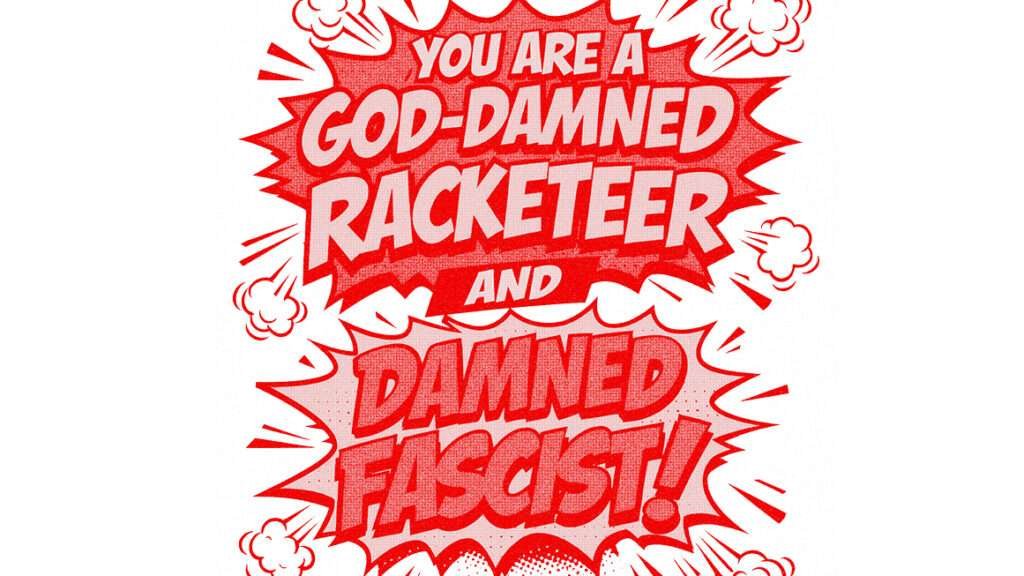
“You are a God-damned racketeer” and “damned fascist,” Chaplinsky allegedly said, adding that “the whole government of Rochester are fascists or agents of fascists.” Those “offensive, derisive and annoying words and names,” Kenison explained, were a crime under New Hampshire law.
That crime earned Chaplinsky a six-month jail sentence, which the New Hampshire Supreme Court unanimously approved in March 1941, rejecting the preacher’s argument that his prosecution violated the First Amendment. A year later, the U.S. Supreme Court unanimously agreed that Chaplinsky had no right to call Bowering a “racketeer” and a “fascist.” To reach that conclusion, the justices invented a new, hazily defined exception to the First Amendment that would-be censors are still invoking more than eight decades later.
Freedom of speech, the justices ruled in Chaplinsky v. New Hampshire, does not apply to “‘fighting’ words—those which by their very utterance inflict injury or tend to incite an immediate breach of the peace.” After formulating that vague and potentially sweeping rule, the Supreme Court never again relied on it to uphold a criminal conviction. But the Court has not explicitly repudiated the doctrine, which continues to influence lower-court decisions—often involving defendants who, like Chaplinsky, were arrested for talking back to the police.
The “fighting words” doctrine also figures in contemporary political debates about the constitutionality of punishing people for offensive speech. President Donald Trump explicitly invoked the doctrine last August, when he instructed Attorney General Pam Bondi to “prioritize” the prosecution of flag burners. Bondi herself alluded to the “fighting words” exception after the September 10 assassination of conservative activist Charlie Kirk. Drawing an erroneous constitutional distinction between “free speech” and “hate speech,” she warned that the Justice Department “will absolutely target you, go after you, if you are targeting anyone with hate speech.”
Syndicated columnist Wilmer J. Leon agreed with Bondi that “hate speech” should not be confused with “free speech.” But as Leon saw it, Kirk himself had crossed that line.
“We cannot afford to be lulled into this trap equating racist rhetoric and hate with protected political speech,” Leon wrote. Citing Chaplinsky, he argued that Kirk’s criticism of Martin Luther King Jr., whom Kirk had called “awful” and “not a good person,” amounted to “fighting words” rather than “political speech” because “those comments have no social value.” Since Leon described Kirk as “an angry, ignorant, intolerant, xenophobic, racist, hate spewing white supremacist,” that column might itself qualify as “hate speech” in Bondi’s book.
The versatility of the “fighting words” doctrine is not a point in its favor. The Supreme Court’s rationale for blessing Chaplinsky’s punishment is an open-ended license to restrict speech based on the anticipated response of people offended by it. Might they decide to physically attack the speaker? And even if they remain peaceful, might they suffer the “injury” that certain words “inflict” by “their very utterance”?
These subjective judgments are bound to be influenced by the majority’s view of acceptable expression. The “fighting words” doctrine is therefore inherently hostile to dissenters like Chaplinsky, precisely the people who are most likely to need the First Amendment’s protection.
Kenison’s account of the day Chaplinsky was arrested omitted details that underline the dangers of letting fear of violence, let alone the possibility of hurt feelings, override freedom of speech. Kenison conceded that Bowering advised Chaplinsky to stop preaching in light of the anger his words had provoked. But according to Chaplinsky, Bowering also refused to protect him from hecklers who repeatedly assaulted him.
Chaplinsky’s lawyers described “a tumultuous crowd of about fifty or sixty persons” who “objected to his work and threatened him with violence if he did not discontinue.” When Bowering first arrived at the scene, he was “accompanied by a man named Bowman,” who “assaulted” Chaplinsky, “catching him by the throat with his left hand” and punching him “with his right fist.” Chaplinsky “wrenched himself free” and turned to Bowering, saying, “Marshal, I want you to arrest this man.” Bowering’s reply: “I will if I feel like it.”
According to Chaplinsky’s Supreme Court brief, Bowering then left. About five minutes later, Bowman, armed with an American flag on a staff, ran toward Chaplinsky and tried to spear him. Chaplinsky “avoided the blow” but “was pushed by Bowman into the gutter against an automobile.” Bowman then “gave the flag to another man,” grabbed Chaplinsky by the collar, called him a “son of a bitch,” and demanded that he salute the flag.
Bowman knew Chaplinsky would refuse. Jehovah’s Witnesses view such gestures as a form of idolatry—one of several unpopular beliefs that help explain why the group was frequently singled out out for abuse and discrimination.
After the flag incident, Chaplinsky’s lawyers reported, Bowering and three other officers “picked him up from the ground” and started “shoving him along roughly” to the police station. Chaplinsky again suggested that Bowering do his job, asking him to “please arrest the ones who started this fight.” The marshal again refused, saying, “Shut up, you damn bastard, and come along.” This was the context in which Chaplinsky called Bowering a “racketeer” and a “fascist,” although he denied saying “God-damned.”
It got worse. While being “shoved and dragged” to the police station, Chaplinsky “recognized among the officers escorting him one of the men who had struck him,” who identified himself as Deputy Sheriff Ralph Dunlap. “If you are a deputy sheriff,” Chaplinsky replied, “this whole city” must be run by “fascists.”
At the police station, Dunlap vented his anger at Chaplinsky, saying, “You son of a bitch, we ought to have left you to that crowd there and have them kill you.” Bowering shoved Chaplinsky into a chair and added, “You unpatriotic dog, I am going to arrest you on account you called me a God-damned fascist.”
Bowering was true to his word. Chaplinsky was convicted of violating an 1885 New Hampshire statute that said: “No person shall address any offensive, derisive or annoying word to any other person who is lawfully in the street or other public place, nor call him by any offensive or derisive name, nor make any noise or exclamation in his presence and hearing with intent to deride, annoy or offend him or prevent him from pursuing his lawful business or occupation.”
That broad language proved to be a problem for the New Hampshire Supreme Court when it considered Chaplinsky’s appeal. Rather than apply the statute as written, the court claimed to have discovered a limiting principle in two of its earlier decisions.
In an 1894 case involving a defendant who had publicly called another man “a God damned blackmailer,” the court said the “purpose” of the statute was to “preserve the public peace.” It explained that “the direct tendency of such conduct” is to “provoke the person against whom it is addressed to acts of violence.” A case decided six years later involved a defendant who publicly called a woman a “bitch” and “other obscene words.” The court reiterated that the law was aimed at utterances that might provoke “a breach of the peace.”
Based on those precedents, the New Hampshire Supreme Court concluded, Chaplinsky had adequate notice of the conduct covered by the law. “Long before the words for which Chaplinsky was convicted,” the court said in State v. Chaplinsky, “the construction of the provision was made plain, to the extent that no words were forbidden except such as have a direct tendency to cause acts of violence by the person to whom, individually, the remark is addressed.” So construed, the court ruled, the law was perfectly consistent with the First Amendment.
“At the moment the defendant uttered the words for which he was convicted, he undoubtedly felt resentment because he had been roughly handled by the crowd,” the court conceded. “His resentment might well enough have extended to the police if they had failed to take any step reasonably within their power to control the crowd, or if they had failed to prosecute anybody who they had reasonable ground to believe had assailed him. But those facts, if true, would not have justified the offensive manner in which he sought to bring the Marshal to what Chaplinsky may have regarded as a sense of his duty. It was not useful or proper comment for bringing truth to light. Its plain tendency was to further breach of order, and it was itself a breach of the peace.”
The court rejected Chaplinsky’s argument that the statute was unconstitutionally vague. “The test is what men of common intelligence would understand would be words likely to cause an average addressee to fight,” it said. “The English language has a number of words and expressions which by general consent are ‘fighting words’ when said without a disarming smile….The statute, as construed, does no more than prohibit the face-to-face words plainly likely to cause a breach of the peace by the addressee, words whose speaking constitute[s] a breach of the peace by the speaker—including ‘classical fighting words,’ words in current use less ‘classical’ but equally likely to cause violence, and other disorderly words, including profanity, obscenity and threats.”
As Belmont University law professor David Hudson notes, the phrase “fighting words” had never before appeared in an appeals court decision. Yet the New Hampshire Supreme Court assumed everyone knew which words fell into that category. It also asserted that uttering them, in addition to inviting violence, is “itself a breach of the peace”—except perhaps when the speaker is smiling. The decision was a muddle, and the U.S. Supreme Court made it worse by extending the First Amendment exception to include words that inherently cause “injury,” whether or not they provoke violence.
Justice Frank Murphy’s seven-page opinion, published in March 1942, cited the Supreme Court’s 1940 ruling in Cantwell v. Connecticut, which also involved proselytizing by Jehovah’s Witnesses. In Cantwell, the Court unanimously rejected a state licensing requirement for such activity and held that the preachers, Newton Cantwell and his two sons, had not committed a “breach of the peace” by publicly playing a phonograph recording that inveighed against the Catholic Church and organized religion in general.
Cantwell did that in a heavily Catholic neighborhood of New Haven, and “the hearers were in fact highly offended,” Justice Owen Roberts noted in the Court’s opinion. “One of them said he felt like hitting Cantwell and the other that he was tempted to throw Cantwell off the street.” The Court nevertheless held that Cantwell’s message was protected by the First Amendment. By contrast, Roberts said, “resort to epithets or personal abuse is not in any proper sense communication of information or opinion safeguarded by the Constitution.”
That passing remark, Murphy said in Chaplinsky, illustrated the supposedly longstanding principle that “fighting words” are not protected by the First Amendment. “It has been well observed that such utterances are no essential part of any exposition of ideas,” he wrote, “and are of such slight social value as a step to truth that any benefit that may be derived from them is clearly outweighed by the social interest in order and morality.”
Two decades ago, Temple University law professor Burton Caine published a devastating 122-page critique of Chaplinsky in the Marquette Law Review. Among many other problems, Caine noted that Murphy’s definition of “fighting words,” even if it is understood as applying only to face-to-face confrontations between two individuals, can be interpreted in at least 10 distinct ways, each with different implications for freedom of speech.
“There is no constitutional basis for denying protection to fighting words, either alone or as a subcategory of speech claimed to be unworthy of First Amendment protection,” Caine wrote. “The Chaplinsky opinion, plagued with vague language regarding categories and characteristics of expression that purportedly do not qualify for First Amendment protection, violates established First Amendment standards in several regards. Perhaps most importantly, what the Court in Chaplinsky labels as fighting words is, in reality, ‘political’ speech or speech on public issues, which deserves the utmost protection in the American democracy.”
The facts of the case underline that point. Chaplinsky did not call Bowering a “racketeer” and a “fascist” out of the blue. He applied those labels to a police chief who had manifestly abandoned his responsibility to keep the peace, arrest violent aggressors, and protect the constitutional rights that Chaplinsky was exercising on the street in Rochester. In other words, Chaplinsky was criticizing the conduct of a public official, albeit in terms that both the New Hampshire Supreme Court and the U.S. Supreme Court viewed as distasteful.
If the “fighting words” doctrine aims to keep the peace, Murphy’s distinction between controversial advocacy and “epithets or personal abuse” was puzzling. Chaplinsky’s preaching, which even Bowering conceded was constitutionally protected, actually provoked a violent response. By contrast, there was no evidence that his evaluation of Bowering had a similar effect.
Although the Supreme Court has never officially overruled Chaplinsky, it has declined to follow the decision’s logic in a long series of cases. Just a year later in Cafeteria Employees Union v. Angelos, the Court described fascist, one of the words that led to Chaplinsky’s conviction, as an example of “loose language” that is “part of the conventional give and take in our economic and political controversies.” Subsequent cases featured speech that the justices deemed constitutionally protected even though it was much more offensive than anything Chaplinsky said to Bowering.
In Terminiello v. Chicago, decided seven years after Chaplinsky, the justices sided with a priest who had been convicted of breaching the peace after he delivered a viciously antisemitic speech in Chicago, calling people who disagreed with him “slimy scum,” “snakes,” and “bedbugs.” As Justice Robert H. Jackson noted in his dissent, the words for which Chaplinsky had been imprisoned were “mild in comparison to the epithets” that Arthur Terminiello “hurled at an already inflamed mob of his adversaries.” A prosecution witness testified that she was so “riled up” by “all the lies” Terminiello told that she “felt like” responding with violence.
Two years later in Kunz v. New York, the Supreme Court upheld the First Amendment rights of a Baptist minister who had publicly called Catholicism “a religion of the devil,” condemned the pope as “the Antichrist,” and described Jews as “Christ-killers” and “garbage” that “should have been burnt in the incinerators” of Nazi Germany. The Court likewise perceived no “fighting words” in cases involving defendants who addressed law enforcement officers with epithets such as “white son of a bitch,” “chicken shit mother fucker,” “fucking, prick-ass cops,” and “goddamn motherfucking police.”
Concurring in one of those cases, Justice Lewis Powell suggested that the standard for “fighting words” should be especially strict in cases involving police encounters. “If these words had been addressed by one citizen to another, face to face and in a hostile manner, I would have no doubt that they would be ‘fighting words,'” Powell wrote in the 1972 case Lewis v. New Orleans. “But the situation may be different where such words are addressed to a police officer trained to exercise a higher degree of restraint than the average citizen.” Two years later, Powell reiterated that “a properly trained officer may reasonably be expected to ‘exercise a higher degree of restraint’ than the average citizen, and thus be less likely to respond belligerently to ‘fighting words.'”
The Supreme Court’s 1971 ruling in Cohen v. California also cast doubt on Chaplinsky’s viability. The decision overturned a 19-year-old man’s conviction for disturbing the peace by wearing a jacket bearing the slogan “Fuck the Draft” in the Los Angeles County Courthouse. That message did not qualify as “fighting words,” Justice John Marshall Harlan II said in the majority opinion, because “no individual actually or likely to be present could reasonably have regarded the words on appellant’s jacket as a direct personal insult.” The ruling nevertheless undermined a key premise of Chaplinsky: that criticism of the government loses constitutional protection when phrased in an offensive way.
“Governmental bodies may not prescribe the form or content of individual expression,” Harlan wrote. He noted that “words are often chosen as much for their emotive as their cognitive force…which, practically speaking, may often be the more important element of the overall message.”
These cases suggest that, contrary to what Murphy implied in Chaplinsky, neither “profanity” nor “obscenity” is enough to classify speech as “fighting words.” They also suggest that Murphy’s expansion of the category to include inherently injurious words has gone by the boards—an impression reinforced by the Supreme Court’s 2011 ruling in Snyder v. Phelps.
That case involved demonstrations at the funerals of soldiers by members of the Westboro Baptist Church, who displayed signs bearing statements such as “Thank God for Dead Soldiers,” “Fags Doom Nations,” “America is Doomed,” “Priests Rape Boys,” and “You’re Going to Hell.” The Court ruled that holding those demonstrators civilly liable for intentional infliction of emotional distress would be inconsistent with the First Amendment.
“Speech is powerful,” Chief Justice John Roberts wrote in the majority opinion. “It can stir people to action, move them to tears of both joy and sorrow, and—as it did here—inflict great pain. On the facts before us, we cannot react to that pain by punishing the speaker. As a Nation we have chosen a different course—to protect even hurtful speech on public issues to ensure that we do not stifle public debate.”
Writing in dissent, Justice Samuel Alito cited Chaplinsky’s reference to words of “slight social value” that “by their very utterance inflict injury.” He thought that description easily applied in this case. “When grave injury is intentionally inflicted by means of an attack like the one at issue here,” he said, “the First Amendment should not interfere with recovery.” But the majority did not even mention Chaplinsky.
Rumors of Chaplinsky’s death nevertheless seem exaggerated, since the “fighting words” doctrine lives on in the lower courts. Caine, who analyzed 89 cases decided from April 1996 to September 2001 that explicitly or implicitly involved “fighting words,” found that state courts were much less likely than federal courts to protect speech.
The 39 federal cases did not include any decisions that upheld convictions based on offensive utterances, although eight district courts and two appeals courts rejected “relief actions involving wrongful arrests for speech,” and one appeals court upheld a $7,000 fine imposed on a lawyer sued for fraud who used “vile language” during a deposition. The 50 state cases, by contrast, included 36 decisions allowing speech-based convictions.
Many of those state cases, Caine found, involved nothing more than “critical words” aimed at “authoritative bodies.” The cases also frequently involved interactions with police officers. In 1996, for example, the Indiana Supreme Court upheld the disorderly conduct conviction of a man who had repeatedly exclaimed “fuck this shit” while being questioned by police. The court said the state reasonably could have viewed those outbursts as an “abuse” of “the right to speak” because they posed “a threat to peace, safety, and well-being.” That same year, the Connecticut Supreme Court concluded that a man who said “fuck you” during a police interrogation could be prosecuted for breach of the peace because his speech “constituted ‘fighting words’ that had a tendency to incite imminent violence.”
In 2020, Hudson noted that the “fighting words” doctrine was still “alive and well in the lower courts.” He described 14 state and federal cases, six of which involved words addressed to law enforcement officers. In 2004, for example, a federal judge in Kansas dismissed a civil rights lawsuit by two people who were arrested after shouting insults at the police while recording traffic stops. The derogatory terms included “motherfuckers,” “fucking pigs,” “pieces of shit,” “Gestapo,” “jack-booted thugs,” and “oppressive, sick assholes.” Those utterances, the judge concluded, qualified as “fighting words” because they were “inherently likely to produce a violent reaction.”
In 2008, by contrast, the South Dakota Supreme Court sided with a man who was convicted of disorderly conduct for “yelling profanities at a passing police car.” Marcus J. Suhn, who had just left a bar in Brookings at closing time, shouted: “Fucking cop, piece of shit. You fucking cops suck. Cops are a bunch of fucking assholes.” Those insults did not meet the Chaplinsky test, the court ruled: “Just because someone may have been offended, annoyed, or even angered by Suhn’s words does not make them fighting words.”
Along similar lines, federal appeals courts have rejected punishment of people who give cops the finger. In 2013, for instance, the U.S. Court of Appeals for the 2nd Circuit ruled that the “ancient gesture of insult” did not justify a traffic stop or an arrest for disorderly conduct. Eight years later, the U.S. Court of Appeals for the 8th Circuit reached a similar conclusion in a case involving another motorist who had flipped off the cops.
In 2014, a Wisconsin appeals court likewise held that annoying the police is not enough to sustain a disorderly conduct conviction. “Fuck the fucking cops they ant shit but fucking racist basturds an fucking all of y’all who is racist,” Thomas G. Smith had written on a local police department’s Facebook page. “Fuck them nigers policy bitchs wat the you got on us not a darn thing so fuck off dicks,” he added. The cops thought those were “fighting words,” but the appeals court disagreed, saying the state had failed to show that “Smith’s comments had a tendency to incite an immediate breach of the peace by others against the police.”
That decision illustrates continuing uncertainty about the contours of the First Amendment exception described in Chaplinsky. The Supreme Court’s ruling involved a face-to-face confrontation in which the putative threat to public order was the potentially violent reaction of the person who had been insulted. But in Smith’s case, the appeals court suggested “fighting words” could include speech that threatens to “incite an immediate breach of the peace by others.” It also said “fighting words” are not necessarily “limited to situations in which the speaker and listener are in physical proximity,” leaving open the possibility that online comments could fall into that category, although they did not in this case.
The president is, if anything, even more confused about the meaning of Chaplinsky. “Burning this representation of America may incite violence and riot,” Trump said in his executive order targeting flag desecration. That symbolic act, he suggested, might be “a form of ‘fighting words.'”
Inconveniently for Trump, the Supreme Court has explicitly rejected that very argument. In the 1989 case Texas v. Johnson, the justices ruled that prosecuting a protester for burning a flag during the 1984 Republican National Convention in Dallas was inconsistent with the First Amendment. That ritual did not amount to “fighting words,” Justice William Brennan said in the majority opinion, because “no reasonable onlooker would have regarded [Gregory] Johnson’s generalized expression of dissatisfaction with the policies of the Federal Government as a direct personal insult or an invitation to exchange fisticuffs.”
The state’s position, Brennan said, “amounts to a claim that an audience that takes serious offense at particular expression is necessarily likely to disturb the peace and that the expression may be prohibited on this basis.” But “if there is a bedrock principle underlying the First Amendment, it is that the government may not prohibit the expression of an idea simply because society finds the idea itself offensive or disagreeable.”
Congress swiftly responded to that decision by approving the Flag Protection Act of 1989, which applied to anyone who “knowingly mutilates, defaces, physically defiles, burns, maintains on the floor or ground, or tramples upon any flag of the United States.” Legislators voted overwhelmingly to criminalize conduct that the Supreme Court had just said was protected by the First Amendment. Unsurprisingly, the Court did not think that act of defiance changed the relevant constitutional analysis. In the 1990 case United States v. Eichman, it again rejected the argument that flag burning constitutes “fighting words.”
In Trump’s view, only “stupid people” think “it’s unconstitutional” to jail flag burners. Yet both of the Supreme Court’s flag-burning decisions were joined by Justice Antonin Scalia, a conservative icon whom Trump has described as the very model of a “great” jurist. “If I were king, I would not allow people to go about burning the American flag,” Scalia remarked in 2012. “However, we have a First Amendment, which says that the right of free speech shall not be abridged. And it is addressed, in particular, to speech critical of the government.”
Bondi did not explicitly invoke “fighting words” when she talked about targeting “hate speech,” and she later claimed she had been referring to “threats of violence that individuals incite against others.” But that rationale did not make much sense either. Under the Supreme Court’s 1969 ruling in Brandenburg v. Ohio, even explicit advocacy of violence is protected by the First Amendment unless it is both “directed” at inciting “imminent lawless action” and “likely” to have that effect. The “hate speech” that Bondi presumably had in mind—comments celebrating Charlie Kirk’s murder or justifying violence against conservatives in general—would not meet that test.
Whatever Bondi may have meant, people who favor legal restrictions on “hate speech” frequently invoke the “fighting words” concept. In 2015, for example, then–CNN anchor Chris Cuomo, who has a law degree, claimed that “hate speech is excluded from protection” under the First Amendment. When that comment provoked criticism, Cuomo conceded that “hate speech is almost always protected” but argued that “hate speech can be prohibited” as “fighting words” under Chaplinsky. Even if the comments that got Chaplinsky into trouble “would not qualify as fighting words by today’s reckoning,” he said, “the test still stands as good law.”
That same year, Pope Francis condemned “provocateurs” who “speak badly” about “other religions.” If someone “says a curse word against my mother,” the pope said, “he can expect a punch,” which is a “normal” response. He added that the same goes for people who “insult the faith of others,” which is why “you cannot make fun of the faith of others.”
The pope’s argument probably would not fly even under Chaplinsky, since it equates any mockery of religion with face-to-face insults that “tend to incite an immediate breach of the peace.” But that sort of conflation is common.
In 2012, for instance, the Washington Metropolitan Area Transit Authority rejected a subway ad that read: “In any war between civilized man and the savage, support the civilized man. Support Israel. Defeat jihad.” Those were “fighting words,” the transit authority argued. U.S. District Judge Rosemary Collyer disagreed. Under Cohen, “fighting words” must be “directed to the person of the hearer” and “likely to evoke a violent response,” she noted. “As a message communicated in advertising space, Plaintiffs’ speech does not meet the Court’s description of this category of unprotected speech.”
Five years later, Howard Dean, former chairman of the Democratic National Committee, cited Chaplinsky to argue that conservative commentator Ann Coulter should be banned from speaking on college campuses. That decision, Dean claimed, showed that Coulter’s opinions are “NOT protected speech under the first amendment.”
While Coulter is unlikely to be arrested for uttering “fighting words,” the same cannot be said for ordinary Americans who express anger at police officers or other government officials. “Court convictions for offensive speech, commonplace in the states, invariably stem from statutes that have vaguely incorporated selected parts of the Chaplinsky holding without citing the case, or from arguably overbroad statutes in which no mention of the fighting words doctrine exists,” Caine noted in his 2004 law review article. “In defiance of the Supreme Court, states do what they want when it comes to suppressing speech.”
A bill Kentucky legislators considered in 2021 exemplified that tendency. The bill, which passed the Kentucky Senate by a 2–1 margin but failed in the House, would have expanded the state’s definition of “disorderly conduct” to include anyone who “accosts, insults, taunts, or challenges a law enforcement officer with offensive or derisive words, or by gestures or other physical contact, that would have a direct tendency to provoke a violent response from the perspective of a reasonable and prudent person.”
The bill’s lead sponsor said he was responding to the previous year’s protests against police abuses, including the March 2020 death of Breonna Taylor in Louisville. “In these riots, you see people getting up in officers’ faces, yelling in their ears, doing everything they can to provoke a violent response,” state Sen. Danny Carroll (R–Benton), a retired police officer, told the Louisville Courier Journal. “I’m not saying the officers do that [i.e., respond violently], but there has to be a provision within that statute to allow officers to react to that. Because that does nothing but incite those around that vicinity, and it furthers and escalates the riotous behavior.”
Carroll’s defense of his bill, which relied on Chaplinsky, illustrated the confusion engendered by that decision. The bill applied to speech that “a reasonable and prudent person” would think was apt to “provoke a violent response,” presumably from the insulted police officer. Carroll’s comments confirmed that impression, since he described protesters who tried to get a rise out of cops. At the same time, Carroll cast doubt on the notion that police were apt to punish words with violence and suggested the real concern was incitement of other protesters—a threat more logically analyzed under the Brandenburg test.
Carroll was rightly criticized for trying to punish criticism of the police. As Justice Brennan noted in the 1987 case Houston v. Hill, “The freedom of individuals verbally to oppose or challenge police action without thereby risking arrest is one of the principal characteristics by which we distinguish a free nation from a police state.” But Carroll’s position stemmed directly from the dubious assumption at the heart of Chaplinsky. The justices implied that it would have been perfectly understandable for Bowering, upon hearing the epithets racketeer and fascist, to punch Chaplinsky in the face. They thought it was unrealistic to expect that a sworn peace officer would restrain himself in that situation.
The Court’s subsequent decisions contradicted that premise, suggesting that police officers, given their training and experience, can and should resist the urge to meet words with violence. Still, if there is anything left to the “fighting words” doctrine, it is the assumption that violence is a natural, predictable, and even excusable response to offensive speech—a position that is hard to reconcile with the ostensible goal of keeping the peace.
Read the full article here
Fact Checker
Verify the accuracy of this article using AI-powered analysis and real-time sources.