

 Freedom Index
Listen to the article
The American Civil Liberties Union (ACLU), despite its name, historically has not been keen on defending the constitutional right to keep and bear arms. After the Supreme Court affirmed that right in the landmark 2008 case District of Columbia v. Heller, the ACLU continued to maintain that “the Second Amendment protects a collective right rather than an individual right,” saying it “disagrees with the Supreme Court’s conclusion about the nature of the right protected by the Second Amendment.” Yet in United States v. Hemani, a case the Supreme Court will hear on Monday, the ACLU is unambiguously defending the right it used to say does not exist.
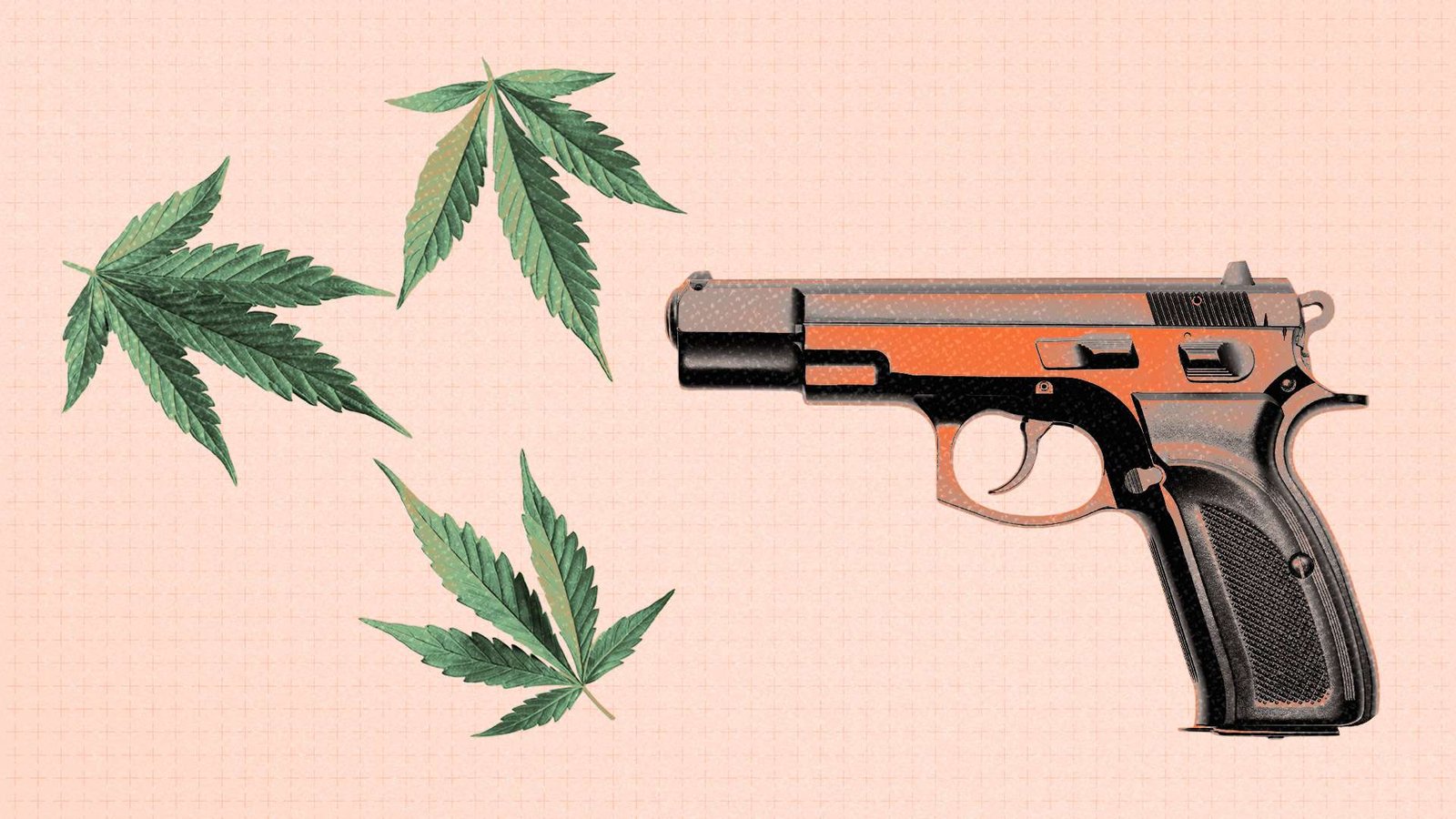
The ACLU’s position puts it on the same side as the National Rifle Association (NRA). Although this is not the first time that has happened, it is the first time it has happened in a Second Amendment case. The confluence of interests illustrates the potential for cross-ideological alliances at the intersection of gun control and the war on drugs—a subject I explore in my book Beyond Control.
The Supreme Court case involves Ali Hemani, a Texas man who was charged with illegal gun possession in 2023 after an FBI search of his home discovered a Glock 19 pistol, about two ounces of marijuana, and less than a gram of cocaine. Hemani admitted that the gun was his and that he smoked marijuana a few times a week, which would have been enough to convict him under 18 USC 922(g)(3).
That law, the original version of which Congress enacted in 1968, makes it a felony, punishable by up to 15 years in prison, for an “unlawful user” of “any controlled substance” to receive or possess a firearm. But the case against Hemani was dismissed based on United States v. Connelly, a 2024 decision in which the U.S. Court of Appeals for the 5th Circuit ruled that the Second Amendment bars such prosecutions when they are based on nothing beyond the elements specified by the statute.
The Trump administration, despite its avowed commitment to “protecting Second Amendment rights,” is asking the Supreme Court to reinstate the Section 922(g)(3) charge against Hemani and reject the 5th Circuit’s conclusion that prosecutions under that law are unconstitutional without additional evidence that the defendant poses a danger to public safety. The government’s stance has drawn opposition from an ideologically diverse set of critics, including the National Organization for the Reform of Marijuana Laws, the Drug Policy Alliance, and the National Association of Criminal Defense Lawyers as well as leading Second Amendment groups such as the NRA, Gun Owners of America, the Second Amendment Foundation, and the Firearms Policy Coalition.
The unlikely coalition siding with Hemani also includes the ACLU, which did not participate in his July 21 brief opposing Supreme Court review of the case but joined the brief that his lawyers filed after the justices granted the Trump administration’s petition. The latter brief argues that Section 922(g)(3) is unconstitutionally vague because it is not at all clear what “unlawful user” means. But the brief also argues, consistent with the 5th Circuit’s reasoning, that “the Second Amendment forecloses the government’s attempt” to prosecute Hemani under that law.
The ACLU is embracing both arguments, which is pretty striking given the organization’s previous position that the Second Amendment does not guarantee an individual right to arms. The ACLU’s national board adopted a revised position on gun rights in 2015, acknowledging that Americans at the Founding “took the individual possession of firearms for granted.” It noted that “many of the legislators who wrote the Second Amendment owned guns” and “undoubtedly assumed that their ownership was part of their rights to property and self-defense.” Still, it said, “the right to own and use guns was not considered absolute.”
Accordingly, the board said, “the ACLU will not oppose governmental regulation of firearms as long as such regulation is reasonably related to a legitimate governmental interest, such as protection of the public health, safety, or welfare. Deference should be given to legislative judgments limiting gun ownership or use so that state and local governments are allowed an opportunity to experiment with solutions to the complex problems involving guns.”
That deference apparently reached its limits with Section 922(g)(3). “This is the first time that we have entered a case affirmatively on behalf of an individual making a Second Amendment claim,” says Brandon Buskey, director of the ACLU’s Criminal Law Reform Project and one of the attorneys listed in Hemani’s brief. “Now that the Supreme Court has recognized this as a fundamental right, we see this as an important civil liberties issue.”
Although Democratic politicians who usually support criminal justice reform tend to have second thoughts when the issue involves guns, it is not hard to see how Hemani’s case intersects with the ACLU’s traditional concerns. “The government is trying to imprison someone for up to 15 years based on a statute that only requires that someone be an ‘unlawful user’ of a drug like marijuana and be in possession of a weapon, even if that weapon is safely secured,” Buskey notes. “That not only invites arbitrary and discriminatory enforcement because of how vague the statute is,” he says. It is “also inconsistent with how other [constitutional] rights are treated.”
The vagueness argument is based on the principle that the Fifth Amendment’s guarantee of due process requires “fair notice” of what a law requires or prohibits. Section 922(g)(3) “doesn’t give proper notice of what kind of behavior it actually prohibits, which is a core due process requirement,” Buskey says.
The statute does not define “unlawful user,” and for decades federal courts have tried to figure out what it means. According to the Justice Department’s gloss, a gun buyer or owner violates Section 922(g)(3) if he has used an illegal drug “recently enough to indicate that [he] is actively engaged in such conduct.” Federal courts have said “a temporal nexus is required between the drug use and the firearm possession,” the Justice Department says. “Courts now examine the ‘pattern and recency’ of the defendant’s drug use in determining if there is a temporal nexus between the possession of the firearm and drug use.” But they “do not require contemporaneous use.”
The Bureau of Alcohol, Tobacco, Firearms, and Explosives (ATF) recently proposed a revised definition of “unlawful user” aimed at excluding people who have stopped “regularly” and “unlawfully” using a controlled substance and people whose “unlawful use is isolated or sporadic or does not otherwise demonstrate a pattern of ongoing use.” Under the new definition, for example, a single positive drug test in the previous year would not be enough, by itself, to trigger the loss of Second Amendment rights under Section 922(g)(3).
Adding to the confusion, the Trump administration in Hemani avers that Section 922(g)(3) applies only to “habitual drug users,” which is not what the law says. That reading also seems inconsistent with the provision’s treatment of individuals who are “addicted to any controlled substance” as a distinct category of people who are not allowed to possess firearms. The law does not define “addicted.” But under the Controlled Substances Act, the term “addict” includes “any individual who habitually uses any narcotic drug so as to endanger the public morals, health, safety, or welfare.”
Depending on what “unlawful user” means, potential defendants could include anyone who owns a gun and occasionally consumes marijuana, even if he does so in compliance with state law. Judging from survey data on drug use and gun ownership, that category might encompass something like 20 million Americans.
In addition to a violation of Section 922(g)(3), gun-owning cannabis consumers can be charged with three related federal felonies. All told, the combined maximum sentences add up to nearly half a century. And even if a defendant does not face multiple charges, a single conviction is enough to permanently strip him of his Second Amendment rights under a different provision of the same law, which applies to anyone who has been convicted of a crime punishable by more than a year of incarceration. So the stakes in figuring out exactly who is covered by Section 922(g)(3) are pretty high.
Because the law does not answer that question, it is “up to the government’s choice as to what counts as an ‘unlawful user,'” Buskey notes. “That’s really a matter for Congress to decide, and not for administrative agencies to change, literally in the course of litigation on this very question.” While the revised ATF definition is an improvement, he says, it “doesn’t give much certainty to the millions of marijuana users in this country as to where the government might go next if it decides that the rule is not to its liking.”
Despite the large number of potential defendants, federal prosecutors pursued charges under Section 922(g)(3) just 120 times a year, on average, from FY 2008 through FY 2017, according to TRAC Reports. That is partly because the government generally does not know who uses drugs or who owns guns, let alone which people fall into both groups. But the paucity of charges also suggests that federal prosecutors, despite the law’s treatment of people at that intersection as felons who deserve stiff prison sentences, do not view such cases as a high priority.
Although millions of Americans violate this law every year, only a tiny percentage of them are prosecuted. And that situation, the ACLU worries, opens the door to decisions that may be affected by racial bias. “There’s always the risk that considerations of race [or] a group being disfavored may come into play,” Buskey says. “However it’s applied, the law as written is ripe for abuse [because it] becomes essentially a blank check for prosecutors to use whenever…they want to target someone who might be a recreational drug user and also possesses a weapon.”
The relative rarity of Section 922(g)(3) cases casts doubt on the Trump administration’s claim that cannabis consumers are so untrustworthy and dangerous that they should be categorically disarmed. “Despite the government’s protestations about how dangerous marijuana users are as a group,” Buskey notes, these cases “don’t seem to be a priority for federal prosecutors.”
Under the Supreme Court’s 2022 ruling in New York State Rifle & Pistol Association v. Bruen, the government has the burden of showing that Hemani’s prosecution is “consistent with this Nation’s historical tradition of firearm regulation.” In attempting to meet that test, the Trump administration relies primarily on the historical treatment of “habitual drunkards,” who could be confined to workhouses as “vagrants” or, later, civilly committed.
These supposed historical analogs had nothing to do with gun rights per se, and in both cases the restrictions, in contrast with the categorical ban imposed by Section 922(g)(3), were based on individual determinations by judges or justices of the peace. Another problem with this argument is the equation of cannabis consumers with “habitual drunkards,” which makes little sense.
The government argues that “regular users of a drug like marijuana are the equivalent of habitual drunkards at the Founding,” Buskey says. “I don’t think that comparison rings true to most Americans.” Those “habitual drunkards,” he notes, were not simply people who regularly consumed alcohol; they were an especially problematic subset who “could not conform their behavior to the law” or whose heavy drinking interfered with their ability to support themselves and their families.
“Habitual drunkards are not like ordinary users of alcohol or marijuana,” Buskey says. “There’s just not a close relationship between those two types of people. That’s why our position is that the government’s analogy there just strikes at too high a level of generality—one that really would eviscerate the Second Amendment right if it [were] taken to its logical conclusion.”
Notably, the Trump administration has abandoned an analogy favored by the Biden administration, which likened Section 922(g)(3) to early laws that prohibited people from publicly carrying or discharging guns while intoxicated. But as the 5th Circuit emphasized, those laws were narrowly aimed at the problem of drunken gun handling. Unlike Section 922(g)(3), they did not apply in private or to drinkers when they were sober.
“This issue of alcohol users and firearms has been around for a long time,” Buskey notes. “The way the Founding generation handled that was to limit gun regulations [to] times when people were actually intoxicated.” And “because that problem is an old problem,” he says, Supreme Court precedent tells us “the government has to have a ‘distinctly similar’ historical analog.”
The Trump administration has not identified even a superficially plausible historical analog to Section 922(g)(3), let alone a “distinctly similar” one. There is “no historical analog that would give the government that much authority in regulating a fundamental right,” Buskey says.
While the ACLU, at least in this case, seems to have overcome its aversion to the Second Amendment, the same cannot be said of the 18 attorneys general who are siding with the Trump administration even though their states have legalized the recreational use of marijuana. Those states have decided that marijuana should be treated like alcohol. Yet their attorneys general still think it is perfectly OK to disarm residents who consume marijuana purchased from government-licensed pot shops.
What’s up with that? “It’s our position that the Supreme Court’s precedent leaves room for reasonable gun restrictions,” Buskey says. “However, I think anyone should be concerned [about] the breadth of authority the government is claiming, in this case, to regulate weapons.” The position taken by states that have legalized marijuana, he charitably suggests, “may simply reflect [a] difference of opinion” about the risk that the decision in Hemani could restrict their ability to regulate firearms.
I am not alone in thinking it is weird for states to abandon marijuana prohibition but nevertheless defend an irrational, unjust, and constitutionally dubious restriction that stems from that policy. Although Colorado Attorney General Phil Weiser, a Democrat, joined the brief taking that position, Colorado Gov. Jared Polis, also a Democrat, disagrees. “There is no reason that someone should be banned from exercising their Second Amendment right simply because they use marijuana,” Polis says, “especially when that logic is not being applied in the same way to other substances such as alcohol.”
Read the full article here
Fact Checker
Verify the accuracy of this article using AI-powered analysis and real-time sources.