

 Freedom Index
Listen to the article
On September 26, 2025, the Supreme Court of Texas issued a momentous order. The Justices likely signaled that the ABA will no longer have the “final say” on accreditation.
After further consideration of the matter, including review of the many helpful comments received, the Court is of the tentative opinion that the ABA should no longer have the final say on whether a law school’s graduates are eligible to sit for the Texas bar exam and become licensed to practice law in Texas.
In April, the Supreme Court of Texas requested comments on whether to “reduce or end” the reliance on the American Bar Association’s Section on Legal Education. I organized a symposium with the Civitas Institute, offering some contrary viewpoints. I also submitted a comment to the Court. All but one of the Deans of Texas Law Schools opposed the changed, offering what I thought was a fairly weak defense of the ABA. Kudos to UT Dean Bobby Chesney for not joining the crowd, and offering a nuanced take on the ABA. Apparently, the Supreme Court of Texas did not find all of the other deans persuasive.
The Court how now proposed a single change to Rule 1 of the Rules Governing Admission to the Bar of Texas: the Supreme Court of Texas, and not the American Bar Association would accredit law schools.
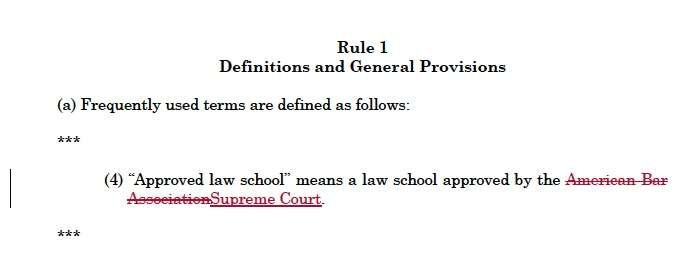
The Court has requested comments by December 1, 2025, and announced the amendment will likely take effect on January 1, 2026.
The Court invites public comments on the proposed amendments. Comments should be submitted in writing to rulescomments@txcourts.gov by December 1, 2025.
The Court will issue an order finalizing the amendments after the close of the comment period. The Court expects the amendments to take effect on January 1, 2026.
I think the phrasing here is signifiant. Consider how the prior order specifically listed the law school deans before the public:
The Court invites comments on this topic from the Texas Board of LawExaminers, the Texas law school deans, the bar, and the public.
In my comment, I criticized this phrasing:
With respect, I think this order lists the relevant constituencies backwards. The Supreme Court’s authority to regulate the legal profession is premised on serving the public interest. And the interests of law school deans, in particular, are not always consonant with the public interest.
It is the public that should weigh in on how this change affects the public.
The Court offered several points to guide the comment process.
First, the primary objection of the law deans was that removing the ABA’s role would affect portability. In other words, graduates of Texas law schools would not be able to sit for bar exams in other states. I think the Deans care less about graduates of foreign law students sitting for the Texas bar. This concern would be raised more by law firms.
Commenters and other interested parties are advised that the Court, in reasserting its authority over the approval of law schools:
a. intends to preserve the portability of Texas law-school degrees into other states and to preserve the portability of out-of-state law-school degrees into Texas;
It is not clear how portability will be preserved, but SCOTX is moving forward.
Second, another objection was that even if the ABA is removed as the sole accreditor, law schools will still opt to voluntarily maintain ABA accreditation. This two-tier accreditation could lead to duplicative and burdensome work. Texas explains there will not be “additional” burdens.
b. does not intend to impose additional accreditation, compliance, or administrative burdens on currently approved law schools, which need not take any additional action in order to remain approved law schools in Texas;
Third, for schools that are already ABA accredited, Texas will offer “ideologically neutral criteria” to maintain accreditation. Say farewell to DEI mandates to teach “cross-cultural competency” and similar topics. More pressingly, accreditation will be premised on neutral output measures, such as bar passage and employment statistics. Seth Chandler offered a metrics-based approach in his Civitas essay.
c. intends to provide stability, certainty, and flexibility to currently approved law schools by guaranteeing ongoing approval to schools that satisfy a set of simple, objective, and ideologically neutral criteria (such as bar exam passage rate) using metrics no more onerous than those currently required by the ABA;
Fourth, Texas law schools that opt out of ABA accreditation could maintain Texas accreditation. There may be Texas law schools that decide to go down this path. Cutting the ABA’s expensive mandates could help improve actual student outcomes.
d. will not consider the fact that a law school loses ABA accreditation to be sufficient grounds for removal of the school from Texas’s list of approved schools;
Fifth, schools in other states that are not ABA accredited will be able to opt in to the Texas list.
e. intends to develop, in consultation with the Texas Board of Law Examiners, a deliberative approach to requests from law schools not currently accredited by the ABA that wish to be added to Texas’s list;
Sixth, the Court lists all of the law schools currently accredited by the ABA, and says they are now “approved by the Court as satisfying the law study requirements for admission to the Texas Bar.” No further work needs to be taken. Graduates of those schools can con
f. does not anticipate immediate changes to the current list of approved law schools; and
Seventh, there are currently efforts by Florida, Texas, and other states to create alternative multi-state accrediting agencies. I think the Trump Department of Education will gladly certify these bodies, thus further weakening the ABA’s authority.
g. may consider, in the future, returning to greater reliance on a multistate accrediting entity other than the ABA should a suitable entity become available.
It is difficult to explain how significant this order is. In the span of a few pages, the Texas Supreme Court demonstrated what many of us realized years ago: states do not need the ABA as an accreditor. The ABA only has itself to blame. Rather than realizing what time it was, and focusing on its core function, the organization continued its mission creep, and squandered its credibility.
I suspect Florida, Ohio, and other states to follow suit.
I have helped to organize a panel at the Federalist Society National Convention on the future of the ABA. It could not be more timely. And I intend to submit a comment to SCOTX by December.
Read the full article here
Fact Checker
Verify the accuracy of this article using AI-powered analysis and real-time sources.