

 Freedom Index

Listen to the article
Weekly net stablecoin inflows rebounded last week as onchain activity picked up even while US awmakers and banking groups sparred over whether stablecoin issuers should be allowed to pay yield, according to a new Messari research report.
Weekly net stablecoin inflows accelerated to $1.7 billion, a 414.5% increase week-over-week, according to the report published on Wednesday.
The recovery also flipped the 30-day average to a positive $162.5 million in daily inflows. Transaction volumes also rose 6.3%, while average transaction size continued to decline, reflecting renewed stablecoin issuance demand and “strengthened” onchain activity amid retail investors, the report states.
Stablecoin inflows track net new stablecoins entering circulation after accounting for redemptions.
The surge follows a weaker period earlier in the year. Messari data showed $249 million in weekly inflows two weeks earlier and $4.4 billion in net outflows over the 30 days leading up to Feb. 18.
Stablecoin yield debate stalls US market structure bill
The renewed demand comes as debate in Washington has sharpened over “yield-bearing” stablecoins. Banking groups have argued that allowing stablecoin issuers to pay yield would create a loophole that could pull deposits away from banks, and have urged lawmakers to restrict the practice as they negotiate a broader crypto market structure bill.
Related: Indiana lawmakers pass crypto rights bill banning discriminatory taxes
Initially scheduled for mid-January, the Senate Banking Committee’s markup of the bill was postponed indefinitely amid disputes over stablecoin yield.
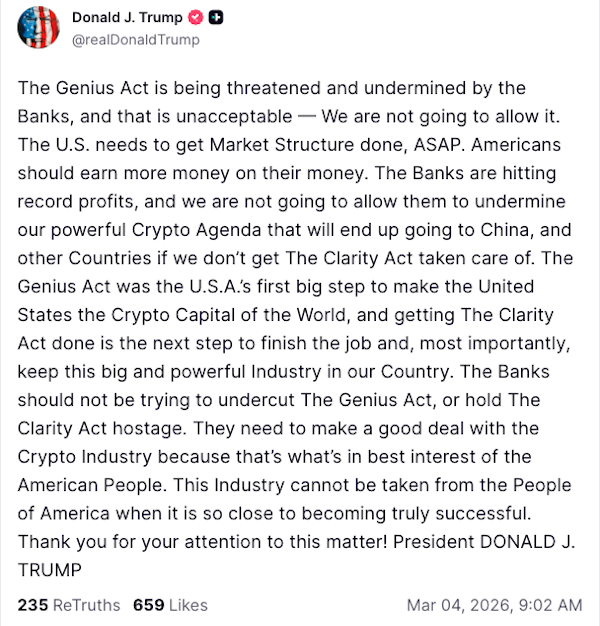
On Tuesday, US President Donald Trump criticized banks for stalling the Senate’s bill.
“The Genius Act is being threatened and undermined by the Banks, and that is unacceptable — We are not going to allow it,” said Trump in a Tuesday post on the Truth Social platform.
Related: Tether invests in AI sleep tracking firm at a $1.5B valuation
The GENIUS Act, a federal framework for regulating stablecoin issuers, prohibits issuers from paying interest or yield solely for holding a payment stablecoin. Third-party platforms, however, can still offer rewards programs tied to stablecoin balances.
Separately, the Digital Asset Market Structure Clarity Act, known as the CLARITY Act, is designed to provide a broader regulatory framework for digital assets. The House passed the measure on July 17, 2025, and it has been under debate in the Senate.
Magazine: How crypto laws changed in 2025 — and how they’ll change in 2026
Read the full article here
Fact Checker
Verify the accuracy of this article using AI-powered analysis and real-time sources.