

 Freedom Index
Listen to the article
In the previous essay in this four-part series on the impact of the Second World War in Southeast Asia, I looked at the widespread violence, scarcity, and militarisation that characterised the Japanese occupation. This third essay will focus on the experiences of individual countries under the occupation and examine how local nationalist movements were cautiously co-opted by the Japanese.
Japan’s Conquest Shattered European Rule in Southeast Asia
Southeast Asia in World War II, Part One: Japanese Conquests and British Disgrace
Terror and Transformation
Southeast Asia in World War II, Part Two: The Japanese Occupation and Its Repercussions
The Japanese occupiers had an ambivalent relationship with the local nationalists they encountered in Southeast Asia. Like the European colonialists before them, the Japanese often preferred to enforce their rule by collaborating with traditional elites rather than with local nationalists. In cases where the Japanese did choose to cooperate with the latter, the end goal was always enforcing control and mobilising the resources of Southeast Asia to feed the Japanese war machine, rather than creating independent states.
Yet, as the war intensified and the Allies advanced across the Pacific, the Japanese saw fit to grant more concessions to local nationalists, including plans for eventual independence. It was hoped that, if granted more autonomy, Southeast Asian elites would be better able to channel local manpower and materials to the Japanese.
Indonesia
This was how the Japanese approached the administration of Indonesia, the primary target of the Japanese offensives throughout Southeast Asia in 1941–42. Many Indonesians initially welcomed the invaders, believing Japanese propaganda that they were there to liberate them from the Dutch. In Gorontalo in northern Sulawesi and Aceh in northern Sumatra, revolts against the Dutch broke out before the Japanese even arrived. By the time the Japanese arrived in Aceh, they were met by cheering crowds, the Dutch having already fled.
If the Indonesians hoped that independence was imminent, however, they were to be sorely disappointed. Horrified by the violence they encountered, the Japanese promptly banned all political parties, as well as Indonesian nationalist symbols such as the red and white flag and the national anthem. To the dismay of nationalists, the administrative unity of the archipelago was dismantled, with Sumatra annexed to Malaya and administered by the army from Singapore, Java administered as its own separate entity, and the eastern half of the region handed over to the Imperial Japanese Navy. Sumatra was later governed as a separate entity.
To administer the territory and to mobilise its rich resources of oil and rubber, the Japanese ruled through the traditional Javanese administrative aristocracy, just as the Dutch had done before them. Local nationalist leaders like Sukarno (the future president of independent Indonesia) and Muhammad Hatta (the future vice-president) were generally sidelined, enlisted instead into Japanese-sponsored mass organisations to help inspire and mobilise Indonesia’s vast reserves of manpower into supporting the war effort.
Many of the nationalist leaders were not blind to Japanese intentions. Sukarno told a friend, “I know the Japanese are fascists. But I also know that this is the end of Dutch imperialism. We will suffer under the Japanese, but thereafter we will be free.” Aligning with the Japanese allowed these nationalist leaders to reach the masses through their system of mass propaganda, which included radio broadcasts transmitted via loudspeakers attached to trees and poles. Through the Japanese, thousands of Indonesians were introduced to the charismatic Sukarno for the first time, allowing him to build a mass following.
In return for being provided with a platform, nationalist leaders turned a blind eye to the miseries being inflicted on their fellow countrymen. Among the most wretched were those recruited as forced labour for the Japanese. The mobilisation of such labour in Indonesia was called romusha. Villages were ordered to supply quotas of men. They usually targeted poor peasants and landless people, who would be put to work in ports and coal mines, as well as in the construction of military fortifications, airstrips, and railways. They were provided with no clothes and very little food. Some one million Javanese were enlisted as romusha, 120,000 of whom were transported to Sumatra and 70,000 to mainland Southeast Asia, where many worked on the notorious Burma Railway.
Tens of thousands died of hunger, exhaustion, and disease. Some 15,000 Javanese romusha died during the construction of the Burma Railway, while another 25,000 were killed building the 220-kilometre-long Pakan Baru Railway from East to West Sumatra. On a visit to a lignite mine in Bayah in West Java, Sukarno recalled encountering “wretched skeletons performing slave labour.” At the behest of the Japanese, Sukarno urged people to sign up to be romusha—something that would later haunt him. He admits inhis memoirs, “Yes, I was the one who put them to work. Yes, I shipped them to their death. Yes, yes, yes, I am responsible. It was awful. I handed them over to the Japanese, no one likes this ugly truth.”
As unpalatable as collaboration was, Japanese policies ultimately proved crucial to facilitating the nationalist project and forging an Indonesian identity. A critical role was played by the education system, on which the occupation had a revolutionary impact. The Japanese made primary schooling free, allowing a growing number of children from the lower classes to gain access to the education system for the first time. At its peak in 1944, some 2.6 million attended primary school (compared to 2.2 million in 1940). Teachers were better paid, and besides teaching the Japanese language, Indonesian youth also learned the new language of Bahasa Indonesia, a standardised form of Malay developed by Indonesian nationalists (up until then, most Indonesians had spoken their local dialects).
As Japan’s war situation began to deteriorate in mid-1943, the Japanese responded by drafting Indonesia’s large pool of young men into paramilitary and auxiliary militias. Local militias such as the Keibodan were established throughout Java to maintain order; their members received military training but no weapons. By early 1944, the Keibodan had 1,280,000 members. A further 25,000 Javanese men were recruited as auxiliary soldiers (Heiho) to perform supporting tasks for the Japanese army, such as guarding prisons and building fortifications. The Heiho were also provided with military training. In October 1943, the Pembela Tanah Air or the Defenders of the Fatherland (PETA) was established. PETA was the first ever military force under Indonesian command, and was well armed, with a total of 20,000 rifles. Among those who served with PETA were Sudirman (independent Indonesia’s first commander-in-chief) and the future military dictator, Suharto.
By early 1945, nearly two million young Indonesians were members of a militia. This created a large pool of young men with basic military training, imbued with a militant mentality by their Japanese trainers. From among their midst emerged the pemuda, a term literally meaning youth but that often refers to the spirited nationalists who took up the fight against the returning Dutch in the postwar struggle for independence. Although the Japanese attempted to drill a hatred of the West into their charges (“Amerika kita setrika, Inggris kita linggis”—“We’ll squash the Americans, we’ll bash the British”), many of the pemuda soon developed a loathing of the Japanese too, angered by the brutality and deprivations inflicted on their families. The pemuda also became alienated from the much older nationalist leaders like Sukarno, who were collaborating with the Japanese and were seen as too conciliatory and out-of-touch.
While the Japanese had initially hoped to annex large parts of Indonesia, the deteriorating war situation in 1945 pushed Tokyo to announce the creation of a Committee for Investigating Independence for Indonesia. The committee was to research models for an independent Indonesia to be forwarded to the Japanese for review. The sixty-four members of the committee included Sukarno and Muhammad Hatta. It was as a member of this committee that Sukarno first formulated Indonesia’s founding principles, Pancasila. On 7 August, one day after the Americans dropped an atomic bomb on Hiroshima, the Japanese announced the formation of a Committee to Prepare for Independence and promised that independence would be granted in September of that year.
Japan’s surrender on 14 August caught Java’s politicians unaware. On 16 August, pemuda kidnapped Sukarno and his immediate circle and forced them to make a unilateral declaration of Indonesian independence, as they did not want people to think they had been granted independence by the vanquished Japanese. On 17 August, then, Sukarno proclaimed Indonesian independence in the name of the Indonesian people in a declaration he co-signed with Muhammad Hatta. Indonesia thus became the first country to declare independence after the Second World War.
Malaya and Singapore
As in Indonesia, the Japanese had initially expressed little interest in preparing the British colonies of Malaya and Singapore for independence. Instead, they envisioned turning Singapore (renamed Syonan or Brilliant Harmony) into a colony, while the Malay states were to become protectorates.
One of the most lasting legacies of the Japanese occupation would be the deepening of racial animosities, especially between the majority Malay Muslims and the minority Chinese. Notwithstanding the privations felt by all races under occupation, the Malays were generally treated more leniently than others. Malay schools received preferential treatment, while a number of Malays willingly served the Japanese administration as auxiliary policemen and in other paramilitary sub-units. By mid-1943, as Japan’s war situation deteriorated, the Japanese began fostering Malay nationalism.
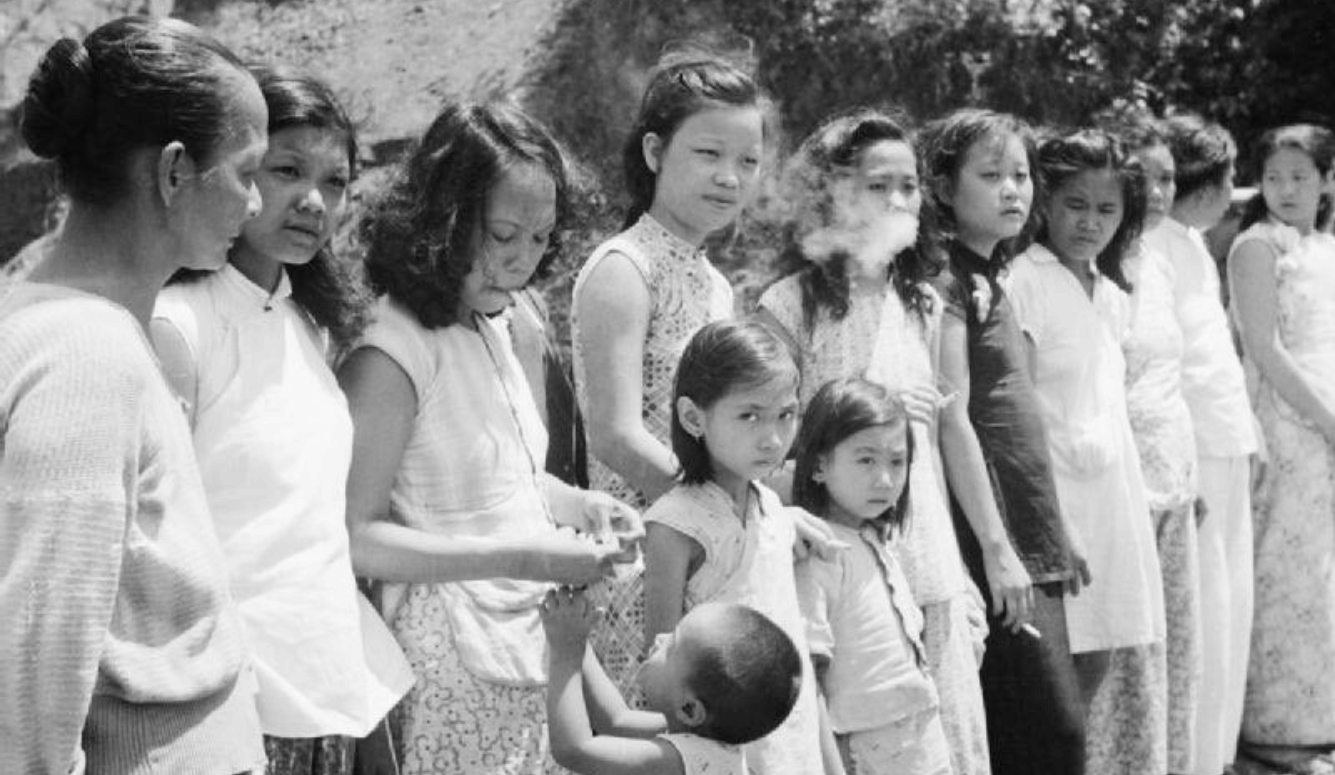
The Chinese suffered greatly at the hands of the Japanese. Most of them had migrated to Malaya when it was still under British rule, to work in the rubber plantations and tin mines, all the while maintaining links with mainland China. The Japanese were aware that Chiang Kai-Shek’s efforts to expel them from China had been generously funded by the overseas Chinese. Following the British surrender on 15 February 1942, the Japanese carried out the first sook ching massacre in Singapore (sook ching is a Hokkien term meaning ‘purge through cleansing’). This involved the mass round-up and screening of Chinese males to filter out supporters of Chiang Kai-Shek’s nationalist Kuomintang (KMT) as well as communists, pro-British Chinese, members of the China Relief Fund, and members of the British-led Dalforce, a Chinese irregular unit hastily organised by the British during the Japanese invasion.
Those identified as “anti-Japanese” were taken to the killing fields. At one of these fields, Changi beach in northeastern Singapore, the victims were machine-gunned down, after which their bodies were dumped in the sea. Similar sook ching massacres took place in most major cities in Malaya.
The Chinese were also squeezed for financial contributions to the war effort, while Chinese social institutions such as dialect and clan associations were shut down. The collapse of Malaya’s export economy during the occupation forced thousands of unemployed Chinese to become squatters, eking out a living growing food on the fringes of the jungle.
It is thus no surprise that the Chinese became the group most committed to opposing the Japanese occupiers. Indeed, the most effective armed resistance group in Malaya, the Malayan People’s Anti-Japanese Army (the MPAJA), was largely comprised of Chinese. The MPAJA was formed in consultation with the British during the Japanese invasion and continued to receive support from the British during the occupation, especially from Force 136 (a stay-behind force directed by agents of the British Special Operations Executive or SOE). The MPAJA was dominated by the Malayan Communist Party (MCP), itself a largely Chinese body.
MPAJA numbers were bolstered by young Chinese fleeing into the jungle to escape the sook ching, while food supplies were provided by the squatter Chinese. Indeed, these links with the squatter communities were to prove enduring. Across the central range of northern Malaya, the MPAJA fought for control of the squatter communities against other Chinese guerrilla groups, many of whom were aligned with the rival Kuomintang. The MPAJA also fought against the largely Malay police force aligned with the Japanese, thereby heightening racial tensions between the two communities.
After the Japanese surrender on 15 August, the MPAJA took advantage of the collapse of order during the interregnum that ensued until the British returned, to settle old scores. Emerging from the jungle to take over towns and cities, the MPAJA dealt harshly with those believed to have collaborated with the Japanese. Given that many of those targeted were Malays, this only further exacerbated racial tensions. In response, many Malays carried out their own pogroms against Chinese communities. On their return, the British encountered a combustible environment. The seeds had been sown for the later Malayan Emergency of 1948–60.
French Indochina
In French Indochina, the Japanese were effectively dominant but allowed nominal French rule to continue. The nature of this arrangement seemed to bely the Japanese proclamations of “Asia for the Asians.” Many Vietnamese questioned why the Japanese had not overthrown the French, as they had the British and Dutch. The French themselves noted that the Vietnamese seemed cheerful upon hearing news of Japanese defeats over the Europeans. However, allowing French nominal rule to persist allowed the Japanese to divert resources towards other, more critical theatres in the Pacific.
All this changed in March 1945, when the Japanese swept the French regime aside due to fears of a possible American invasion from the recently liberated Philippines. The Vichy regime in France had also been vanquished in 1944, after the Allies liberated the country. In Indochina, the Japanese now took over French bases and installations, crushing any resistance they encountered. Fugitive columns of French soldiers tried to escape by cutting a path through the deep jungle across Tonkin to the Chinese border, hunted by both the Japanese and Vietnamese guerrillas as they fled. The Americans, who had aircraft and bases in neighbouring China, refused to provide aid, since the Roosevelt administration was hostile towards French colonialism in Indochina. Their British allies were appalled at this, while the French were outraged. After struggling through the jungles of northern Vietnam, some 5,000 barefoot, bedraggled French fugitives reached China. Impressed by the spectacle of fellow Asians sweeping aside European rule, the Vietnamese dubbed the Japanese “oia”—“awe-inspiring.”
After ousting the French, the Japanese encouraged the former emperor, French puppet Bao Dai, to declare Vietnamese independence. But Bao Dai’s rule in Tonkin was entirely notional. Across most of the country, real power was in the hands of the League for the Independence of Vietnam—better known as the Vietminh. Founded in 1941, the communist-led nationalist movement was led by Ho Chi Minh, born Nguyen Sinh Cung (Ho Chi Minh means ‘Bringer of Light’). The son of a Vietnamese mandarin, Ho had withdrawn or been expelled from a French school (accounts vary) after his father’s disgrace. For several years, Ho travelled around the world, moving within political circles wherever he went.
In China, in 1940, Ho met with fellow revolutionary Vo Ngugyen Giap, who was later to lead the Vietminh’s military forces. Giap lacked formal military training but had voraciously read up on the strategies and theories of Napoleon, Clausewitz, and Mao. Throughout his military career, Giap combined undeniable strategic genius with a callous disregard for casualties.
With the Japanese now in charge, the Americans decided to throw their support behind the Vietminh guerrillas. Agents of the Office of Strategic Services (the OSS, the precursor to the CIA) were dispatched to Vietnam to liaise with Ho, with whom they quickly became enthralled. Ho asked the Americans: “Was not Washington considered a revolutionary? I, too, want to set my people free.” Many of them were convinced that Ho was more of a nationalist than a communist, and that the weapons they were supplying to the Vietminh were being used to wage a guerrilla campaign against the Japanese. In truth, however, besides being a nationalist, Ho was also a committed Stalinist. Furthermore, rather than fighting the Japanese, the Vietminh preferred to husband their weapons in preparation for fighting the French.
Burma and the Philippines
Only two states within occupied Southeast Asia were granted independence by the Japanese: Burma and the Philippines—the two most advanced states in Southeast Asia at the time in terms of constitutional development and indigenous political participation. As historian Nicholas Tarling has pointed out, given their advanced levels of self-governance, anything less than full independence would have been unacceptable to the Burmese and Filipino elites. Both countries were also fought over twice: the Japanese were successfully ousted from Burma and the Philippines by the British and Americans, respectively.
Burma was the last country in the Sphere to be occupied and the first to be granted independence (the Greater East Asia Co-Prosperity Sphere refers to a new Asia-Pacific-led order with Japan as its nucleus). Prior to the Japanese invasion, the Burmese had managed to secure the trappings of a fairly advanced constitution from the British, including a cabinet that was responsible to a House of Representatives elected by a limited franchise. With war approaching, Burmese nationalists unsuccessfully pressed the British for dominion status. Other more radical nationalists decided to throw their lot in with the Japanese, which led to the creation of the Burma Independence Army (BIA) under the leadership of former student activist Aung San. The BIA marched alongside the Japanese during the 1942 Japanese invasion of Burma.
As the British fled into India, the BIA raced the Japanese to liberate Burmese territory, since neither side fully trusted the other. As the BIA fanned out into the countryside, Burmese groups aligned with the army committed communal violence against minorities like the Christian Karens (whom many Burmese accused of being favoured by the British) and the Muslims of the Arakan region. These incidents were not quickly forgotten and would continue to bedevil ethnic relations in Burma post-independence.
To feed their troops, the BIA billeted their soldiers throughout the towns and villages they passed through, allowing them to establish enduring links with rural Burma. The BIA soon established their own state-within-a-state under the Japanese occupation, earning the gratitude of Burma’s peasantry by protecting them from the predations of Japanese soldiers. BIA soldiers from the far south of the country served in the northern fringes, allowing different communities from across the country to fraternise with each other. Many Burmese were proud to see their young men in uniform. In their eyes, the BIA was reviving the proud military heritage Burma had enjoyed before British colonisation.
Although they were ostensibly allies, the new Japanese military administration was initially hesitant to delegate authority to the BIA (which was later renamed the Burma Defence Army or BDA). However, by 1943, the deterioration in Japan’s wartime position prompted the Japanese to offer the Burmese early independence. On 1 August, the Japan-backed State of Burma declared independence. It was led by former prime minister and now Adipadi (or First Man) Ba Maw, with Aung San serving as Minister of Defence. Most Burmese viewed this independence as a mere façade, however, since the Japanese military continued to hold veto power over all policies. Japanese firms gained privileged access to Burma’s resources, pillaging the country’s timber, profiteering from rice shortages, and forcing households in cotton-growing areas to produce raw cotton. Young men were increasingly recruited into “sweat armies” to build roads and bridges for the Japanese and village headmen were threatened with punishment if they failed to meet their quotas of men.
By late August 1944, following the Japanese rout at Imphal and Kohima in north-eastern India and with worsening economic conditions in Burma, Aung San and other BDA officers began planning a revolt against the Japanese, having already entered into covert communication with the Allies. The left-wing Anti-Fascist People’s Freedom League (AFPFL) was promptly formed, in league with Burmese communist networks, with Aung San as its leader. In March 1945, the BDA launched a revolt, attacking Japanese positions in the Rangoon area. According to their own claims, over the next five months, the BDA killed 8,826 Japanese. To escape the wrath of the Japanese, the BDA fled into the countryside, relying on their established connections with the Burmese peasantry. BDA soldier Maung Maung recalls:
Partisans, young men from villages, left their homes to march with us. We ate the food that the villagers offered us, wooed their daughters, brought danger to their doors and took their sons with us.
As General William Slim, commander of the 14th Army, noted, the BDA revolt helped tie down large numbers of Japanese troops, thereby speeding up the British advance into Burma. Yet the alliance with the BDA left a sour taste in the mouths of many in the British government, who correctly surmised that the presence of the BDA would hugely complicate Britain’s efforts to recolonise Burma.
Like Burma, the Philippines had already been granted a high degree of self-government by their American colonisers, who went a step further than the other colonial powers in Southeast Asia in their commitment to grant the Philippines its independence by 1946. The timeline to independence was brutally interrupted by the Japanese occupation. While Philippines’ President Manuel Quezon and Vice-President Sergio Osmeña fled with General Douglas MacArthur to form a government-in-exile in the United States, many of the Filipino elites who remained chose to collaborate with the new occupiers. Their motivations varied—while some were outright admirers of Japan and its achievements as a modern Asian power, others saw collaboration as the only way to protect the Filipino people from harsh treatment.
In case the Americans returned, many elites also maintained links with the many anti-Japanese guerrillas that had sprung up during the occupation, several of which had been formed from remnants of the US Armed Forces Far East (USAFFE). The elites were not exactly thrilled by some of the anti-Japanese resistance groups, however, particularly the communist-leaning Hukbong Bayan Laban na Hapon—the People’s Anti-Japanese Army (commonly shortened to Huks). The most effective guerrilla outfit to fight the Japanese, the Huks had their roots in the various peasant movements that had formed in the late 1930s to defend the traditional rights of peasant tenant farmers in the central plains of Luzon, the heartland of rice and sugar cultivation. Increasingly violent conflicts between peasants and landowners had been taking place prior to the Japanese invasion, brought on by the collapse of the traditional Spanish-era feudal tenancy system in favour of systems of sharecropping, whereby small farmers were forced by debt into becoming wage labourers.
Absentee landlords would evict peasants from their lands, using corrupt police and armed goons to brutally suppress their tenants’ attempts to mobilise and assert their rights. In response, peasant groups were forced to arm themselves. While there was considerable overlap between the Huks and the Philippines Communist Party, the deeply Catholic peasants who made up the bulk of Huk fighters were generally more concerned with achieving fair treatment for the peasantry. As historian Michael Burleigh has argued, “[a] putatively socialist Jesus meant more to them than Lenin or Stalin, let alone Mao Zedong.” By the time the Japanese arrived, the legacy of armed peasant resistance in Central Luzon ensured a vicious struggle between the Japanese and the Huks for control of the countryside.
By mid-1943, the deteriorating war situation prompted the Japanese authorities to prepare the Philippines for independence. As with Burma, a Japanese puppet state was duly declared in October 1943, with former Senator and Supreme Court Justice Jose P. Laurel as president. Tokyo’s demand that the new republic declare war against the Americans was resisted by the Filipino leadership, who were well aware that much of the populace remained pro-American. As the Japanese themselves admitted in March 1944: “Even after their independence, there remains among all classes a strong undercurrent of pro-American sentiment… Guerrilla activities are gradually increasing.” By this point, the Japanese were fully in control of only twelve of the Philippines’ eighteen provinces, having to contest control of the rest with anti-Japanese guerrilla groups. The new republic was to prove fleeting, ending when American forces landed on the island of Leyte in October 1944 to begin their reconquest of the Philippines.
The Allied Fightback
By the latter half of 1944, Japanese-occupied Southeast Asia was contracting at both its eastern and western extremities. In October, a titanic clash between the US and Japanese navies took place in the Leyte Gulf, resulting in the destruction of a large part of Japan’s fleet. On 20 October, General MacArthur waded ashore on Leyte, fulfilling his promise to return. Alongside him was Philippines President Sergio Osmena, who had succeeded Manuel Quezon after the latter’s death in American exile on 1 August. After securing Leyte, landings were made on Luzon at Lingayen Gulf to the north of Manila and Nasugbu to the south.
The Japanese commander in the Philippines, Tomoyuki Yamashita (the very same general who had humiliated the British in Singapore) opted to abandon Manila in favour of fighting the Americans north of Luzon. However, a 12,000-strong Japanese naval detachment ignored Yamashita’s orders and chose to fight for the city. The Japanese had ample time to fortify it, lugging artillery up onto the top floors of buildings, while improvised mines made from shells and bombs were laid at road junctions, with machine gun emplacements to cover them. On his approach to Manila, an overconfident MacArthur announced the imminent fall of the city. What followed instead was one of the heaviest bouts of fighting of the entire Pacific War, and one of its few instances of urban warfare.
Between February and March 1945, American troops fought for control of Manila, street-by-street and house-by-house. Since most of Manila’s major buildings were designed to be earthquake-proof, American forces often resorted to blasting Japanese encampments using heavy artillery and tanks. The defending Japanese, well aware that they were going to die, turned their fury against the hapless Filipinos. Many were bayonetted and shot, while women were raped. Refugees were massacred as they sheltered in schools, hospitals, and convents. The Americans were horrified at this inhumanity. A diary found on the body of a dead Japanese soldier tells of his love for his family and the beauty of a sunset, before describing in graphic detail how he massacred civilians, including clubbing a baby against a tree.
A total of 8,000 Japanese and 1,000 American soldiers, alongside an estimated 100,000 Filipino civilians, were killed during the fighting for Manila, many by the Japanese but a majority by US shelling. A good portion of the city, once nicknamed the Jewel of the Orient, was destroyed. Sixty percent of the housing was obliterated by shelling, bombing, and fire. Dwight Eisenhower laterobserved that only Warsaw suffered more damage during the war.
As one Manila resident, commenting on the devastation of the city, put it, “I was no longer sure what was worse: the inhumanity of the Japanese or the helpfulness of the Americans.” Military historian Max Hastings remarked of the carnage in Manila: “Instead of a triumphal parade through the streets for which MacArthur had made elaborate preparations, he found himself presiding over Manila’s martyrdom.” After securing Manila, the Americans defeated Japanese forces in the Visayas and Mindanao. The remnants of the Japanese forces under Yamashita stubbornly held out in the hills of Northern Luzon until after Japan’s formal surrender on 2 September.
On the western extremities of the Japanese Empire, Japanese attempts to advance into north-eastern British India in early 1944 proved disastrous, crippling Japanese fighting power on the Burmese front. Ostensibly to forestall a British attack, the Japanese had devised U-Go: a two-pronged offensive targeting Imphal and Kohima (located in the modern Indian states of Manipur and Nagaland, respectively). Launched in March 1944, the offensive culminated in two titanic battles at those two towns, where the British and Indian troops of the 14th Army were able to hold their ground due to the presence of tanks and superior airpower (in particular, air supply). The Japanese, by contrast, had limited food and ammunition, and their supplies had to be brought using pack animals, such as oxen and elephants. By July, the Japanese had conceded defeat, and their crippled army was ordered to retreat back towards the Chindwin river, chased by the British all the way.
The Japanese defeats at Kohima and Imphal were turning points in the larger Burma campaign. More than 53,000 Japanese died in the U-Go offensive, making it one of the worse defeats in Japanese military history. The subsequent Japanese rout was horrific, with soldiers trudging through torrential rain and rivers of mud, beset by starvation, exhaustion, and disease. Japanese soldiers who stumbled upon Kachin and Shan tribal levies were often beheaded. One eyewitness with the Fourteenth Army, following in the wake of the Japanese, observed:
The air was thick with the smell of their dead. The sick and wounded were left behind in hundreds… We saw dead Japs all along the road, some in their stockinged feet, and where the hills were highest and most exhausting, they lay huddled in groups. … Five hundred dead in the ruins of Tamu. The pagoda was choked with the wounded and dying. They had crawled here, in front of the four tall and golden images, to die. Hand grenades littered the altar. In the center of the temple was a dais, and carved into this was a perfectly symmetrical pattern on the foot of Buddha. It was littered with blood-soaked bandages and Japanese field-postcards.
Starting in the autumn of 1944 and continuing throughout the monsoon, the 14th Army advanced south-eastwards into northern Burma, eventually linking up with Chinese divisions moving southwards to reopen the Burma Road. Swinging southwards, the 14th Army recaptured Mandalay on 20 March,following “house-to-house and pagoda-to-pagoda fighting.”
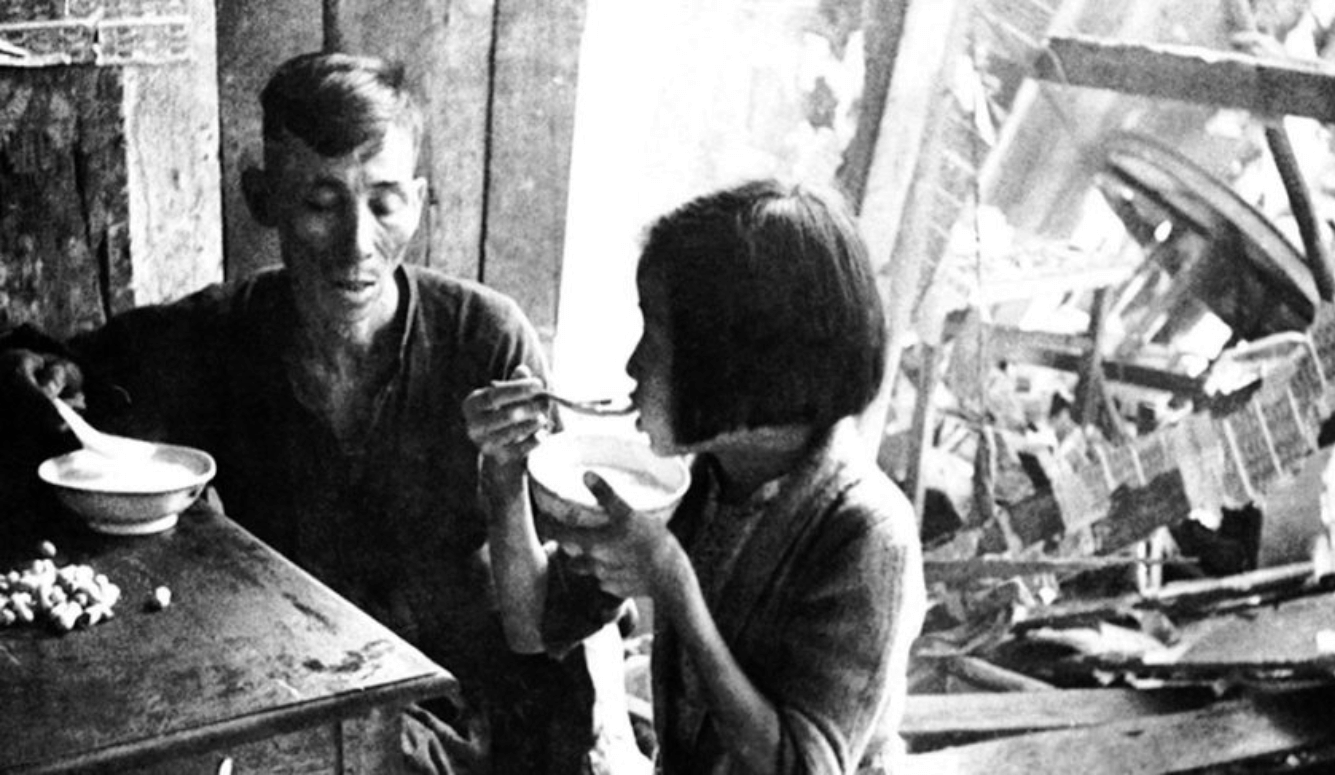
By April, the Japanese had decided to evacuate Rangoon, just as the British had done in 1942. The remnants of the Japanese army fled across the Siamese border, thus ending the single longest campaign of the Second World War. Parts of Burma were among the regions most devastated by the war. Rangoon was a scene of destitution, with no public transport, no electricity or kerosene, and entire city blocks reduced to rubble by Allied bombings. Many of the inhabitants were emaciated, and venereal disease was rampant due to so many women having been forced into prostitution by the end of the occupation. The population of Rangoon is believed to have been reduced by two-fifths. Banditry was rampant across the country, the bandits armed in part by the retreating Japanese.
The last major campaign carried out in Southeast Asia was a series of Australian amphibious landings on the north and east coasts of Borneo, ostensibly to recapture the Bornean oil fields. Australian troops landed on the offshore island of Tarakan in May 1945, in Brunei Bay in June, and in the Indonesian city of Balikpapan in July.
The Japanese garrisoned there found themselves caught between the Australians advancing from the coast and Allied special forces units operating in the interior, tasked with preventing the Japanese from fleeing into the jungle. These Allied special forces were aided by Borneo’s indigenous Dayak headhunting communities, whom they trained and armed. Having attempted to stamp out headhunting during colonial rule, the Allies rather hypocritically encouraged the Dayaks to take up the practice again, albeit this time targeting Japanese troops. The Dayaks were more than happy to oblige. Anthropologists visiting Dayak longhouses in the 1980s have recalled encountering Japanese skulls swaying from the rafters.
Following the atomic bombings of Hiroshima and Nagasaki on 6 and 9 August, respectively, the Japanese surrendered on 14 August. The instrument of surrender was signed on 2 September, on board the USS Missouri in Tokyo Bay, thus officially ending the Second World War.
A World Transformed
Across the West, Japan’s surrender on 15 August is now recognised as Victory Over Japan Day (VJ Day), marking the official end of the global conflagration and a return to peacetime. Last year, the British government oversaw the 80th anniversary of VJ Day. In a message marking the occasion, King Charles remarked:
For the millions of families gathered around their wireless sets, and for their loved ones still serving far from home, it was the message a battle-weary world had long prayed for. “The war is over,” declared my Grandfather, King George VI, in his address to the nation and Commonwealth on VJ Day eighty years ago today.
However, for the people of Southeast Asia, VJ Day did not necessarily herald an end to the bloodshed and turmoil. The coming decades would see further strife and agony as the returning Western powers sought to reassert control over their colonies, in the process clashing with newly empowered and emboldened nationalist movements seeking independence.
Overthrowing Western colonialism in Southeast Asia would be an uneven process across the region, both complicated and heavily influenced by the ideological divisions now developing between the capitalist West and the communist East. In the fourth and final article in this series, I will examine Southeast Asia in the immediate postwar period, when local nationalists struggled with the returning Western powers for their independence, against the backdrop of the early Cold War.
Quillette invites thoughtful responses to its essays.
Selected responses are published once per week as part of a curated Letters to the Editor feature. If selected, letters appear under the contributor’s real name and may be edited for clarity and length.
To submit a letter for consideration, please email [email protected].
Read the full article here
Fact Checker
Verify the accuracy of this article using AI-powered analysis and real-time sources.