

 Freedom Index
Listen to the article
In popular media, the presentation of Shakespeare has become a clue to the cultural leanings of the time. A great number of variations on his plays have come and gone, including those with modern reworkings like Baz Luhrmann’s Romeo and Juliet, revisionist performances featuring all-female casts, and popular retellings like She’s the Man and Ten Things I Hate about You. But writers and directors have also taken an interest in the life and experiences of Shakespeare himself, a shift from the dramas to the dramatist, from plays to biography—or rather pseudo-biography. One enticement, it appears, is not how much but rather how little is actually known of the person who created the greatest dramatic corpus in English—and very likely any language.
The paucity of information about Shakespeare’s life still inspires those who try to find someone else to credit for his accomplishments. These imaginative revisionists always manage to find someone who embodies their own idea of genius. In Shakespeare’s day, the real author was presumed to be one of the upper-crust, Oxbridge-educated intellectuals of the period—Christopher Marlowe, Francis Bacon, or any of a number of more or less prominent earls. (The 2011 film Anonymous egregiously picked up on that tradition.) In more recent times, the faux-laurel crown has passed to Emilia Lanier, the first woman in England to claim the title of poet. Here we find the original literary conspiracy theory that just won’t die: I expect that the honour will next be bestowed upon a person of colour, very likely one of Islamic heritage.
The Paranoid Style in Shakespeare Denialism
Against conspiracist trends, there is an obligation on defenders of a liberal society to uphold the integrity of its intellectual methods.
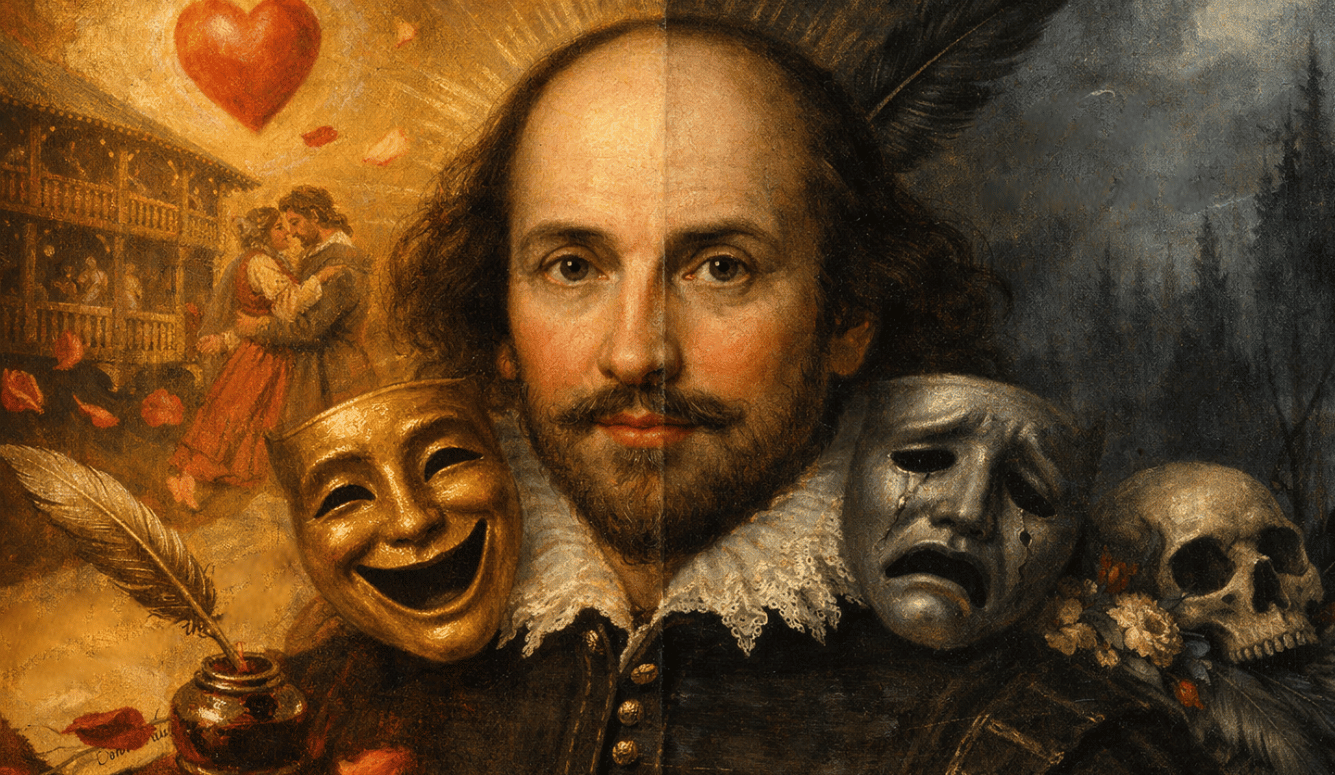
I’m grateful that the cinematic works I’m focusing on here do at least allow Shakespeare to be Shakespeare. Still, they tend to tell us considerably more about ourselves than about the Bard. The playful and witty Golden-Globe-and-Academy-Award-winning 1998 film Shakespeare in Love, directed by John Madden from a screenplay co-written by the late great Tom Stoppard, could hardly differ more from last year’s lugubrious Hamnet, directed by Chloé Zhao and based on the 2020 novel by Maggie O’Farrell. Both films are fictionalised presentations of a limited part of Shakespeare’s life. And in both, the fictional experiences undergone by the protagonist lead directly to the creation of one or more of his actual plays. But there the similarity ends.
In the 1990s, we were wired to seek joy, even if it came from those difficult literary works foisted on us in high-school English class. In the 2020s, on the other hand, almost any work of fiction that hopes to be taken seriously must rely heavily on personal trauma. Redemption may be possible but only by travelling through the muck and mire of grief. So while Madden’s film chose to focus on a sweet and purely fictional love affair early in Shakespeare’s life, Zhao’s directs attention to a dark fictionalised version of the death of Shakespeare’s son Hamnet, which occurs quite some time after the adventure of life and hope for success have lost their bloom. (That the earlier film is entirely the work of male writers and filmmakers while the later is the work of female ones is a point I can’t help noting but won’t go into here. Make of it what you will.)
Shakespeare in Love does not, to say the least, romanticise the bonds of marriage. As in Stoppard’s brilliant play Arcadia, marriage does little to serve the interests of either women or men. Love, however, does have a prominent place. Shakespeare is married, having left his wife to fend for herself in Stratford while he plays the stage and the field in London, but we are not invited to berate him for undertaking a passionate love affair with a wealthy merchant’s daughter, the entirely fictional Viola de Lesseps. To the contrary, we sympathise with him because his marriage will prevent his entering an official union with the love of his life. Sixteenth-century marriage had little to do with personal choice or love, but the moral atmosphere of the film was surely drawn more from the 1990s than the 1590s.
Madden and Stoppard are candid about the liberties they have taken in revising Shakespeare’s life. Long before Sofia Coppola inserted a pair of baby-blue Converse high-tops into Marie-Antoinette’s shopping scene, Madden placed a Stratford-upon-Avon souvenir mug in Will Shakespeare’s dressing room. The film is as fictional as Shakespeare’s Twelfth Night—the romantic comedy his love affair supposedly inspired. With one important difference: Shakespeare’s comic play takes place in a magical world removed from the social restraints and class restrictions that would inhibit marriages based on love. As a result, the real play, unlike the unreal real life of the film (it does get confusing), can end with most of the major characters paired off happily ever after. The cinematic Shakespeare, on the other hand, loses his love as she heads to America for a new life with her aristocratic husband, but she has provided the inspiration for another great play, which is reward enough. And so Will begins to write as the life- and art-affirming music swells and the credits roll.
Twenty-some-odd years later, our world has changed and so has Shakespeare’s. Let me admit that I am not a particular fan of either O’Farrell’s revisionist novel or Zhao’s screen adaptation. Nevertheless, both versions of Hamnet have been warmly received by audiences, critics, and awards ceremonies alike. At the time of writing, the film has already won the 2026 Golden Globe for Best Motion Picture-Drama. Apparently, the age of trauma drama is not yet over. In this case, an outcome of some merit supposedly results from all the woe and misery—the creation of Hamlet. But I found the implied connections between Shakespeare’s grief and specific lines in the play strained beyond plausibility. It’s true that Shakespeare wrote the majority of his great tragedies after his son died—but that was years later, and none of those plays directly or indirectly addresses his son’s death.
Read the full article here
Fact Checker
Verify the accuracy of this article using AI-powered analysis and real-time sources.