

 Freedom Index
Listen to the article
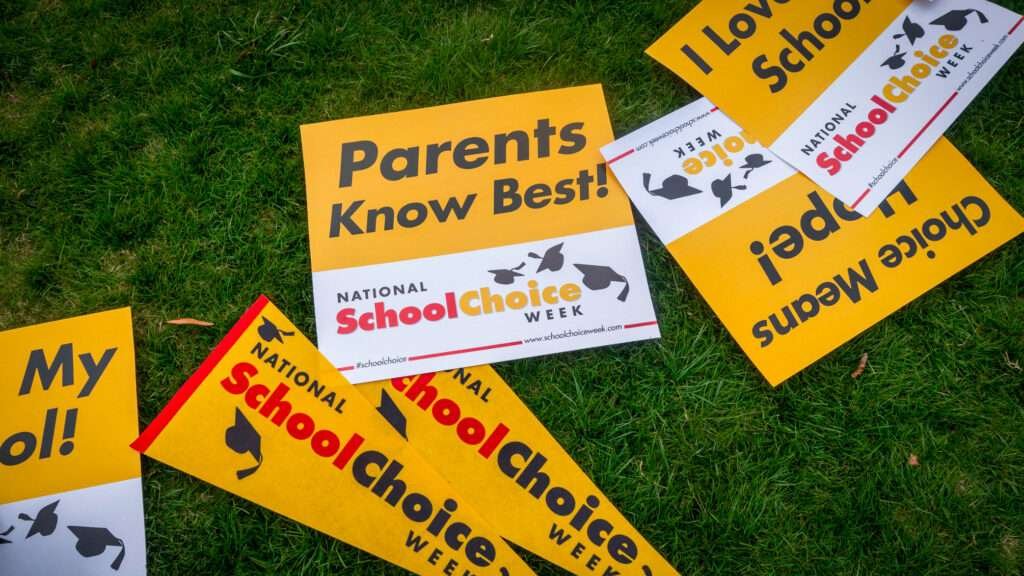
As of January 26, over 100,000 Arizona students are making use of the state’s Empowerment Scholarship Accounts, the local implementation of education savings accounts (ESAs). The popularity of the program, under which education funding follows children rather than being attached to an institution, is evidence of growing acceptance of school choice and of the diversity of education opportunities available for students and families who want something better than one-size-fits-some schooling.
You are reading The Rattler from J.D. Tuccille and Reason. Get more of J.D.’s commentary on government overreach and threats to everyday liberty.
First introduced in Arizona in 2011 for children with special needs, ESAs were later expanded to include students in failing schools, children of military families, and those who are adopted. Under former Republican Gov. Doug Ducey, ESAs became universal. Subject to broad rules, any student can make use of portable education funding equivalent to “90% of the state funding that would have otherwise been allocated to the school district or charter school for the qualified student.”
“Part of what animated my run for governor in 2014 was universal school choice,” Ducey told Reason in 2024. “The Milton Friedman idea that he shared on Free to Choose is something that took me all eight years of my governorship to accomplish.”
In Arizona, according to the state Department of Education, “with the ESA program, the money that would pay for that student’s education in a neighborhood school follows that student to whichever school the parents choose for their child, including education at home.”
A 2025 RAND Corporation report found that roughly 7 percent of Arizona’s school-aged population used ESAs as of the 2024–2025 school year. The program induced more families to pick their own education models, with 29 percent of ESA recipients made up of students who had not previously homeschooled or attended private schools. By enabling more families to shop for education that worked better for their children, “Arizona’s ESA program has induced growth in the education marketplace: The number of vendors on Arizona’s online education marketplace increased from 1,339 in 2021 to 6,091 by 2024, and the estimated number of private schools in Arizona has increased from 451 to 515 since 2022.”
Arizona has been a pathbreaker when it comes to school choice, but its experience is not unique. According to BallotPedia, 18 states currently have universal school choice programs, with many embracing choice after public schools fumbled their handling of lockdowns and distance learning during the pandemic—when they weren’t alienating families with politicized lessons. Another 15 states have school choice programs available to some but not all students. Seventeen states don’t have any education choice programs that extend to private options.
In 2024, the number of American students using programs that make education funding portable—universal school choice—exceeded one million for the first time. The popularity of programs that increase access to private education is understandable given the results.
A paper by education researchers M. Danish Shakeel, Kaitlin P. Anderson, and Patrick J. Wolf, published in 2021, looked at 21 studies of voucher programs. The authors found “moderate evidence of positive achievement impacts of private school vouchers.” Such programs, they added, appeared to be cost effective even if they didn’t improve outcomes.
Of course, these programs also have the added benefit of helping people choose where and how children are educated instead of forcing them into state institutions.
Even before the recent surge in programs that extend education funding to private schools and homeschoolers, charter schools gave parents and students options beyond cookie-cutter district schools. These publicly funded, independently managed schools have offered greater flexibility and a wider variety of education approaches for about a quarter century.
“As of June 2016, 43 states and the District of Columbia had enacted legislation authorizing the creation of charter schools,” reports BallotPedia. “Seven states had not.”
The potential benefits from charters’ flexibility was apparent this week in a report by The74‘s Jo Napolitano, which found that “charter school students in Washington, D.C.’s high-poverty Ward 8 far outshined their peers citywide in mathematics last year — besting children in even the wealthiest communities.” After a rocky start, Center City Public Charter School’s Congress Heights campus completely reworked the teaching of mathematics. The result was that every eighth grader completed Algebra I and 70 percent scored proficient. “Just 25% of all D.C. students and 64% of those in wealthy Ward 3 scored the same.”
The National Center for Education Statistics notes that “between fall 2010 and fall 2021, public charter school enrollment more than doubled, from 1.8 million to 3.7 million students—an overall increase of 1.9 million students. In contrast, the number of students attending traditional public schools decreased by 4 percent, or 2.0 million students, over the same period.”
Harder to track because of its DIY nature, but seemingly growing in popularity the fastest, is homeschooling. In the past, homeschooling had to be explained. But so many Americans tried their hands at it (over 11 percent of households) in desperation during the pandemic when public schools proved incapable of rising to the occasion that millions of Americans are now familiar with microschools, learning pods, online resources, and individualized education. Many of them like the approach.
Roughly 6 percent of students were homeschooled as of the 2022–2023 school year, with their numbers rapidly increasing. “Homeschooling growth is nearly triple the pre-pandemic rate and shows no signs of slowing down. This isn’t a pandemic hangover; it’s a fundamental shift in how American families are thinking about education,” commented Angela R. Watson, director of the Johns Hopkins University Homeschool Research Lab.
But as promising as the environment looks for school choice, it still has enemies. The current governor of Arizona, Democrat Katie Hobbs, wants to impose an income cap on the ESA program used by more than 100,000 students. She also makes claims of corruption in choice programs for which there’s little evidence.
Americans want choice in schooling just as they do in other areas of life. Unfortunately, many politicians are as hostile to freedom in education as they are to it everywhere else. Despite a lot of progress, Americans still have to fight for their right to teach their kids where and how they prefer.
Read the full article here
Fact Checker
Verify the accuracy of this article using AI-powered analysis and real-time sources.