

 Freedom Index
Listen to the article
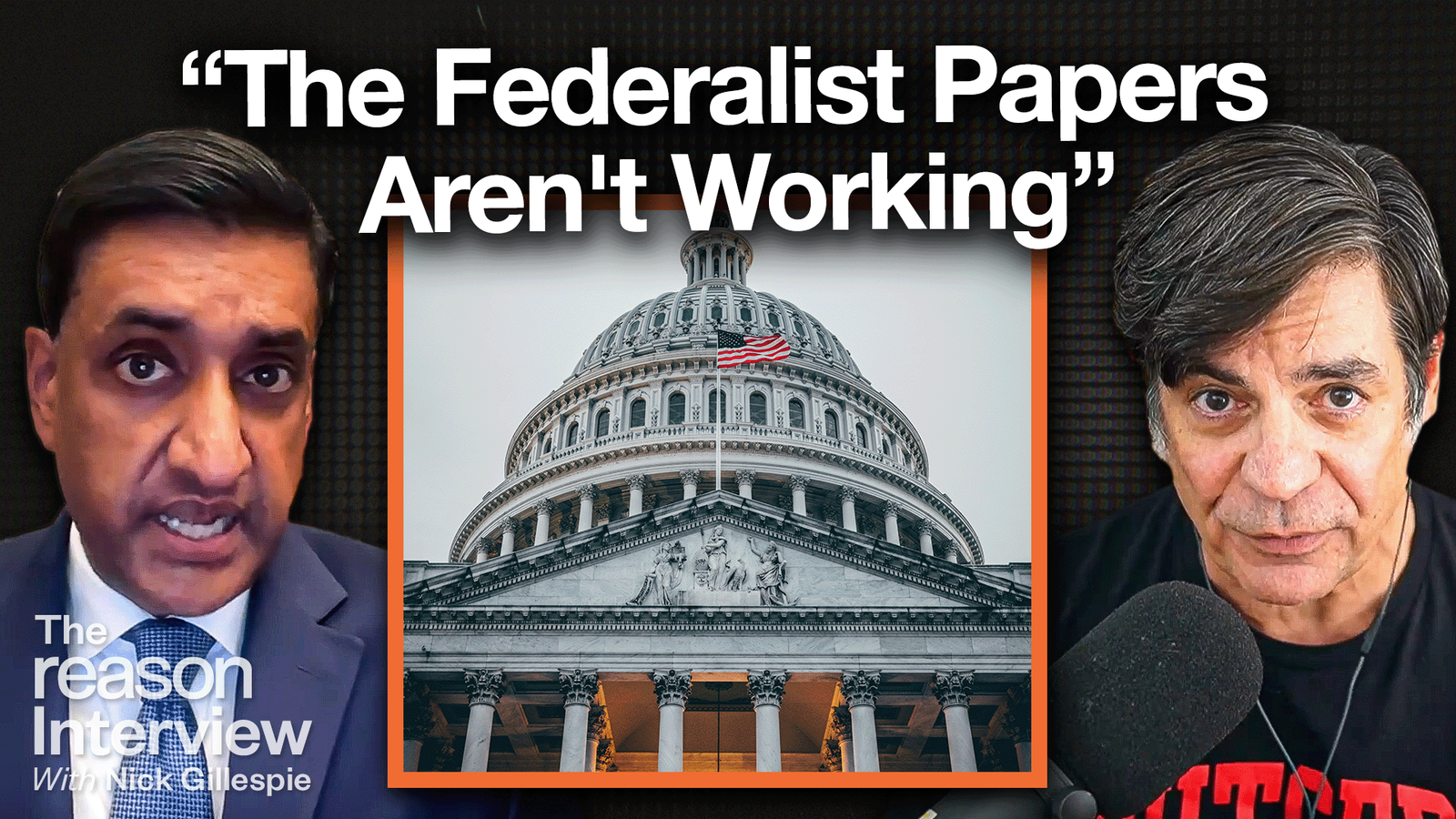
Today’s guest is Rep. Ro Khanna (D–Calif.), a self-styled “progressive capitalist” who represents such major Silicon Valley cities as San Jose, Santa Clara, and Cupertino in Congress but who also supported the independent Vermont socialist Sen. Bernie Sanders for president. He has shown an increasingly rare willingness to work across the aisle, cosponsored with the libertarian-leaning Rep. Thomas Massie (R–Ky.) a war powers resolution aimed at President Donald Trump’s bombing of Iran. He also joined forces with the Massie last fall to push disclosure of the Epstein files.
In this interview, Nick Gillespie talks with the five-term congressman about the need for Congress to reassert its control over the initiation of military force. They also discuss whether high taxes and regulations are why California was one of just five states to lose population last year. They argue the merits of California’s proposed wealth tax that some say pushed Steven Spielberg, Mark Zuckerberg, the founders of Google, and other ultra-wealthy people to leave the Golden State.
They also discuss the role of government in spurring and regulating AI and other technologies, the meaning of the Epstein files, and whether the United States can redefine itself in a way that reduces polarization without reducing pluralism.
0:00–What is the biggest problem with the Iran War?
3:00–Did Trump start the Iran War to distract from domestic policy?
4:36–What should Congress do about the Iran War?
6:59–What is progressive capitalism?
9:10–Does Khanna support the proposed California wealth tax?
12:23–Are taxes and regulations causing California’s population loss?
19:21–The role of environmental policy in California housing
21:03–Do billionaires weaken democracy?
24:19–The track record of wealth taxes
25:50–Will federal spending ever be reduced?
27:47–Artificial intelligence and impacts on the labor force
33:09–Assessing the New Deal
40:54–Is there a need for a national purpose?
46:24–The next attorney general and the Epstein files
51:19–What defines us as Americans?
Reason is hiring! Check out the two open roles on the video team now:https://reason.org/jobs/associate-producer/https://reason.org/jobs/producer/
This is an AI-generated, AI-edited transcript. Check all quotes against the audio for accuracy.
Nick Gillespie: Hello everybody. This is The Reason Interview With Nick Gillespie, and my guest today is Ro Khanna. He’s a representative, a Democrat from California, who represents Silicon Valley cities like San Jose, Santa Clara, and Cupertino. He’s known for working across the aisle with people like libertarian Republican Thomas Massie. They cosponsored legislation to force a vote on the Iran war, as well as pushing to release the Epstein files. And Rep. Khanna calls himself a progressive capitalist, and he’s a big Bernie Sanders fan. We’re going to talk about that and what we have as common ground and where there might be some issues about that. So, Ro Khanna, thank you for talking to Reason.
Ro Khanna: Appreciate it. Thank you for having me on.
Let’s start with the Iran war. You’ve been outspoken against the Iran war. As I mentioned, you co-sponsored a War Powers Resolution, a call for a resolution about Iran, with Thomas Massie. What is the biggest problem you see with the Iran war as it’s being prosecuted?
It’s both a moral and a strategic blunder. It’s a strategic blunder for two reasons. First, we’re not making America any safer. We have replaced Khamenei with his son, Khamenei Jr. Khamenei at least had a fatwa against nuclear weapons. Khamenei Jr. does not. If we replaced Khamenei Jr. by assassinating him, we would have the IRGC, the military, which is even more hard-line. They oppose the JCPOA. And at this point, Iran has leverage with the bombing in the Strait of Hormuz. When we stop bombing, which we should, along with Israel and Iran, we’ve actually given Iran more leverage in any deal that’s going to come from it. So that’s a…
It’s kind of amazing that somehow we start this war and then the Strait of Hormuz is gatekeepered in a way that it had never been before. Not going well. You said recently Trump should just declare victory and get out. Do you think realistically there is any chance of that?
Yes, because he keeps going back and forth. I think Trump instinctively understands the American people don’t want a long, drawn-out war. Unfortunately, today we had a plane shot down. One of the people was rescued. We’re still waiting to see what happened to the second service member. We’ve seen 13 casualties already. Seven thousand of our troops are at risk. We’ve seen gas prices explode. Trump gets the risks, but he’s got other people in his ear saying that he can somehow destroy the Iranian regime and bring about a new regime. And he’s been, you know, made a terrible decision. But my hope is he can understand and recognize the longer we escalate, the more risk there is to the country and to his own legacy.
You mentioned people whispering in his ear. Two kinds of questions related to that. Why do you think Trump started the Iran war when he did? If you look back at somebody like Bill Clinton, to take a Democratic president, he bombed Kenya and Afghanistan. He bombed Kosovo when domestic politics got very messy for him. And it was very uncomfortable to witness that. Trump seems to respond to—when something is going bad for him in one place, he starts something new. Do you think Trump started the Iran war to take the focus off domestic policy failings?
It has taken the focus off of Epstein. I mean, the search results are down, but I don’t believe that is the only reason. He, in my view, saw the Maduro capture and a more client leader coming there. I was opposed to that, but he saw that as a success and they thought, “Well, I can do this around the world.” Of course, there’ve been three famous great American presidents, George Washington, Abraham Lincoln, and FDR. People said, “Wow, they all won wars, so what are you going to do, Donald Trump, to have your military glory?” I mean, the State of the Union was all about the regalia of military achievement. So I believe that he’s been talked into saying, “Well, you’re going to be the one who gets rid of bad guys around the world.” He thought it was simpler than it is, given what he did with Soleimani in his first term and Maduro, and has made a mistake of hubris.
What can Congress do, or what should Congress do? This is something that is beyond partisanship. The president has been dictating foreign policy and when wars start and kind of when they stop for decades now. Is there anything that Congress can or should be doing that it is not?
First, we should be showing up. I don’t mean this rhetorically, but we’re in one of the major wars that we’ve been in in many years. And the Congress is out for two weeks. Like, I’m not saying that members of Congress are having a vacation. Some of them are doing district work.
Well, some of them are vacationing, right? We saw those horrific images of Lindsey Graham at Disney World, for instance.
And Lindsey has been the biggest cheerleader of the war. But even if they’re working in their districts or doing things, I mean, don’t you think that when we’re engaged in a war where Americans are dying and where the president is saying, “I want 400 billion more dollars,” that we should be every day debating that from the House floor? That we should be voting on War Powers Resolutions?
Is that a failure of Speaker Johnson, essentially?
Yes, but he’s not the only one. We’ve had these speakers, candidly, who’ve given up an assertion of our authority. One of the things that Massie and I, when we succeeded with the Epstein Transparency Act, is we were relentless. People could have said, “Oh, they’re going to ignore a discharge petition. Oh, Donald Trump will ignore you. They’ll never sign the law.” But we said, “No, we’re going to speak about this night and day and we’re going to push it.” If you have an executive branch, which is taking maximalist power when it comes to war and peace, and we’ve seen this obviously with Trump, but we’ve seen this, as you alluded to, with other presidents, Democrats and Republicans, and you have a Congress which is basically silent, then who’s going to win that fight? Obviously the executive branch. We haven’t seen Congress stand up and say, “No, we’re going to push back” in a meaningful, assertive way, where then you really have a conflict between two branches. And that’s why the Federalist Papers aren’t working, is because we’ve got a pliant branch of government on war and peace, because many members of Congress are fine not having to deal with these complicated, controversial issues.
But you guys, you’ve got a lot to do, right? You’ve got to get reelected. So, you know, we all have different priorities. Let’s talk about an area that I find very fascinating about you. You call yourself a progressive capitalist. What do you mean by that?
I mean that I believe in entrepreneurship, I believe in markets, but I don’t believe in unfettered capital going wherever it wants. For too long, we’ve had capital basically dictating to the state with deregulation and allowing for the free flow of capital.
Before we get to the progressive part of this equation, who are some of your favorite capitalists? Because I want to talk to you about kind of tax policy and your take on tariffs and things like that. But, you know, are there capitalists who are—you’re like, “These are the people we need more of”? You know, who are your favorite businessmen or women heroes?
Well, Bill Knudsen, he came in FDR’s government and basically helped industrialize America to win World War II, off the top of my head. That’s one person. But, you know, Warren Buffett is someone who has talked about having more fairness for billionaires and having economic development—I mean, there are other people. Andy Grove is someone who talked about….
Intel. Long-time head of Intel, yeah.
You know, David Packard and Bill Hewlett were people who built HP, but had a sense of ethics, of contributing back to the…
Are there any billionaires today who fit that bill for you, you know, a kind of Hewlett-Packard model, or are they all…
I’m having a fireside chat with Jensen Huang of NVIDIA. I don’t want to put him on a pedestal, not knowing all his views, but certainly he’s, for example, said that, “Well, if I have to pay a tax, a billionaire tax, so be it.” And he is really focused on how do we make sure that the economic development in this country is more even. I’m not saying he’s a saint, but he’s in a direction, I think, more of economic development and building an economy that works for everyone.
So you’ve come out in favor of a billionaire tax, you know, generally, and you’ve worked to introduce things. You’ve said recently, if Bernie Sanders were 15 years younger, he’d be the next president of the United States…
I believe that.
Yeah, and that kind of encapsulates the progressive element of this. Let’s talk about billionaire taxes. I have read kind of differing, or I have a surmise of your view, on the proposed ballot initiative in your home state of California for a one-time 5 percent wealth tax on billionaires. That would be retroactive. Do you support that initiative?
I support the idea of a one-time 5 percent tax to pay for health care and to pay for child care. I’ve had issues which I’m hoping get clarified, which is that it should not be a tax on founders’ voting shares and it should not tax illiquid assets of paper billionaires.
It shouldn’t be on unrealized gains, basically.
Well, it could still be on a— I don’t want to, you know, if you had public stock, for example, that still may be a tax on unrealized gains. But I’m talking about people who have totally illiquid assets and some startup that’s valued at a billion dollars, but really haven’t—could go down the other day. And—
How do you feel about the retroactive nature of the tax? This seems also kind of, it’s a little bit different than usual, that if it passes in California in the fall, it would tax all of 2026. Is that good constitutional lawmaking or is that problematic?
Well, it’s retroactive just to the first of the year. I think that was to disincentivize people leaving and exiting California. My view is that people who did it looked carefully at the law and thought that would be constitutional to do it within the year so people don’t leave. But obviously, I assume people will challenge that. But I think at a federal level, it is much harder for folks to leave because we tax, as you know, by nationality, we don’t tax by territory.
Yeah, for a long time it was the U.S. and Libya were the only two regimes that did that, and now it’s kind of just the U.S. So it’s not a great club to be part of, Congressman. But so talking about people leaving California, billionaires leaving California, this is part of the problem, right? If you say, “Ok, we’re going to start taxing billionaires,” last fall Steven Spielberg, Mark Zuckerberg, Larry Page and Sergey Brin of Google, left California. Others did just over the threat of this. Are they wrong to leave California if you say, “You’re a billionaire and we’re just going to take more of your money because you can afford it?”
Yes, because we live in a democratic society and 99.9 percent of Americans can’t just get up and leave if their city council or state governments pass laws that they don’t like. They say, “Yeah, I’m part of a democratic society and I’ll work to elect someone else or I’ll live with the laws that we pass.”
But California also last year was one of five states that actually lost people, and it started doing that for the first time in 2020, partly because of COVID deaths as well as people moving. But, you know, does tax and regulation policy in California, is that one of the reasons why California is losing people—not just, you know, Steven Spielberg?
No. I’ll tell you why. And I’m trying to give a fair critique and assessment of California. My district is producing 25 percent of the wealth of the country. We have $20 trillion in my district. It is the heart of the AI revolution. We’re going to produce more wealth over the next five years than any place in human history. The argument that somehow California is having an exodus of wealth generation is just contradicted by…
No, no, but it is having an exodus of people. It’s working-class people, middle-class people.
Yes. But that’s not because our policies aren’t good enough for entrepreneurship or our policies aren’t enough for innovation or wealth generation. That’s because we’ve had bad housing policy in California. We have not been building enough housing. We’ve had too much NIMBYism. And so the cost of housing is much higher than the cost of housing in other parts of the country. That’s a genuine issue in California. We have had not sufficient investment in our public schools after Prop. 13 and have not had an education system that has delivered results like New Jersey or Massachusetts or other places and that’s…
New Jersey schools are not—I’m wearing a Rutgers T-shirt, I grew up in New Jersey—their schools are not delivering for anybody except for teachers and bureaucrats, I must say…
But they’re number one. Massachusetts and New Jersey are number one in student achievement…
But California— Well, not to get bogged down in per-pupil spending in California and things like that, but you’re saying that the billionaire class, like, you can hold it captive in California. And I know I’ve listened to you talk about how, you know, if you’re in Silicon Valley, Silicon Valley people are not going to go anywhere. The companies are not going to go anywhere because there’s benefits to being in that place near each other, competing and sharing and all of that. But the fact remains, places like Texas and Florida are gaining people by leaps and bounds, and they’re moving from places like New York state, where I’m talking to you from, and California.
Is this an optical illusion?
Yes!
A state like California will be able to keep more people by taxing people even more? California is like the number one most highest-tax state in the country, or it’s always in the top three.
Not for working- and middle-class families. But you know, this idea— I’ve been hearing about Miami becoming the next Silicon Valley for 10 years. And Austin, it’s a joke compared to Silicon Valley. It’s 1/37th of the venture capital. They don’t have the ecosystem of Stanford and of Berkeley…
Well, what about Hollywood? Hollywood is dying. They’re doing everything they can to try and bring productions back there because it is too expensive to shoot movies in Hollywood. So Silicon Valley is a newer industry. Maybe that’ll happen 50 years down the road. But what I’m saying is, I mean, you’re saying that the California model—and I’d say California and New York, they share similar models of governance, where it’s like, “We’re going to tax a lot, we’re going to regulate a lot, and we’re also going to, at least on paper, offer high levels of services.” Texas and Florida—and they’re distinct from each other, as are New York and California—but they’re like, “We’re gonna tax and regulate less and we are also going to offer less.” But then when you look at what Florida offers in higher education, it’s actually available to people and it’s great in a way that the UC system, arguably the best public university system in the country, it is like, you know, nobody can get in anymore. People leave partly because of that.
The UC system has produced results so much better than almost any place in the country.
Yeah, but it’s an elite— I mean, you know, why hasn’t UC created more campuses?
We should. We should be investing in that.
But what I’m getting at is…
That could be something that taxing the billionaires…
You’re not, you don’t see anything in the current kind of ecosystem where California and New York are losing population to Florida and Texas, and that doesn’t make you think twice about a high-tax, high-service model.
Because of the fact that Florida is not producing nearly the wealth or innovation of California to make it think twice. I mean, there’s a reason no one in the world knows what’s happening in Austin or Miami and everyone knows Silicon Valley and that we’re leading the United…
I don’t know. I worry for you. You know, that you’re saying like nobody knows that, but it’s like those states—Texas, every year Texas—that when Texas is going to become more populous than California grows closer.
And people in California are like, no. The wealth gap and generation between Silicon Valley and Miami and Austin has leaps and bounds grown over the last couple of years because of the AI revolution. What builds wealth is not marginal tax policy. It’s whether you have a culture of innovation and entrepreneurship and building new companies. I’ve literally got $5 trillion companies in my 50-mile radius in my district. How many trillion-dollar companies are in Florida?
Yeah, I don’t know.
Zero. How many are in Texas? Zero. Zero.
And then you’ve got at least one in Arkansas, right? Probably with Walmart…
But I don’t even think Walmart is a trillion-dollar company. So now, does California have problems? Yes. The problem is on housing policy. There are people leaving California because they want to go for cheaper housing. And does California have a problem in terms of not having high enough wages? Yes, we need to have higher wages. We need to have child…
California also routinely has one of the highest unemployment rates in the country, it’s always above the national average, and you’re saying basically if we say the minimum wage, instead of it being $7 or whatever it is at the federal level, we’re going to make it $20 or $30, that’s going to make people stay in California, or is that going to make jobs that much harder to get?
Well, I believe that we need a living wage, we need child care, we need health care, but we also need to have federal investment, state investment in new jobs. And then if we had a housing boom, because we didn’t have restricted zoning, we would create many more jobs.
What’s the role of environmentalist policy? And this is interesting. And I enjoy this conversation. I’m not trying to, like, you know, do gotchas or anything. Florida and California are interesting in that Florida has—and this certainly started under Jeb Bush and other Republicans—they have a strong conservationist streak because the environment there is just kind of precarious. So it’s not like they don’t care about the environment. But is California’s real strict statewide environmental review systems, etc., is that what kind of energizes the lack of housing development or the lack of development of new property that people can actually live on or work at?
We had made it too difficult in some places to get permitting, and we’ve reformed that because the environmental legislation was being abused by people who had nothing to do with the environment to try to slow down building. And we just passed, the governor signed, a reform on permitting on CEQA, which was a reasonable reform that we needed. But there are other issues. The rich people don’t want to have their aesthetics ruined. They don’t want people moving into their communities who are lower income. I mean, I think if you want to critique California, critiquing the housing policy is fair, critiquing the education policy in terms of our not having delivered enough is fair, critiquing the high cost of living in terms of lower- and middle-class families is fair. But the critique that we’re not producing enough billionaires or wealth is just factually false.
Well, actually, though, I mean, in a way, if I can say this politely, I think your fixation on billionaires gets things wrong. I mean, if you look at post-tax-and-transfer income in America, inequality stabilized a couple of decades ago, according to the work of Scott Winship and other demographers. So it’s, you know, fixating on billionaires. Like, I’m not poor because Jeff Bezos has a thousand times more income than me.
Well, but I think…
It’s really it’s about where are people in that, you know, the thick part of the income distribution
Well, I disagree with that for two reasons. One, and we understood this, I think, in the Gilded Age, that there was a correlation between wealth and power. The fact that people have this kind of wealth and they can put $300 million into super packs is a problem for a democracy. That when you have the top 19 billionaires controlling 12.5 percent of the GDP, $3 trillion, three times the wealth concentration of the Gilded Age. When they’re using that to buy up companies and platforms and exert political power, that diminishes our equal voice in democracy. And that’s why I believe that wealth inequality of this extreme is not helpful for a democratic project.
How do you fight that, then, as the congressman from Silicon Valley? And that, you know, accurately, that’s how you define yourself, and you have megacorporations in your district. How do you withstand the pressure to dance to the tune that you’re essentially saying that billionaires are calling?
Because there are enough engineers and vice presidents and leaders and even some billionaires who understand that the social contract is broken, who understand if you do good in America, you need to do good for America, and support my call for a new social contract in this country where we celebrate the creation of wealth and entrepreneurship. But we ask, of those billionaires, their help to fund health care, child care, a Marshall Plan for America…
So according to the Tax Foundation, which is a pro-market but generally well-regarded organization, the top 1 percent of income earners in America pay about 40 percent of the income tax, and they capture about 26 percent of the wealth in America. How much more of the federal government should the top 1 percent pay for if 40 percent isn’t enough?
But the problem is that a lot of this wealth is never being taxed because they’re in stock, folks never pay tax on it, they hold it til they die, they borrow against it, and then their heirs inherit it with a step-up in basis. So I’m talking, not about the tax on income, I’m talking about the tax on all of this capital. Which isn’t being taxed, and it’s not the 1 percent, we’re talking about the 0.00001 percent.
You know, since about 1960, about 14 European countries tried wealth taxes. All but three of them repealed them because they found them unwieldy or counterproductive. Does that give you pause at all in saying, “What we need now is a wealth tax?” Even as we spend $7 trillion as a federal government, California’s state budget goes up. Virtually every state budget goes up every year. So we’re spending more and more, but we’re getting less and less results. And is the answer to that, say we’ve got to squeeze billionaires more, because when we spend this much more, then we’ll finally be able to achieve state capacity on delivering…
Well, first of all, I don’t believe that we’re getting less and less results. I mean, President Obama’s Affordable Care Act got 20, 30 million people health insurance who never had that. Saved many, many lives. The fact that we had infrastructure projects under President Biden, the fact that we had investment in solar and energy and wind and geothermal was deeply important. Do I think there’s waste and fraud in government? Absolutely. That’s why Burchett and I have proposed audits to make sure that the government spending isn’t wasteful. But the reality is there are too many people who don’t have health care, we don’t have child care. Instead of spending $400 billion on these wars in Iran, I’d rather keep up with college, I’d rather do child care, $10 a day. I’d rather have an economic bill of rights…
I would love to see the war spending just stopped and reduced. I mean, we’re spending like $7 trillion a year in the federal budget, and this was unimaginable even seven years ago when things were in the $4 trillion range. Do you see any way in which that spending comes down? Or is it just we’re going to keep spending more and more and more and then we’ll figure out how to pay for it?
The Pentagon budget is 56 percent of all discretionary spending. We should reduce…
But the big-ticket items are so secure. And I agree with you, it’s insane, but Social Security, Medicare, interest on the debt, and defense spending are the giant ones.
So that’s one of the big—scrapping the cap on Social Security taxes would make that solvent in a huge way, meaning if after $170,000 you should pay your Social Security tax. Mitt Romney proposed…
But that’s not the 1 percent either. I mean, that’s, you know, if you are like two college graduates who have been working for 25 years, you’re probably making that as a household. So that typically attacks not on the super-rich, but on the upper middle class, right?
I would do it after $400,000, but yes, you’d capture a fair amount of people who are upper-middle-class professionals with that. But I think people would be fine with that to secure Social Security and make sure we can increase Social Security benefits. And then I would go on taxing the ultrawealthy, and then I would get rid of some of the Medicare Advantage fraud. That’s been a huge drain on our—
That is an insane policy, right? Medicare Advantage plans, that the government will pay more for them, and it just doesn’t make any sense—if you have single-payer health care, why you would allow that?
Can I ask, you’ve said some things interesting about AI and the way AI innovation needs to be respectful of the people driving it—and this is in your district—the people driving AI need to be respectful of the possibility of dislocation, mass dislocation of employment and whatnot. What does that look like? You’ve talked about how workers need to have a say in how this stuff develops, around policy around it. What does that mean?
Well, let’s take a very concrete case where you have autonomous vehicles used in public transport, and the building trades and transportation unions work with some of the cities. And they said, “OK, if you want to add autonomous vehicles, it can’t displace the existing fleet, and you need to make sure that our members are going to have a job, whether it’s dispatch or maintenance, and we’re going to do the maintenance here domestically, we’re not going to offshore it.” And they came up with agreements to have autonomous vehicles added. So they weren’t sort of saying no to technology, but very concrete commitments for their members to get jobs and to be part of that future. And what I’m saying is that’s the kind of model we need as technology is adopted.
I mean, that can get out of hand, though. And I was thinking as I was talking about this, my father worked for SeaLand, which is a shipping company that is now owned by, I think, CSX or something. But they pioneered containerized shipping. The big fight that they ultimately had while they were rolling out this technology—which everybody says is one of the major reasons why the post–World War II world is richer than it was—is because of containerized shipping. It reduced costs of shipping goods, limited spoilage, all sorts of things. But they had to take on the longshoremen’s union, which still exists in a much beggared form. But if the longshoremen had been able to direct the development of that technology, it never would have happened. I mean, the automobile industry might not have happened, etc. So how do you make sure—and this, I guess, goes back to your progressive-capitalist idea—how do you make sure that you’re not strangling innovation by, you know, saying, “OK, well, nobody can ever lose a job. Nobody can ever be displaced by technology,” which is going to benefit everybody in the medium or long run?
Well, it’s a balance. It’s saying that we can find jobs for the longshoremen on the containers. I mean, we could have figured out—no one’s saying stop the technology. We’re saying make sure those longshoremen have jobs, make sure as you’re developing automobiles that people have jobs as mechanics, as car drivers, as doing things, and have that bargaining and not a complete ban on technology development. I guess the question in my view is, is the central problem in America a lack of efficiency, or is the central problem in America a lack of social cohesion? And of course you want both. You want efficiency and cohesion. But I would argue that the central problem in this country is a lack of cohesion, that the working class has gotten shafted. That people have not had jobs because of offshoring and the hollowing out of communities because of globalization and automation. And that we should be cautious in doing things that are going to exacerbate that as opposed to making sure that the AI revolution works for all of us. That’s not to say “Stop the technology.” I’m not one calling for a moratorium on the technology.
Doesn’t Bernie Sanders tend toward that? I mean, you know, he seems to be very Luddite in technology. He also tends to be very anti-immigrant. I worry about that.
No, I would reject that characterization. I mean, Bernie has campaigned on a multiracial, multiethnic democracy. That was every one of his speeches and his campaign ads. And he just sat down with a lot of the technology leaders in Silicon Valley. I mean, he understands the technology. He wants to make sure that the technology works for ordinary Americans. But I certainly don’t support, you know, what Elon Musk was for just a year ago, which was, let’s just have a pause on AI development. I believe that there are uses for AI development and mRNA. We could develop the RNA genome. We could figure out cures for rare diseases. But when we are adopting it, we have to make sure we don’t just displace millions of blue-collar workers. I mean, if there’s anything that we should have learned in our politics, even for those who are more pro-market than I am, it is that the massive displacement of people in the working middle class causes angry populism that poses the greatest threat to the rule of law and to capitalism itself.
Let me ask, as a final question—
Let me ask you one question. How do you assess FDR’s New Deal, a positive at this time or a negative?
I actually think that FDR—and there’s a guy down at UCLA, an economist named Lee Ohanian, who I find very convincing—that most of FDR’s interventions actually extended the Great Depression and that there are at least two Great Depressions. And also that the Depression did not end with the mega-buildup of the economy during World War II, but after, when government spending, federal spending, fell precipitously right after. I think the bold, if I may, the bold, persistent innovation or intervention that he talked about—experimentation—it made it very difficult for businesses to restart. And if you look at the economic data, I’m thinking of something like Amity Shlaes’ book The Forgotten Man, unemployment and business starts went sideways for a long time. I think having simple rules and having a social safety net for people who need it is good. But I don’t think that FDR was, ultimately, the New Deal was not what we are taught. I think it actually—
But if you look at just the data on unemployment, when FDR takes over, it’s about 25–27 percent. It falls to about 18 percent because of the New Deal. And then he goes with the Works Progress Administration because of the ’36–’37 recession, where it falls a little bit more. But it’s undisputed that in ’41, ’42, ’43, it falls to like 4 percent because of the war.
Yeah, but it’s also, you know, first off I don’t want war to be the health of the state, you know, broadly, even though I support, you know, obviously we should have fought in World War II. My father actually literally fought in World War II.
No, no, I’m not…
No, no, no, I get that. The government can direct the economy and goose economic growth for some period of time, but that gets problematic. And when you look at what life was like when the federal government was controlling most of the economy, there was rationing on everything. People were not necessarily doing better. That came after the war, when the government actually reduced its year-over-year spending. It’s massive. We reduced our debt, we reduced our spending, and the economy roared back to life for a lot of reasons, most of which I think have to do with the federal government getting out of the way rather than…
The industrial base was built, but I think it’s an interesting—the reason I ask that is because, of course, I have an admiration for FDR, with the caveat that it excluded the Black South.
Oh, and the Japanese internment is horrifying—
Yes. Of course. But I think that is a fair sort of insight into where our worldviews may differ, both in American politics, where FDR sees himself as saving capitalism from itself, and you see him as having overreached.
Well, yeah, and I agree with you. One of the things that I think people on the right and the left who are not populists—and I’m certainly not, and I don’t think you are—thinking about where…and you know there are left-wing and right-wing versions of populism. And where do they come from? And they come from moments of dislocation where large numbers of people, or substantial numbers of people, feel left out. Trump called back to FDR in 2016 when he said, “I’m speaking for the forgotten man.”
We need to make sure that people understand that they’re connected and that there’s a society where they have a place and something to connect them. I tend to think most of the time freer markets—not absolute anarchy or whatever—deliver better for people than larger and larger numbers of state controls on capital, on tariffs, on immigration, on things like that. And that the dislocations in industries tend to be slower and more digestible than we think. When we talk about industrial workers, which Trump won’t stop talking about, the industrial percentage of the labor force peaked during World War II, and it’s been kind of a straight-line decline since then. Long before globalization. And you learn how America got richer over that time. More people moved into houses, more people went to college, more people had more stuff. So we can digest and we can handle economic creative destruction, I think.
We can handle it on a macro sense, but I think what Trump’s election twice showed is that there was a great anger that we didn’t anticipate, of a loss of pride. And, you know, I do describe myself as an economic populist, but I don’t think economic populism needs to be hostile to immigrants or hostile to a role in the world or hostile to technology. And this is what I’m trying to reconcile with progressive capitalism and FDR, putting aside the internment camps, which is a big….
But you also did mention the South. This is part of the thing—A number of analyses show this about…more money went to the places that voted for him in larger numbers. So I worry about political control of largesse.
Yeah, I think that’s a fair concern. I mean, obviously, we have to—you know, it’s funny, because at first when the Public Works Administration came, Ickes was a great champion on integrity, and it was the Hoover Dam, and of course that largely people think was a good project. And then by the time the ’36–’37 recession happened, you get FDR saying, “Well, I don’t care about all of the constraints,” and you have the Works Progress Administration that hires 3.8 million people. But the word boondoggle comes out of that, because it’s hiring people who may not be doing the most productive work. But overall, I guess I assess FDR as having really saved capitalism. And I believe you need a kind of moment like that that’s more inclusive. I mean, that’s…
Well, I also, to be honest too, we’re not in that moment now. And one of the things that is amazing to me is really—this is an odd thing to be saying, because this has been a hell of a century, right? But, you know, we’ve gone through 9/11, we’ve gone through the financial crisis, we’ve gone through COVID and things like that. Median household income is higher than it’s ever been. We’re actually doing pretty well, even though we’ve had a ton of stuff thrown at us.
Certainly we’re not in a Great Depression with a collapse of demand in the same way. And yet the sentiment among Americans is that we’re not. And I don’t think it’s just driven by envy. I mean, I don’t think it’s, “Ok, that Jeff Bezos is making all this money and I see him on Instagram and so I’m not doing well.” I think there’s a real sense that people feel anxious about not having a $35 job and being able to buy housing and child care.
I agree with you that there is a lot of anger. And then how much of it is driven by actual material circumstances and how much of it is driven by narratives that take advantage of that? I think a huge part of it—you are about to turn 50, right? So you are part of Gen Z, or Gen X rather. Correct?
Yeah, we’ve been the skipped generation.
Whereas millennials and Gen Z, who are very pessimistic, feel like they are, in many ways, they are doing better than anybody. When you look at the number of Gen Z people at the same age as their parents, more of them own houses than 25-year-olds did 50 years ago, but they feel cheated and robbed by everything. And I think that’s not a material issue, that is a narrative issue. And I think one of the biggest problems—I’m the grandchild of immigrants. I know you are the child of immigrants, am I correct?
Yes.
That era when you could talk about America being a nation of immigrants, and that helped create a sense of belonging and community, that’s been over for a long time. The common identity of Americans as “we are not the Soviet Union,” that’s over. We don’t have an overarching national identity that helps us see where we are in relation to our peers. And I think that’s a huge issue. And I don’t know where the fix for that comes from, but I doubt it is from billionaire taxes, to be quite honest, or more industrial policy on the part of the state.
Well, I agree with the central theme, which is that we’re missing a common national purpose and we’re desperate and hungry for leaders who will ask us to be bigger and to come together. And one thing I would argue is that a vision of economic renewal could be that. Now, we can disagree about how much of a role the state will play in that, but certainly we could agree that whether it’s business leaders, technology leaders, labor leaders, faith leaders, that someone can summon the American people to help rebuild communities that have been left out, to help create economic pathways for those left out, and can make it a national call. And then, you know, if you’re more libertarian, like Thomas Massie, he may rely more on the private sector. And if you have more faith in the role of the state, I may rely more on initiatives with state collaboration. But the point is we’re missing a common national purpose.
Right. Well, and also if I may—and then I have a final question for you, that you mentioned, and Massie brings up—I think it’s important also to recognize that a national purpose does not mean that we are trying to make people fit into a singular vision of America as the greatest nation on Earth. I’m not saying you are, but that people—
I do think America is the greatest nation of the Earth, but I don’t think we have to have a thick conception of the common good. But we do need a conception of an allegiance to some sense of common mission. Even, you know, I think even this Artemis launch, which has some finally feel-good stories there. But, you know, there are only Americans who’ve landed on the moon, the 12 Americans who actually walked on the moon. And it’s Americans again who are now going, 50 years later, not to land on the moon, but circle the moon. And I do think things like that matter. And we’ve been missing moments like that.
Well, another Bay Area denizen is Stewart Brand, the founder of the Whole Earth Catalog, as well as The WELL in San Francisco and the Long Now Foundation. He is somebody who I think is worth thinking about in these terms, of where you build a common vision that’s kind of opt-in but is transcendent, and it allows for diversity of individuals but also a kind of commonality of belonging or purpose. And that can be great. Because when I think back to my grandparents who left Ireland and Italy, and they were leaving other people’s ideas of like, “Ok, this is your role in our great story of some kind of national purpose.” It’s something that we need to address because people do feel alienated from one another in a way that, I agree with you, it leads to political polarization and populism. And I think very little good comes out of populism, to be quite honest.
Well, I think the populism that recognizes the anger against systems that aren’t working is a necessity. But if it’s just that, without a positive vision, then I think it can feed into cynicism and nihilism. So it’s a concept that—
Let me ask you…
And this Epstein [unintelligible] is an example of, I would argue populism, in terms of standing up against a group of people who raped or abused these young girls. One could argue that that is, in essence, standing up against bad guys in a system, is populist.
I was going to ask, I guess, two questions. One, with Pam Bondi out, you know, what happened as attorney general— What happens to the Epstein files? Because there’s still like half of the files have not been released yet, right?
Yeah, I mean, I think Congress should make that a prerequisite, the Senate for confirmation, that you’re going to release the rest of the files and you’re going to make sure that we have investigations, and a future attorney general has to make those commitments. And if they lie in those confirmation hearings, they will be held accountable, just like Pam Bondi was. This is an issue that too many Americans care about, including Trump’s voters. So it’s a time for a great reset to get the rest of the files out.
In the Epstein saga, on the most kind of baroque level, people talk about a kind of global ring of pedophiles who are well-placed in business and universities and governments, are kind of running the world as their own pleasure palace. Does that go too far? Or what ultimately is the essence of the Epstein files saga, which has had an incredible hold on the public imagination?
I think it’s a look at the recklessness, immaturity, venality, and callowness of our modern elite class. Not all of them, but that they were seduced by networks and power. And some of them participated in the abuse and rape of young girls, who thought the rules didn’t apply to them. And others were so enamored by being part of this network of the privileged that they turned a blind eye to women and young girls being treated as dispensable. And so this culture that was created of impunity, a culture that people of decency could get caught up in. I don’t think that everyone who went to Epstein’s island was evil or a bad person, but how did we create this culture of an elite group that felt apart from the country?
And it goes to what we were talking about earlier, that there’s sort of different lived experiences for Americans. It used to be, you know, when I was growing up on Amsterdam Avenue in Bucks County, my father was an engineer, my mom a schoolteacher. We were middle class on our street. We had an electrician and a track technician, a nurse. We had a vice president at a big company, and that person had the pool and we would go to the pool, but we all were on the same Little League teams and went to the sports games and the Phillies, and you had a shared common experience. And now I feel like that’s missing. And this Epstein class highlights a type of experience that most Americans can’t relate to and don’t understand. If you’re in a small town and you have an affair, it’s not like human nature is perfect, but there’s a sense of shame. There’s a sense of, “What is the church gonna think? What’s my neighbor gonna think?” And here you have, you know, obviously the abuse of girls. But even behavior that may not go as far as abuse, but just one that is totally shameless.
How do you restore that and, you know, that sense of a kind of multiclass common experience? And, you know, if we had more time, I would probably pick nits about, you know, your experience, which I’m sure was much better than many people in the greater Philadelphia area or in Pennsylvania. But how do you bring something like that back? Because I don’t think it’s going—one, it’s not going to be easy…it’s not going to be by taxing Steven Spielberg 5 percent. Right?
Well, I think it goes to the sense of how do we create a common sense of purpose again in this country, and an experience where we’re dealing with other folks. I mean, one of the places I’m thinking about is called for Work for America, where if you’re a young person, the federal government will help hire you whether you want to work for a company, whether you want to work in local communities, whether you want to come for the federal government, and you’re doing things with other people in a common way. But, you know, I think this is the big question—I mean, some of it is housing policy, right, restrictive zoning. Some of that is a sense of basic health care and child care. But I don’t think it’s just material, and I think you’re fair to point out that it’s not just material, it’s not just government. There is a sense of speaking to the American experience and identity. We have to be inspired again.
Can I ask, and this is hard to put you on the spot like this, but what is that flexible identity matrix that defines us as Americans? Because we’re all going to have different, ultimately different experiences, and we’re never— I have a background in American literature, and for years Americanists were always saying, “Oh, America was the first classless society.” That’s just wrong. I mean, we always have had and always will have different classes, but that doesn’t need to get in the way of having a shared sense of purpose. What is it for you? What defines the American essence?
The idea is that our country is going to be the first cohesive, multiracial democracy in the history of the world. That you can come from Ireland, you can come from India, you can come from Italy, you could come from anywhere you want, and that the country will give you the chance – based on your hard work and your own initiative – to live out your dreams. To live the kind of life that you want to live, and that there’s been no society in the history of humanity that has actually achieved that, to give everyone the shot to live out their dreams, exude their own genius, as opposed to just the genius of founders in Silicon Valley or kings, but every person to live their own genius and potential, regardless of their race and background and class. And that is the most grand civilizational achievement that should motivate us.
Do you worry that, you know, I mean, that kind of identity politics as practiced, particularly in the Democratic Party, and now there’s a kind of white identity politics that is kind of growing among Republicans, but that’s one of the problems, right? Is that we have to start thinking about individuals again, rather than everybody as a marker for whatever group we assign onto?
I think that at our best, our leaders, even who have talked explicitly about race, like Frederick Douglass, enslaved for 20 years, have talked about a composite nation. A nation where we ultimately transcend that in allowing people, despite their background, to have the basics. I believe that I got a lot from this country. I mean, I was able to go to a good public school, I didn’t have to worry about health care. I had a wonderful childhood as a middle-class son of immigrants, and I just wish at least that for everyone. I think I have too many loans for higher education, but can we do that? And I grew up in a 97% white community in Bucks County, and yeah, there were times I was teased, etc., but overall, I remember a community that really embraced me.
How do we build that kind of positive vision? It doesn’t mean that we say to people who argue, “Well, race matters because of disadvantage, class matters because of disadvantage,” it doesn’t mean we shut their voices out, but we say to them, “That is not determinative of the American story. That is an input, and the North Star is still being a composite nation.” But that isn’t the final diagnosis or end aspiration of America. The end aspiration is to transcend it, but with the honesty to acknowledge it.
You know what, I think that’s a wonderful note to end on. Thank you, Rep. Ro Khanna, California’s 17th District, Silicon Valley. Thank you so much for talking to Reason.
Well, I enjoyed the conversation.
- Producer: Paul Alexander
- Audio Mixer: Ian Keyser
Read the full article here
Fact Checker
Verify the accuracy of this article using AI-powered analysis and real-time sources.